
Degradation and humiliation kinks can be some of the most intense forms of emotional S/M—but they’re also some of the hardest to negotiate. Telling a top “I like degradation” before a scene doesn’t actually clarify whether you mean playful objectification, true humiliation, being made disgusting, CNC, or something else. This guide will help you figure out what degradation means for you and translate that into clear, negotiable information to share with your play partners so that you can fulfill more of your BDSM dreams.
My friend Courtney and I have something in common: we both like appearance-based degradation. (Hey shut up weird thing to bond over but I’ve bonded over weirder and so have most of you.) But it turns out this looks… really different for us.
See, Courtney loves having “date” scenes where a play partner takes her out, whispers to her all evening about how unflattering her dress is and how ugly her freckles are, and then cuckolds her. Then, she wants them to be clear as to how gorgeous she is.
That wouldn’t work for me for a variety of reasons. I remember once, after mentioning degradation to an ex, having sex while he tried to tell me how unattractive I was to him and being like “yeah except the past three years of you telling me I’m hot kinda makes this feel just like lying?” as I totally checked out of the evening. And then nobody got off and everyone was in a Mood.
On the other hand, Courtney once told me about a scene where someone stripped her down, sat her on newspaper on top of a washing machine, and turned it on. They then circled in marker everywhere on her body that jiggled and played some kind of porn as they pointed out when the newspaper started to show how wet she was.
From her perspective, this was just “mean girl bullying” and didn’t land. Sure, she jiggled on top of a washing machine. So what? Don’t all of us? Besides, in what other situations would she end up on a washing machine? Meanwhile, I ended that conversation and immediately added “bullying” to my fetish list.
For me, appearance-based degradation is about being made disgusting. The degradation is the play. I want my face fucked with. I want my hair rubbed in cum or worse. I want to feel like I’ve been put in a position where any innate hotness I have doesn’t even matter, because I’m more useful to my Owner as a source of amusement.
For her, appearance-based degradation is about being unattractive in some way, and it’s more like foreplay where the scene = the consequences of that. And she wants to know afterwards that it was all made up.
Both are degradation.
But when we said it, we meant very different things.
This is because while traditional negotiation in kink is often activity-first—“I want spanking,” “I want rope,” and so forth; you can say yes to “flogging” and both people usually know what to expect—emotional S/m doesn’t work that way. “I want degradation,” “humiliation,” or any other -ation can have *completely* different implications and emotional effects depending on how it’s delivered, why it’s happening, and what it means in the context of the scene or dynamic.
If the question you’re asking is less how do I communicate this? and more why does emotional pain like this appeal to me at all?, I’ve done a bit of informal analysis on what different people have said when I’ve asked them why they love emotional S/m.
Reverse-Engineering from “I Like Degradation” to “Here’s How to Degrade Me”
Here’s what I know after over a decade of bottoming to emotional play, and half of that teaching classes like my “Negotiating and Communicating for Emotional S/m” (and for CNC!): most of us into Emotional S/m (ESM) have highly specific desires. We just often lack the language to communicate them. We say things like “humiliate me” or “degrade me” or “break me down,” and we genuinely mean something by those words. But those phrases are like saying “I want to feel good” — technically true, but useless in practicality.
Your partner can’t read your mind. Sometimes, things just don’t translate. But guessing and getting it wrong with emotional play doesn’t just mean the scene wasn’t hot. It can also mean serious psychological harm. As I’ve written before, you can’t safeword out of your own head. A scene might stop escalating, but the impact of what happened doesn’t necessarily stop with it. All the more reason to articulate what we want as clearly as possible.
So here’s a bit of a process to help you narrow down what you do and don’t desire in this realm. (This can be done from either side, but I personally speak from the right side of the slash.)
STEP 1: Name the Target Feeling Precisely
So to do this, we start with the emotion, not the activity. What do you want to feel during or because of this scene? If you need inspiration, you might use the ESM-adapted emotion wheel I made (or write out your own), or even use a thesaurus… an ESM negotiator’s best friend, IMO!
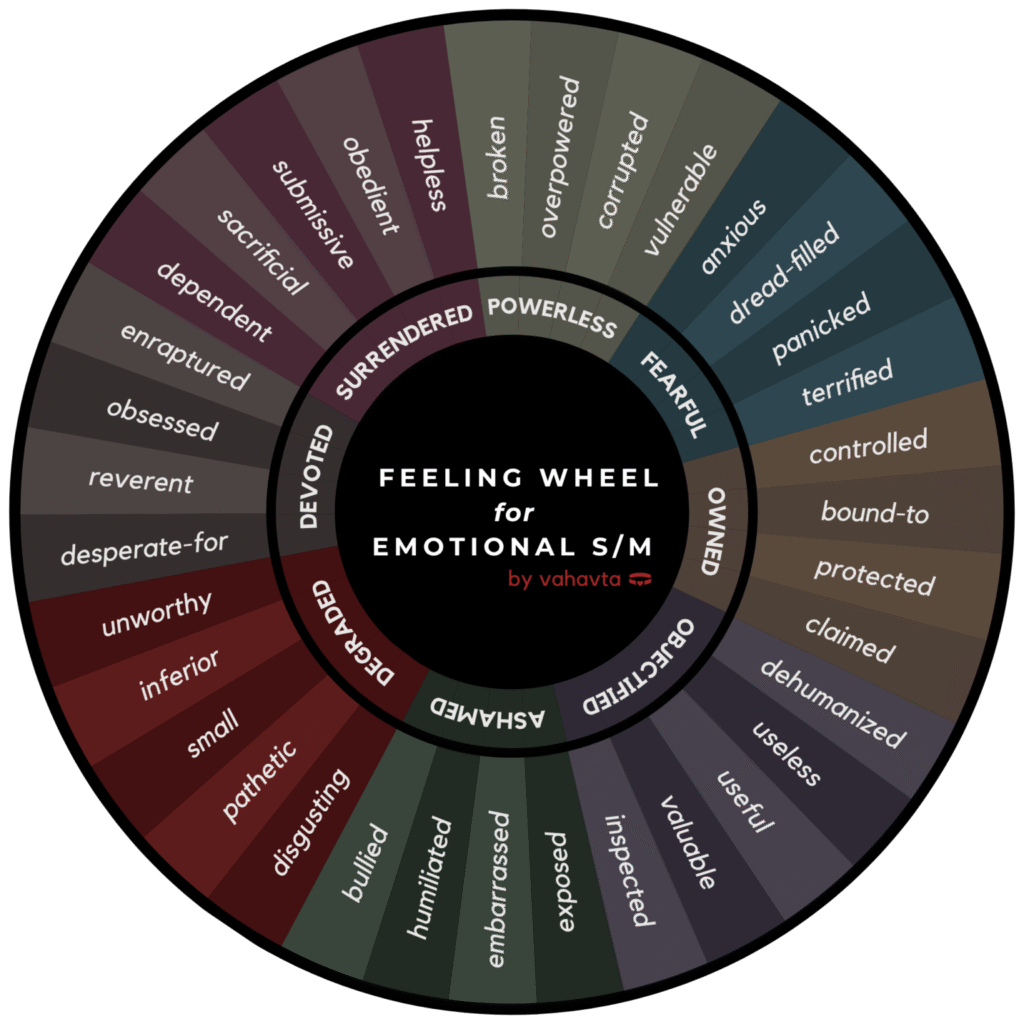
Want your very own sticker of this wheel? You can get one on Etsy here.
What’s important is you get specific: not just “degraded” or “humiliated,” but flavors like dehumanized, exposed, made disgusting.
Maybe you know this answer innately. If not, you might ask yourself questions like…
- If I could only keep one word from the emotion wheel, which is it and why?
- When I’ve fantasized about emotional play, which feelings am I chasing?
- Are there feelings that I’ve experienced accidentally in play which I want to recreate intentionally?
- Are there feelings that seem hot in fantasy but I suspect would be devastating in reality?
- If I imagine the perfect scene for what I want right now, what emotion am I left with at the peak moment, and what emotion am I left with after it’s over?
- Is what I want to be seen as [word], or being made [word]?
- Are there adjacent feelings on the wheel that I’m not interested in, even though they’re close? (This helps identify boundaries within a category!)
STEP 2: Mine Your History for What’s Created This Before
Helping someone else create this emotion in you means giving them some kind of framework of how. Sometimes, we can mine this from past memories, with or without them being ones we’d call play.
I recommend looking in the following places:
Kink experiences: Scenes that worked, dynamics that hit right, porn/erotica that made you go “oh, yeah, that”
Vanilla experiences: Moments of genuine shame, fear, exposure, worthlessness, etc. (yes, even the painful ones, to the extent that is safe for you — you’re looking for data, not trying to relive these memories (unless you *are* trying to, of course))
Fantasies: Even ones you’d never actually do, as they often reveal what your psyche is actually responding to
To get to these, you might ask yourself:
- In a kink scene or dynamic moment where I felt something close to this target emotion, what specifically was happening? Who was there? What did they say or do?
- In a vanilla experience where I felt this way (even if you I didn’t want to at the time), what were the conditions then?
- Is there a specific memory I keep returning to—even if it wasn’t kink—that has the emotional flavor I’m chasing?
- Which story/porn/fanfic beat made my chest pull tight in the right way, and what was the narrative meaning of the emotion (punishment, use, entertainment, devotion)?
- When have people tried to create this feeling in me and missed? What was different about those times?
- If I could direct a film scene of this happening to someone, what would I include? What would be essential vs. optional?
- Have I ever felt [target emotion] and found it erotic vs. felt it and found it devastating? What was different between those times?
And don’t censor yourself here, seriously. Something might have worked in your head that you’d never actually do, and that’s totally fine. The point is to notice patterns.
Which then brings me to…
STEP 3: Pattern Recognition and/or Choosing New Context on Purpose
From your notes, look for repeat details. These might be sensory (e.g., public vs. private; verbal vs. physical; eye contact vs. averted; posture/position), relational (e.g., who can say/do this? Someone whose respect you’ve earned? Someone who holds power over you? Anyone? Does it require them to really believe or clearly not believe something?), narrative (e.g., the meaning/why it’s happening, like for someone’s amusement, a sadist’s pleasure, “because you deserve this”), or contextual (e.g., timing, setting, what comes before/after). Ask yourself questions like:
- What sensory elements appear most often? (Words in a particular tone? Being positioned a certain way? Being watched? Physical touch or lack of it?)
- Who delivers the experiences that work? What’s true about those people/relationships that isn’t true of the times it didn’t work?
- What meaning does the degradation/humiliation/fear/whatever carry in the moments that land right? What is whatever is happening meant to signify about me?
- Do I need buildup or does it work better when it’s sudden?
- Does this need to be “deserved” somehow or does it work better when it’s arbitrary?
- Do words or actions get me here quicker?
Quick aside: Meaning matters most.
If you could only answer one of these, make it meaning. Meaning is what can get fuzziest in between these emotions, which means it’s actually the most important part. Different “meanings” in ESM might be things like…
- “You are less than others.”
- “You failed/disappointed.”
- “You are only useful for X.”
- “You are disgusting/shameful.”
- “You are beneath notice.”
- “You deserve this treatment.”
- “You exist for my entertainment”
…but this is a very non-exhaustive list!
And also, meanings interact with relationships. Some may feel safer for you inside steady devoted commitment (“only useful for X” can feel like worshipful utility) but dangerous inside more brittle attachments, or some other contingency. It’s okay to say this outright in your negotiation.
Step 4: Communicate it!
Now you put your shiny new well-articulated desires into practice! This could be in any number of ways, but here’s a framework if it’s helpful:
“To make me feel [specific emotion], I need [sensory/relational/narrative context]. What tends to work is [primary patterns you discovered], especially when [meaning/undertone].”
For example, I might say…
“To make me feel humiliated, I need to be turned into someone who isn’t the way I’d want You to see me, and I need to be laughed at for it. What tends to work is something being done to me physically or being commanded to take actions I find embarrassing, followed by laughter and verbal degradation — especially when it’s delivered like You find my shame entertaining and like this is the most use I could possibly have. For this to feel erotic instead of erosive, I need it to not impact Your usual level of physical affection toward me, even if it’s framed as happening for a reason which is different than usual.”
(And heyyyy, if you need a reason to practice getting your final statement here out in the open… feel free to link this writing to your person along with some kind of “thought I’d try this just for funsies, here’s what I came up with”! Jus’ saying, happy to be your bold ESM moves excuse 👀)
What if the scene still doesn’t feel quite right?
Sometimes, everyone will do everything “right” and it still won’t hit the way you thought it would. The “close but not quite” problem is actually incredibly valuable here, though. It helps you to determine the boundaries around making your desires come true more precisely. “Oh, I thought I wanted to feel worthless, but what I actually needed was to feel worthless in this specific way, and when they made me feel worthless in that other way, it just felt bad.”
You might ask yourself questions like:
- Which dial was off (e.g., meaning, intensity, context)? Which ones weren’t?
- If we keep these actions or words but flip tone, does it become right?
- Was the meaning right, but the tone off?
- Did something about the relationship context shift recently? (Trust level, recent conflict, life stress)
- Did I need something different before or after?
- What would have shifted it from “close” to “yes, that”?
- Do I need to add this to my explicit boundaries, or was it just about calibration?
And then you know. And then you can communicate it before next time.
—
For those who desire it, emotional S/m can be some of the most intense, intimate, potentially even transformative play there is. It’s also some of the riskiest, precisely because we’re working with elements that can’t be cleanly removed once introduced. There are plenty of important considerations as far as whether its risks are ones you’re willing to take. If you want a broader framework for thinking through what kinds of outcomes you personally are and aren’t willing to risk, I use the BDSM Risk Profile for that.
But that doesn’t mean we shouldn’t do it. It just means we owe it to ourselves and our partners to discuss it as skillfully and as well-informed as possible.
Learning to reverse-engineer desires is one of the most important skills I’ve developed as a bottom. It won’t eliminate all risk. Nothing can. But it will dramatically reduce the chances of these desires being knowable — to yourself, and to your partners. Your desires are valid. And the more you can turn “I want to feel […]” into something specific—the more you can translate vague wants into concrete, context-driven asks—the closer you get to bringing them to life.