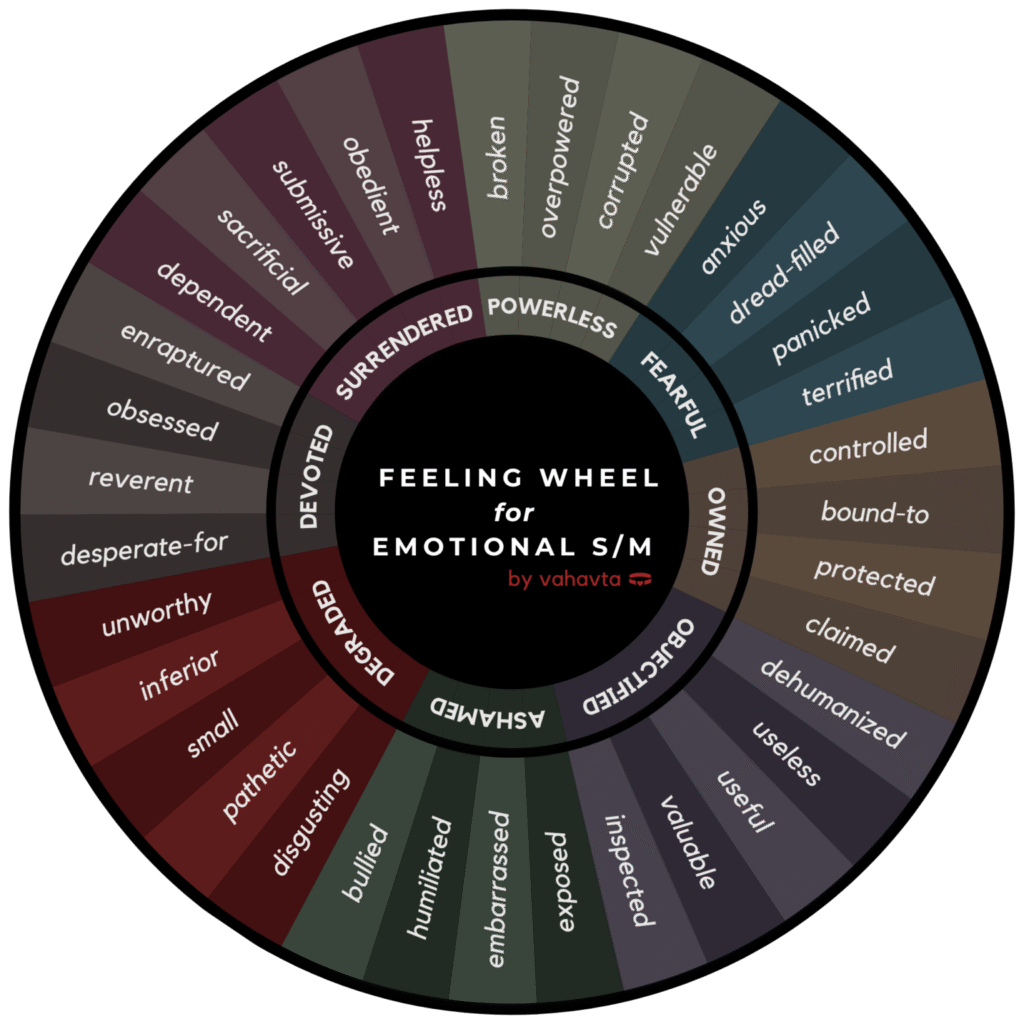
One of the weirdest things about fear play is how often the obvious starting question is also one of the least useful ones: “What scares you?”
Don’t get me wrong, sometimes you do know! Maybe it’s spiders or knives or the sense of being watched through windows. Congratulations, you have some nouns! But fear… isn’t just a list of scary things. (And even if it were, “What are you afraid of?” happens to be not exactly the best question for getting to that.)
I’ve seen plenty of negotiation resources handle fear the way they handle everything else: activities, limits, safeword if using or other communication paths if not, aaaand go. Which is fine, as far as it goes. It’s worked for plenty of folks before. But my perspective is that fear is a category of experience that specifically messes with the machinery we usually rely on to keep play working: attention, language, judgment, the ability to notice you want something to stop and then say so, your awareness of where you are in space, how you try to convince the dangerous thing that you are absolutely-no-trouble-whatsoever-no-really-I-won’t-be-a-problem-I-swear. What your typical fear responses are, and if those are things that mean lean in or back off (especially given that the fear we fantasize about is not necessarily identical to what our actualbodies produce once they believe it).
So.
Here are 30 questions I think are worth considering before somebody sets out to scare you on purpose.
Some of them, you may not be able to answer yet. Some you might be able to reverse-engineer from a combination of fantasies, non-kink memory and body-feeling. Some might remain giant question marks for a bit. And that is FINE!!!
What I want you to walk away with is this: better language, better questions, and a sense of where you may want to build more information or capacity. It’s written from a bottom lens but if you’re the one shaping a scene from the top side, I do happen to think it’s worth reading anyway — you’ll get a decent sense of how much you might be assuming, and maybe it’ll give you some new questions to bring up in your negotiations.
Last note before I get to the dang thing: this is NOT meant to be a test of whether you’re Ready For Fear Play™, so please don’t take it that way! I don’t believe readiness for emotional play, especially fear, is ever a threshold you can like, cross once and then stand on the other side of. I think it’s a set of overlapping capacities you develop over a long time and keep developing, and finding a question here you can’t yet answer is meant to be useful, not a disqualification. (Spoilers: “I have no fucking idea” is sometimes an extremely useful answer!!) And even the answers which might initially seem like they’re “wrong” somehow don’t actually have to mean you don’t go ahead with exactly whatever the fuck pushes your buttons (accepting the risk inherent in that). That’s why they’re questions for consideration. You just consider, and then you get to be the one that decides what you do next.
OKAY LET’S GO
I. What kind of scared do I actually want?
This section has questions meant to help you better articulate the experience you actually want, so that you can figure out if what “fear” means to you and someone else is a match.
If you’re side-eyeing this section because it feels like topping from the bottom… Well, good news, it isn’t! This are not a matter of actually defining the content of the scene, which is a different skill entirely — and regardless of what you INTEND to happen, nervous systems are complex and fear can be designed for but not necessarily commanded to look a certain way or occur on a certain schedule.
That said, if you still can’t shake that and it’s a big turn-off for how you play, skipping to section II will still offer plenty of good info for evaluating your own capacity and providing your top with info they need in order to mitigate fear-specific risks.
1. What parts of being afraid are erotic, satisfying, beautiful, cathartic, or otherwise desirable to me when they occur inside play? Which parts of real fear remain unwanted even something I consent to?
(The rush of adrenaline? Helplessness? The urge to survive? A loss of polished self-control? Hyperalertness? Discovering what you really do under pressure? Catharsis? Relief from decision-making? Instinct without analysis? Pure intensity? Being deeply known?)
2. Do I want to be afraid of my play partner, or afraid of what my play partner is doing?
Being afraid of a person you trust is a fundamentally different animal than being afraid of a situation they’ve engineered. What happens to you emotionally in one versus the other?
3. When I imagine the sort of fear that I’d enjoy, what does it make me want to DO? Do I want to actually take that action, or just feel the impulse to? (Wanting to run and being allowed to run are potentially two different scenes.)
That is to say: how would you personally fill in the blank of “I want the kind of fear that makes me try to ___________” (hint: with verbs, but go further than that!) Is it to pull away? To brace? To cover yourself? To kick or struggle? To challenge? To provoke? To plead? To cry? To refuse? Which versions feel exciting? Which absolutely do not?
(Some Examples of Ways to) Go Deeper, depending on your answer:
- If you want to FREEZE: Is that about invisibility, obedience, self-control, helplessness, terror, something else? Are you envisioning being unable to move, compelled not to move (and scared enough of the threat of what happens if you do for it to actually work), being convinced movement will make things worse, staying still because there’s just no point in running or struggling anymore?
- If you want the urge to ESCAPE: is that about knowing it’s impossible, trying and discovering whether you can at all, succeeding temporarily only to be caught (or not), the illusion of escape being part of a larger trap the whole time?
- If you want to RESIST: Should that have a real chance of succeeding, or is it more about not having a chance whatsoever? Do you want to feel powerful when resisting, frightened by your own defiance, humiliated by how little your effort changes?
- If you want to SURRENDER: Do you want to be asked to surrender, pushed toward it, tricked into it, allowed to discover that you already have?
- If you want to APPEASE (beg, flatter, bargain, agree, smile, obey, make the scary person like you): Is that because it would feel humiliating, vulnerable, survival-brained, submissive, intimate, something else? If you fawn unintentionally, would you know while it’s happening? (Do you want to?) Would you be able to tell your partner afterward? Would they feel prepared to notice that compliance is not always the same as yes? How will they tell a trauma-fawn-response apart from consent?
4. Is the fear experience I want organized around action at all? What is compelling to me about the way I want to experience fear here?
Sometimes the point of fear play is not what fear makes us do, but what we are forced to experience. (Verb (/phrase)s I personally like to use here include ones like waiting, witnessing, enduring, becoming, losing orientation, realizing something too late, feeling a process become irreversible.)
5. Do I want/need to believe the danger is really real?
There’s a difference between “I know I’m safe and the adrenaline is fun” and “some part of me actually does not know if this is going to turn out okay” — and while there are ways to achieve both at once, learning after the fact that something was feigned or otherwise a “mindfuck” can actually spoil the experience in retrospect for some of us.
Go Deeper: What might you need to believe first in order to believe in the danger? (That the person could overpower you? That your choices have consequences? That your choices don’t matter at all? That they’re enjoying your fear? That they won’t back off easily? That something irreversible is coming? That they’re not mad at you?)
Go Deeper: What would break your immersion in fear? What would break your immersion in a way the scene can’t recover from (which is likely not exactly the same question!)? (Bad acting? The dog barking? Inconsistency? Laughter? Excessive talking? Hesitation? Non-kinky pain? Something else?)
6. Are there real-life experiences, phobias, or fears of mine that I’m explicitly trying to engage with? If so, how aware is my play partner of the origin of the fear and of what could trigger a possible trauma response?
Because sometimes engaging with a long-standing fear is the point, yes, but not for everyone, not always, and not without risk.
Go Deeper: Also if so, what makes this container different from the thing that caused the initial fear? What will keep the fear from becoming associated with this person (or even the concept of your agency/consent as a whole), if something goes wrong or doesn’t feel like you imagine it will?
7. Are there things I’ve trusted my play partner with which I would NOT want to enter into fear play? Or is this a case where “you know exactly how to scare me” means “I have consented to you using anything you know”?
(Private insecurities? Trauma history? Family information? Medical fears? Secrets? Real-world vulnerabilities?)
8. What am I excited NOT to know, and what needs to remain knowable? Where’s the line between immersive uncertainty and uncertainty that could stop me from meaningfully participating?
(Things people often enjoy not knowing: the order of events, which of several agreed-upon options is actually happening, the timing, where they are, whether something is “real” within the scene, what a given object will turn out to mean.
Things people often need to stay outside any kind of uncertainty: who is actually in the building, whether a real injury or emergency has occurred (vs being a mindfucks and/or part of a story), whether this can actually be stopped.)
II. What does fear actually do to me?
Fear can, in fact, often look like a negative thing. I’d even argue that’s sometimes the entire fucking point!! But what does your play partner need to know about how fear affects YOU to follow your mental state as accurately as possible, and what extra risks might fear create for you in particular?
This section is not meant to be about declaring a behavior definitely safe because it’s “normal for you.” Instead, think of this as flagging what might be worth your play partner paying a bit of extra attention to, rather than leaving them make assumptions about what your behaviors mean based on people they’ve played with or observed in the past (who also happen to not be YOU). The more info you can give your top here, the more they can know where you’re at mid-scene (and what your different signals do or don’t mean), which means the less they have to guess at while you’re least able to explain yourself, which means all the more focus they can put on being present with you and creating the experience you both want.
9. When I’m truly frightened, what happens to my ATTENTION?
(Do you start scanning? (Do your eyes keep checking doors, hands, objects, exits?) Does your attention narrow until one thing becomes almost impossible to look away from? Do you become hyper-aware of tiny changes? Do you develop an inability to recall information? Do you start missing things that would otherwise be obvious? Do you lose track of pain, temperature, circulation, footing, or time?)
— NOTE: If your attention is already non-neurotypical on a regular day or otherwise complicated by chronic health factors, fear may likewise change it in ways that don’t match standard “hypervigilance” descriptions. Consider sharing what YOUR version of both normal and fear-attention might look like. (A partner who doesn’t know your baseline can’t detect your deviation from it!)
10. When I’m truly frightened, what happens to my SPEECH?
(Do you become quieter? Louder? Repetitive? More literal? Less verbally fluent? More argumentative? Unable to explain complicated things? Very good at saying whatever seems most likely to make the threat happy? How much access do you still have to the vocabulary and cognition you normally use to communicate about play?)
— NOTE: Consider- there’s a biiiiig difference between “I can technically still speak” and “I can calmly analyze what is happening to me and advocate for what I need.”))
11. When I’m truly frightened, what happens to my MOVEMENT?
(Do you back away? Turn your body? Hold your breath? Get clumsy? Go limp? Cover vulnerable areas? Start taking swings? Clench jaw or hands? Pace? Go unusually still? Become restless and start moving before you’ve consciously decided where you’re going?)
Go Deeper: Though this is in part so that your play partner has more information they can use to assess where you’re at mentally, it’s also worth considering through the lens of physical risk assessment and, consequently, may be useful to them in terms of shaping what happens in the scene. What physical fear responses could present extra risks relating to the space, furniture, restraints, another person’s positioning/movements, etc.?
12. When I’m truly frightened, what happens to the way I MAKE DECISIONS?
(Can you assess options accurately? Do you default to the easiest path? Does everything feel urgent? Do you lose the ability to weigh one thing against another? Does “yes” come out faster than you mean it to? Are you more likely to stick with a decision you already made whether or not you still feel that way because it’s easier than explaining you changed your mind?)
13. When I’m truly frightened, what happens to how I INTERACT?
(Can you make eye contact? Do you tend to joke around? Laugh nervously? Apologize more than usual? Do people say you act rudely without realizing it? Do you become extremely polite? Seek reassurance? Get confrontational? Start trying to take care of the other person’s feelings? Do you become easier or harder to direct (can you follow instructions)? Do you disconnect in ways that make outward behavior become -less– obvious rather than more?)
14. Does fear put me further inside my body or further outside it, and what might that do to the accuracy of anything physical I might report while it’s happening? What could that mean as far as what a top might need to watch from the outside, rather than relying on me to share it myself?
Adrenaline is an analgesic. Fear narrows attention. Between those things, some people may not register a cramp, a need to urinate, a compromised limb, a joint doing something it shouldn’t, or the somatic signs of a limit being reached in the same way they would at other times.
15. What else does fear make easier for me, and what else does it make harder?
(Does fear make it easier to surrender, stop overthinking, access emotion, act instinctively, lose composure? Does it make it harder to evaluate risk, notice pain, track time, remember agreements, say no?)
16. Does fear make me more honest, less honest, or honest in a different way/about different things? What should a partner understand about the credibility of my responses in a fear-state?
While this can go a number of different directions, fear can make some people admit things they would usually conceal, say whatever seems most likely to help, agree too quickly, exaggerate distress, minimize distress, etc. in ways can that matter as far as how you and your top communicate in the moment. Knowing you may not be honest and upfront if you’re in fear can be plenty workable for many tops as long as that’s known in advance.
17. What does compliance look like on me when I’m afraid versus when I’m choosing to submit? Can I tell the difference from the inside? Can anyone tell the difference from the outside?
Go Deeper: If fear makes you quiet, compliant, appeasing, or even just difficult to read, what might your top do to get around that when they need honest information? Is there anything you know is likely to snap you out of this if needed? Or is fawning a desired possible response (with the extra risks that entails)?
18. When I’m truly frightened, what might I do that another person could easily misread as a problem but which actually represents exactly the right direction for me?
(Crying? Shaking? Struggling? Begging? Going entirely still? Getting angry? Stimming? Laughing?)
19. What might I do when something actually is going wrong that another person could mistakenly read as “they’re just really in it”? What changes in me are easy to overlook precisely because they do not look dramatic or like “typical” fear responses?
Go Deeper: What could make you feel pressured to pretend the fear is “working” more or differently than it really is? What might that look like?
20. How trustworthy is my -own- interpretation of what I need while fear is actively happening and immediately afterward?
(Do you tend to know quickly when something was too much? Do you sometimes not realize that until later? Are you prone towards “I can handle it, keep going” in the moment and then feeling very differently once you come down? Do you need alone time before you know whether an experience landed well — like, does debriefing too soon keep you too activated to actually regulate? Does relief after the frightening part ends make everything temporarily feel fucking awesome no matter what, but before more complicated and truthful processing appears?)
Go Deeper: Will you be able to evaluate this experience honestly the same day/night, or do you need a few days? If the answer is “a few days” (and for a lot of people who play withfear, it is), do you and your play partner have a plan and a timeline for any needed later check-ins?
III. What’s true for THIS scene, today?
These questions are meant to be more about what could help you get where you want today, with this particular person, as you currently are.
21. When I’m truly frightened in play, which ways of communicating are most likely to remain accessible to me?
(Clear normal speech? Yes/no answers? Answers to direct questions? Choosing between multiple options that have been presented to me? Safewords? Writing/texting? A physical signal? Something else?)
Go Deeper: Are there ways in which fear might change your ability to communicate before it changes your desire to continue?
—NOTE: I’ve written before about how safewords are sometimes structurally weak in emotional play, and fear has a related problem: a safeword requires you to notice, decide, and speak — three capacities which fear can eat in exactly that order. Systems that don’t require all three (a scheduled check-in, an object you drop, a question you only have to answer yes or no to) tend to hold up better and it may be worth having a backup even if you do rely on a safeword, which brings me to…
22. What tends to become unavailable to me first when I’m afraid, and what is our backup when it does? Are we relying on scared-me to perform a fairly sophisticated cognitive task at exactly the moment we’re intentionally making sophisticated cognition harder?
If you lose complex language, what remains as a way of communicating complex thought? If you become highly compliant, what remains as a way of insisting on a no? If you stop initiating communication, does the scene have any way of noticing that change?
(Candidates for what goes first might include: language, initiative, motor planning, spatial awareness, pain recognition, the ability to say no to something you don’t want, the ability to accurately gauge how long something has been happening, etc.)
23. What events or circumstances in my life right now might make fear harder to compartmentalize than usual?
(Job stress? Health issues? Relationship instability? Grief?) This isn’t a “don’t play” list, more about knowing what you’re working with and how it could impact your capacity.
24. What do I still need to trust about this person or relationship while I’m experiencing them as a threat?
You may want to believe, temporarily, that they are dangerous, cruel, deceptive, impossible to reason with, unwilling to rescue you, absolutely going to do the terrible thing, etc. But underneath that, what still needs to remain?
(Their care underneath? Their mindfulness about certain limits? That you can react however you react without disappointing them? Your belief that they will choose you over the scene going perfectly?)
25. Are there things that might normally be okay in other scenes but which need to be excluded from fear play, just in case fear leaves a residue on them after the scene is done? If something that currently feels neutral becomes a fear cue after we play, what would disrupt my life too much to be worth it?
(A room? A toy? A phrase? Certain background music? Darkness? A person you see every day?)
—NOTE: Fear is unusually good at contaminating context. Something that was present during a frightening experience can become a trigger in ways that catch people off guard. (Consider your risk profile and remember it’s okay to have different standards for how you’d play with fear versus something else.)
26. How well does this play partner know what my fear looks like versus what my enjoyment looks like versus what my distress looks like? What does this person know about ME specifically (not about bottoms, trauma responses, or fear in general), and where are they relying on theory instead of knowledge?
(Do they know your common stress behaviors? How you speak when overloaded? What makes you feel abandoned? What you tend to only understand after reflection time?)
—NOTE: If the answer is “they haven’t seen most of those things yet,” that doesn’t have to be a disqualifier, but it does mean that the first few times you try this might be better if they involve more pre-discussion and/or more checking in than either of you thinks is sexy, and that you may need to be the one to ask for that rather than hoping they’ll volunteer it.
27. What does the person scaring me need to be able to handle emotionally? Has my play partner actually seen my fear responses before, or are they imagining something without context?
(Some folks may find it difficult to see someone they care about be truly afraid of them or what they’re doing. Are they prepared for the version of you that: cries, shrinks away fromtthem, shudders at their touch, goes silent, gets angry?)
Go Deeper: If they ultimately feel guilty during or after this play, how will they manage that guilt? How much can you reasonably assist with reassuring them (both in terms of what capacity you have in those moments and in terms of what they’ll actually believe)? Who else might be able to provide them that support if you cannot?
28. If this scene works exactly as well as I hope, what might become harder afterward?
(Might yoy feel more vulnerable around this person? More attached? More wary? More aroused by fear? More likely to seek fear when I am already emotionally raw? More confused about what is play versus what is real? More in need of reassurance, solitude, repair, laughter, food, sleep, or outside perspective?)
Go Deeper: Are there any of these where if they occur, that changes what you need in terms of the aftermath?
29. What does the come-down look like for me specifically after fear, as opposed to after other intense play? What does the rest of my day or night actually look like? Am I driving home? Am I working tomorrow? Is someone expecting a normal version of me within a few hours?
Adrenaline has a tail. How will that affect what the rest of your day or night actually looks like, in terms of driving home, working tomorrow, what those in your life might expect from you a few hours from now? (Do you: crash, get wired, get weepy hours later, sleep badly?) Is there a different framework worth using for aftercare than what you might use for less emotional play?
30. What do I already know about my fear desires, needs, or how I process that I haven’t told anyone yet, and what’s stopping me? What do I still need to know, and what would help me answer it?
What would you need in order to say what you haven’t said? What would you need to move “I don’t know” to something better? (More experience? A specific conversation? Time with a kink-aware therapist? A smaller-scale scene to experiment with? More trust with a particular person? A better understanding of your own nervous system?)
Obviously, everyone experiences fear differently. Though I hope it goes without saying, playing with fear can be very hard on a person and on a relationship (whatever that relationship is), and it benefits enormously from being carefully thought through. Both when a scene goes wrong AND when it works exactly as planned. But with the right partner… I also think it’s one of the most extraordinary, intimate, and goddamn alive experiences available to us.
The goal of theses kinds of questions is not to make fear perfectly safe, perfectly predictable, or perfectly contained. That would rather miss the whole point. These questions are meant as thought-starters and conversation-starters. What you do next with them is up to you.