emotional s/m

How do you play with fear if you don’t know what scares you/them?

If you’ve ever had an interest in exploring fear play but drawn a pretty LOUD damn blank when asked “what are you afraid of?”, you’re in very good company.

That is probably the most common question I got when I first started teaching my “Playing with Fear” class. And to be quite honest with you… I get why, because I didn’t know the answer to it either. I’m not sure I do even now.

That’s not because nothing scares me. I don’t have *phobias* per se, these days, but I’ve had plenty of experiences that leave me shaking, both in and out of kink. Trust me.

And I’ve also had plenty of scenes where what leaves me too terrified to meet the Love of my life’s eyes are the same sorts of words and touches as I encounter every day, just with something… else that’s added on top. But can I put I to words exactly what does it, what that something else *IS*?

Sometimes. Sure, in discrete moments. In general, though? …no, not really. Not in a solid reliable answer to “what are you afraid of?”

And not in a way that covers what a lot of us are really asking when we struggle with that question: “If what scares me is a sort of danger that I know for a fact this human who cares for me is never gonna put me in, given their desire to not kill me and/or end up traumatizing me and breaking our trust forever… Then what? How can I forget for long enough to feel actually threatened?”

(And no, the answer is not “get a top who can convince you they’ve lost it entirely” — mindfucks like that can be hot and fun and interesting for a lotta folks and are ONE possible solution to this whole thing, but they also can be a breach of the faith we put in our play partners and absolutely need to be negotiated for explicitly as not everyone is at all interested in having to ask those questions about their tops’ stability. Anyway, I’ll get off this soapbox FOR NOW, that’s another writing for another day, but boy am I tired of seeing mindfucks be treated as something everyone who likes fear play is automatically also interested in and consenting to!!!!)

Still, I do have one strategy that I’ve found really helpful. And it lies in realizing that the problem was never in the lack of answer.

“What scares you?” is a question that expects a noun. What I had—what lots of us have—in thinking about fear was a lot more about verbs. A flinch. A pull away. A sped-up breath. A shaking thigh.

Our threat systems aren’t built around things. They’re built around behaviors.

Fear, at its most primal, is a survival instinct. And in nature, knowing exactly what causes that fear really just… doesn’t matter all that much?

See, threat detection happens subcortically. Your amygdala fires, your defensive systems activate, your posture changes, all of this before the cortex has finished processing what the threat actually is. You’ve likely experienced this: the jolt when you’re startled before you know *what* startled you, the flinch or dread before you can say *why.* Your body already organizing a response while your conscious mind was still loading up, basically. Sometimes it never loads at all.

And the beautiful thing is it happens anyway. Your nervous system doesn’t wait for you to answer that question. It registers and prepares for danger regardless: increased vigilance, scanning, readiness-to-run, an uneasy sense of apprehension that doesn’t point anywhere specific but turns something analytic on in us, and so forth.

These things get easily dismissed as “intuition”and brushed aside as if they’re useless (which is in part a gendered thing that I’ll also avoid soapboxing on right now but JUST KNOW THAT SOAP BOX IS THERE, LIVIN’ IN MY HEAD), but that’s not useless. At all. That’s a whole damn survival instinct! Picking up on something being a danger, even without the ability to articulate what… that’s what keeps animals alive.

So when someone asks “what are you afraid of?” and you go blank, that blank isn’t as empty as it may seem. It’s full of information. It just isn’t information your verbal brain can always articulate.

That’s not to say it can’t be super useful in negotiation if you DO have a solid answer to that question, and if you do, by all means, use it! But the reality of what underlies fear is danger and how it registers in your nervous system. And the reality of danger is that it is often ambiguous.

Why else it can be so tough to answer this

There are several research-based reasons behind the “I don’t know what I’m scared of” problem, and they aren’t mutually exclusive, because real people are complex and nuanced. So in real people, these things often stack. This is hardly all-inclusive as is. But just for a few:

Fear generalizes. When we learn that something is dangerous, that learning doesn’t usually get to stay neatly contained in the fear folder in our brains. It can spread to similar cues, adjacent contexts, loosely related situations, etc. until the original trigger is buried under a broad wash of “this feels bad.” (Which is worth keeping in mind as far as the context of where you plan your fear scenes and what sensory elements might be involved, which is one part of what we talk about in the design portion of fear play class!) The further fear generalizes, the harder it is to point back to the source. Which means we are sometimes left with a lot of readiness and very little specificity.

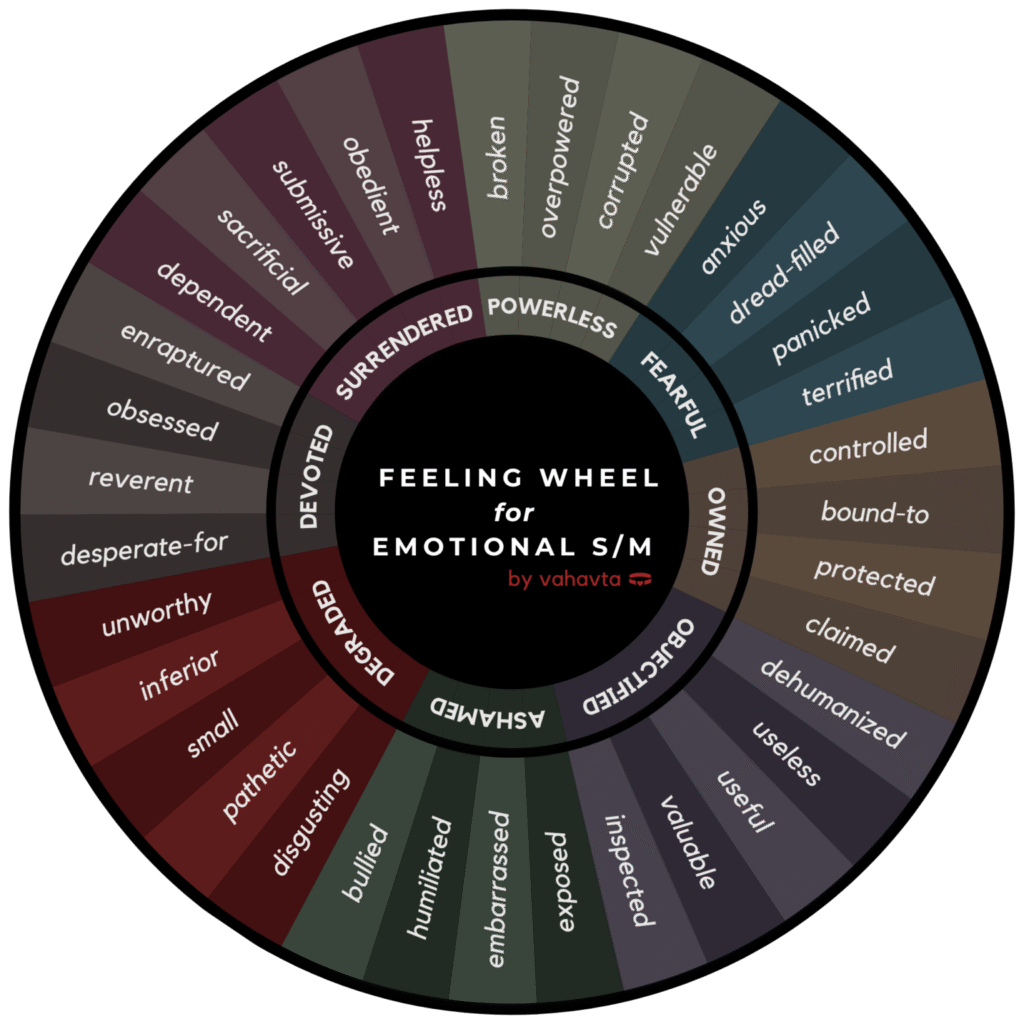
Emotional granularity and detection skills vary too, especially in our modern lives, which often try and distract us from sitting and quietly feeling things in a way that makes all of us a little worse at ID-ing things with particular specificity. It’s why I made tools like the Emotional S/m Feeling Wheel, but the tool *existing* doesn’t make it easy for everyone to actually tell these words apart in their experience. Some people experience “feels bad, man” as one single undifferentiated signal; others can instantly parse it into fear, shame, grief, overwhelm, anger, disgust, etc.; most of us are somewhere in-between. Like most skills, it can be trained. But if you *don’t* intentionally work on that, it doesn’t just come naturally for everyone, and that’s okay!

Sometimes the “threat” really is entirely internal or nebulous. What I’ve been trying to get across is fear simply doesn’t require a clear external object all the time. Fear doesn’t require a noun. A body sensation (tight chest, nausea, sudden heat), a memory fragment, a meaning your nervous system assigned to something, these can all activate your threat system without a School House Rock person-place-or-thing to point to.

And even when you can, in most cases, it isn’t the whole story. You’re not reallu afraid of the dark *itself*. You’re not afraid of what you do logically know is just the Laundry Chair in the corner of your room (though you might be scared of the workload; fellow ADHD kinksters I see you, and lemme tell you, you’re never sitting in that chair again and as long as it’s there to toss stuff on, you will keep tossing the stuff there). You’re not afraid of the fact that when you flip the light switch, it does the same thing as every other person’s light switch.

You’re afraid of what you don’t know is there or not.

Or, put another way, your heart and breathing do something when the light goes out and in the end, we call that fear. The verb of what your body did. Not the noun of what isn’t there.

Not knowing the noun to answer “what are you scared of?” with doesn’t change that the fear is real. Not knowing the noun may sometimes even be the REASON that it’s real.

So the problem isn’t your lack of answer. The problem is that “what are you afraid of?” has always been the wrong question.

See, ethologists (researchers who study behavior in natural contexts) don’t study fear by asking animals what they’re afraid of. They study it by watching what animals prepare to DO.

And that’s because fear isn’t just an emotion. Fear is a motivational state. It functions to make us do *something* as a way to survive.

An animal has a “flight distance” (the point at which it runs) and a smaller “critical distance” (the point at which, if it can’t run, it turns and fights). These things can be studied. They might also freeze (decide they can’t run *or* fight and their best bet is to try and blend into the tall grass, so-to-speak), flop (not *quite* as common in humans but does exist; we can essentially think of this as fainting or going rag-doll to “play dead”), or fawn (a largely-human instinct to appease the threat instead of fight or avoid it). These can be studied too. We can’t ask the gazelle why it freezes in tall grass. But we have a pretty damn good guess, if a lion is nearby.

Regardless of what your actual personal fear responses tend toward (which is worth knowing also, especially because tops can use that to dial intensity up or down and because each response comes with risks of its own), my suggestion for those who struggle with this question is to focus on just how fear is studied in *any* animal: fear is a motivational state that gives rise to behaviors that serve as attempts to defend yourself, blend in, or escape the threat in some way.

And… that’s the reframe. That’s what it comes down to. “What scares you?” is always gonna be limited. But these are the questions that might unlock something slightly more useful, or simply provide another angle to thinking about it all:

What makes you want to defend yourself?

What makes you want to be small and unseen?

What makes you want to escape?

If you struggle to know what scares you, let go of the word “scared.” Point instead at the thing your body is already doing: the action tendency, not the label. The state you’re actually trying to evoke of fear is a motivational one—and so what causes that motivation is the answer, even if it’s not always what you can cleanly connect to words like “panic” or “dread” when you think about it logically.

Other ways of answering

If those reframe questions still draw a blank, that’s okay! Really, this stuff can be tough.

So here are a few other possible handles to hold on to to try and open this particular sticky drawer in your brain up:

  1. Track the action urge. This is a different approach to the same idea of reframing the “what scares you” question to asking what causes your body to want to DO something, just via actually taking notes over time as opposed to some innate self-knowing. Even if you can’t notice these signs internally yourself, you can track them with help: I outsourced noticing some of mine to watching a video we took of a scene, and I’ve seen some friends do cool stuff by pairing that idea with a Fitbit. Or you can ask for help from your play partner(s), or even just an observant voyeuristic friend. Can they help you notice what sorts of things cause you to step or turn away, or when your eyes flit toward the exits? These signal that desire for escape, even though most of us don’t run out of the room while we are playing. When do you brace yourself, ball your fists, or offer more physical resistance? That’s the defense urge. What about going more *still* than usual? Or wrapping your arms around yourself in a way that would cover your vital organs (which we nearly never consciously think of ourselves as doing when we cross our arms over our chest defiantly, but yet is what a LOT of folks do in times of fear)? These physical things may be trackable even when the “why” isn’t, and if you can take some notes each time, the patterns that come out of it will eventually give you/your play partner(s) something real to work with.
  2. Track the bodily sensation. A lot of fear is interoceptive, which means it lives in internally-detected sensation. Tight chest. Heat. Nausea. Buzzing. Chattering teeth. The heaviness in your limbs that you might mistake for tiredness. Interoception isn’t easy for everyone but if you ARE able to notice these things, you can track when those occur without having to alwaystry to explain them. The sensation *itself* is the data, and this still can be something that eventually leads to a usable pattern.
  3. Name the uncertainty itself as the fear. Sometimes the trigger of fear genuinely IS as simple as not knowing what’s coming. “Intolerance of uncertainty” is a pretty well-documented phenomenon: the difficulty of enduring missing information. If ambiguity itself is what activates your threat system, that’s not a dead end, and can actually be a pretty powerful tool for tops to utilize.

And those are just a few of the possible approaches. Don’t get me wrong, depending who you are, they may take some time to produce usable information. But if just one of those leads to any sort of answer for you repeatedly, even a single fuzzy one, now you’ve moved from “I don’t know what I’m scared of” to something more negotiable.

And FWIW, all of this can come out as titrated, choiceful exploration. Which isn’t to say you HAVE to go slow—it’s the safer option, but lord knows I didn’t, so it’d be pretty hypocritical for me to say you’ve gotta—only that being interested in fear play does NOT *have* to mean an interest in forced catharsis, nor “facing your demons,” nor that you need be able to produce insight on command. This is all something you can warm up to and build on over time. Ultimately, whatever the speed, the goal is building trackable patterns you can share with trusted partners, revisit over time, and adjust as you learn more.


Here’s what I want you to take from all this: the door to fear play isn’t locked behind some mysterious self-knowledge you personally are somehow missing out on. There is nothing you are lacking if you have no irrational phobias or can’t name what could scare you in this context.

You may be asking the wrong questions, however. So if this is a thing you, too, struggle with, try out some of the reframes instead. And if those other questions still give you nothing, then see if you or someone who is willing to help you out here can begin to notice what your body seems to want to DO—escape, defend, freeze, scan, appease—and start to take a few notes. Take a few more next time. Once you find a pattern, now you have a stronger starting point than you did in the past.

You don’t need to know what scares you or why to play with fear. And you don’t need a tidy narrative or a perfectly articulated fantasy with clear-cut boundaries. You just need something to start from. Add a bit of curiosity, someone you trust, and some willingness to iterate (which means understanding that scenes which don’t land perfectly are still data that can make future scenes better), and you’re already doing the work.

The rest is practice.

Go do something hot.


If you’re reading this and this tends to be the kind of play you’re into, I hope you’ll consider joining me on Zoom with @Praxium next week.

Playing with Fear: Empowered Navigation of Thrills and Risks is virtual on Tuesday, April 14 from 7:45 – 9:45 PM ET (4:45-6:45 PM PT).

Whether you’re topping or bottoming, whether you’re experienced here or just curious, and whether you can name what you or your person are scared of at all or not.

❤️ Be sure to save your seat and receive your Zoom link by getting your ticket HERE ❤️

Posted by vahavta

How to Communicate About Your Degradation Kink

Degradation kink and humiliation play can be some of the most intense forms of emotional S/M—but they’re also some of the hardest to negotiate. Telling a top “I like degradation” before a scene doesn’t actually clarify if you mean playful objectification, true humiliation, CNC, or something else. This guide will show you how to translate your personal “I like degradation” into clear, negotiable steps so that you can fulfill more of your BDSM dreams.

My friend Courtney and I have something in common: we both like appearance-based degradation. (Hey shut up weird thing to bond over but I’ve bonded over weirder and so have most of you.) But it turns out this looks… really different for us.

See, Courtney loves having “date” scenes where a play partner takes her out, whispers to her all evening about how unflattering her dress is and how ugly her freckles are, and then cuckolds her. Then, she wants them to be clear as to how gorgeous she is.

That wouldn’t work for me for a variety of reasons. I remember once, after mentioning degradation to an ex, having sex while he tried to tell me how unattractive I was to him and being like “yeah except the past three years of you telling me I’m hot kinda makes this feel just like lying?” as I totally checked out of the evening. And then nobody got off and everyone was in a Mood.

On the other hand, Courtney once told me about a scene where someone stripped her down, sat her on newspaper on top of a washing machine, and turned it on. They then circled in marker everywhere on her body that jiggled and played some kind of porn as they pointed out when the newspaper started to show how wet she was.

From her perspective, this was just “mean girl bullying” and didn’t land. Sure, she jiggled on top of a washing machine. So what? Don’t all of us? Besides, in what other situations would she end up on a washing machine? Meanwhile, I ended that conversation and immediately added “bullying” to my fetish list.

For me, appearance-based degradation is about being made disgusting. The degradation is the play. I want my face fucked with. I want my hair rubbed in cum or worse. I want to feel like I’ve been put in a position where any innate hotness I have doesn’t even matter, because I’m more useful to my Owner as a source of amusement.

For her, appearance-based degradation is about being unattractive in some way, and it’s more like foreplay where the scene = the consequences of that. And she wants to know afterwards that it was all made up.

Both are degradation.
But when we said it, we meant very different things.

This is because while traditional negotiation in kink is often activity-first—“I want spanking,” “I want rope,” and so forth; you can say yes to “flogging” and both people usually know what to expect—emotional S/m doesn’t work that way. “I want degradation,” “humiliation,” or any other -ation can have *completely* different implications and emotional effects depending on how it’s delivered, why it’s happening, and what it means in the context of the scene or dynamic.

Reverse-Engineering from “I Like Degradation” to “Here’s How to Degrade Me”

Here’s what I know after over a decade of bottoming to emotional play, and half of that teaching classes like my “Negotiating and Communicating for Emotional S/m” (and for CNC!): most of us into Emotional S/m (ESM) have highly specific desires. We just often lack the language to communicate them. We say things like “humiliate me” or “degrade me” or “break me down,” and we genuinely mean something by those words. But those phrases are like saying “I want to feel good” — technically true, but useless in practicality.

Your partner can’t read your mind. Sometimes, things just don’t translate. But guessing and getting it wrong with emotional play doesn’t just mean the scene wasn’t hot. It can also mean serious psychological harm. As I’ve written before, you can’t safeword out of your own head. A scene might stop escalating, but the impact of what happened doesn’t necessarily stop with it. All the more reason to articulate what we want as clearly as possible.

So here’s a bit of a process to help you narrow down what you do and don’t desire in this realm. (This can be done from either side, but I personally speak from the right side of the slash.)

STEP 1: Name the Target Feeling Precisely

So to do this, we start with the emotion, not the activity. What do you want to feel during or because of this scene? If you need inspiration, you might use the ESM-adapted emotion wheel I made (or write out your own), or even use a thesaurus… an ESM negotiator’s best friend, IMO!

Emotion wheel for emotional S/M negotiation and degradation play - showing relationships between feelings like shame, disgust, fear, and humiliation
Use this tool to target the exact flavor of degradation, humiliation, or other emotions you’re looking to add to your BDSM play!
Want your very own sticker of this wheel? You can get one on Etsy here.

What’s important is you get specific: not just “degraded” or “humiliated,” but flavors like dehumanized, exposed, made disgusting.

Maybe you know this answer innately. If not, you might ask yourself questions like…

  • If I could only keep one word from the emotion wheel, which is it and why?
  • When I’ve fantasized about emotional play, which feelings am I chasing?
  • Are there feelings that I’ve experienced accidentally in play which I want to recreate intentionally?
  • Are there feelings that seem hot in fantasy but I suspect would be devastating in reality?
  • If I imagine the perfect scene for what I want right now, what emotion am I left with at the peak moment, and what emotion am I left with after it’s over?
  • Is what I want to be seen as [word], or being made [word]?
  • Are there adjacent feelings on the wheel that I’m not interested in, even though they’re close? (This helps identify boundaries within a category!)

STEP 2: Mine Your History for What’s Created This Before

Helping someone else create this emotion in you means giving them some kind of framework of how. Sometimes, we can mine this from past memories, with or without them being ones we’d call play.

I recommend looking in the following places:

Kink experiences: Scenes that worked, dynamics that hit right, porn/erotica that made you go “oh, yeah, that

Vanilla experiences: Moments of genuine shame, fear, exposure, worthlessness, etc. (yes, even the painful ones, to the extent that is safe for you — you’re looking for data, not trying to relive these memories (unless you *are* trying to, of course))

Fantasies: Even ones you’d never actually do, as they often reveal what your psyche is actually responding to

To get to these, you might ask yourself:

  • In a kink scene or dynamic moment where I felt something close to this target emotion, what specifically was happening? Who was there? What did they say or do?
  • In a vanilla experience where I felt this way (even if you I didn’t want to at the time), what were the conditions then?
  • Is there a specific memory I keep returning to—even if it wasn’t kink—that has the emotional flavor I’m chasing?
  • Which story/porn/fanfic beat made my chest pull tight in the right way, and what was the narrative meaning of the emotion (punishment, use, entertainment, devotion)?
  • When have people tried to create this feeling in me and missed? What was different about those times?
  • If I could direct a film scene of this happening to someone, what would I include? What would be essential vs. optional?
  • Have I ever felt [target emotion] and found it erotic vs. felt it and found it devastating? What was different between those times?

And don’t censor yourself here, seriously. Something might have worked in your head that you’d never actually do, and that’s totally fine. The point is to notice patterns.

Which then brings me to…

STEP 3: Pattern Recognition and/or Choosing New Context on Purpose

From your notes, look for repeat details. These might be sensory (e.g., public vs. private; verbal vs. physical; eye contact vs. averted; posture/position), relational (e.g., who can say/do this? Someone whose respect you’ve earned? Someone who holds power over you? Anyone? Does it require them to really believe or clearly not believe something?), narrative (e.g., the meaning/why it’s happening, like for someone’s amusement, a sadist’s pleasure, “because you deserve this”), or contextual (e.g., timing, setting, what comes before/after). Ask yourself questions like:

  • What sensory elements appear most often? (Words in a particular tone? Being positioned a certain way? Being watched? Physical touch or lack of it?)
  • Who delivers the experiences that work? What’s true about those people/relationships that isn’t true of the times it didn’t work?
  • What meaning does the degradation/humiliation/fear/whatever carry in the moments that land right? What is whatever is happening meant to signify about me?
  • Do I need buildup or does it work better when it’s sudden?
  • Does this need to be “deserved” somehow or does it work better when it’s arbitrary?
  • Do words or actions get me here quicker?

Quick aside: Meaning matters most.

If you could only answer one of these, make it meaning. Meaning is what can get fuzziest in between these emotions, which means it’s actually the most important part. Different “meanings” in ESM might be things like…

  • “You are less than others.”
  • “You failed/disappointed.”
  • “You are only useful for X.”
  • “You are disgusting/shameful.”
  • “You are beneath notice.”
  • “You deserve this treatment.”
  • “You exist for my entertainment”

…but this is a very non-exhaustive list!

And also, meanings interact with relationships. Some may feel safer for you inside steady devoted commitment (“only useful for X” can feel like worshipful utility) but dangerous inside more brittle attachments, or some other contingency. It’s okay to say this outright in your negotiation.

Step 4: Communicate it!

Now you put your shiny new well-articulated desires into practice! This could be in any number of ways, but here’s a framework if it’s helpful:

“To make me feel [specific emotion], I need [sensory/relational/narrative context]. What tends to work is [primary patterns you discovered], especially when [meaning/undertone].”

For example, I might say…

To make me feel humiliated, I need to be turned into someone who isn’t the way I’d want You to see me, and I need to be laughed at for it. What tends to work is something being done to me physically or being commanded to take actions I find embarrassing, followed by laughter and verbal degradation — especially when it’s delivered like You find my shame entertaining and like this is the most use I could possibly have. For this to feel erotic instead of erosive, I need it to not impact Your usual level of physical affection toward me, even if it’s framed as happening for a reason which is different than usual.”

(And heyyyy, if you need a reason to practice getting your final statement here out in the open… feel free to link this writing to your person along with some kind of “thought I’d try this just for funsies, here’s what I came up with”! Jus’ saying, happy to be your bold ESM moves excuse 👀)

What if the scene still doesn’t feel quite right?

Sometimes, everyone will do everything “right” and it still won’t hit the way you thought it would. The “close but not quite” problem is actually incredibly valuable here, though. It helps you to determine the boundaries around making your desires come true more precisely. “Oh, I thought I wanted to feel worthless, but what I actually needed was to feel worthless in this specific way, and when they made me feel worthless in that other way, it just felt bad.”

You might ask yourself questions like:

  • Which dial was off (e.g., meaning, intensity, context)? Which ones weren’t?
  • If we keep these actions or words but flip tone, does it become right?
  • Was the meaning right, but the tone off?
  • Did something about the relationship context shift recently? (Trust level, recent conflict, life stress)
  • Did I need something different before or after?
  • What would have shifted it from “close” to “yes, that”?
  • Do I need to add this to my explicit boundaries, or was it just about calibration?

And then you know. And then you can communicate it before next time.

For those who desire it, emotional S/m can be some of the most intense, intimate, potentially even transformative play there is. It’s also some of the riskiest, precisely because we’re working with elements that can’t be cleanly removed once introduced. There are plenty of important considerations as far as whether its risks are ones you’re willing to take.

But that doesn’t mean we shouldn’t do it. It just means we owe it to ourselves and our partners to discuss it as skillfully and as well-informed as possible.

Learning to reverse-engineer desires is one of the most important skills I’ve developed as a bottom. It won’t eliminate all risk. Nothing can. But it will dramatically reduce the chances of these desires being knowable — to yourself, and to your partners. Your desires are valid. And the more you can turn “I want to feel […]” into something specific—the more you can translate vague wants into concrete, context-driven asks—the closer you get to bringing them to life.


Want to join in on the conversation? You can find the original Fetlife version of this writing—and the comment section—by clicking here.
Posted by vahavta

The Shame Game: A Primer to Playing with Shame in BDSM

Of everything that comes up in that intersection between psychology and kink that I’m so fond of, shame play might be one of the most powerful. Maybe that’s because it is so flexible and so related to so many kinds of Emotional S/m (ESM), binding to other parts of play and wrapping around them in unique ways that make them into something more. That power itself is what draws many of us to it: the cathartic release, the reclamation of emotions we previously tried to avoid, the liberation from our social conditioning around desires and acceptability, the extraordinary connection that can come from exploring it with someone you trust. It’s also this power that makes it dangerous.

The way that shame can cause or result from nearly any emotion you can think of is what makes many researchers and educators (including but not limited to Brene Brown) refer to it as the “master emotion.” And most certainly, with all the subcategories we think about when we think about ESM—objectification, degradation, fear, others—the psychological mechanics of shame can enter in.

I’ve been thinking and learning about shame for a bit now in a few different realms of life (and have even been considering a 102 level for my ESM class that really focuses there) because that power is just so great, and to me, that makes it really cool. So this is a little bit of a primer on the matter, for those who may not have thought about the workings of shame in-depth… Or maybe for exactly the people that have.

As with anything I write about ESM, I may use examples that could be triggering for some, so please do care for yourself and step away from the writing whenever needed.

What We Talk About When We Talk About Shame in BDSM

Shame operates differently in our brains than other emotions we might consider when it comes to play, or even when it doesn’t. While emotions like fear and anger stem more from our basic survival cues (and certainly there’s a lot of overlap that can happen here), what we think of as “shame” links more directly to our social-emotional circuitry—that is, the parts that evolved to help us better navigate complex social communities. That’s part of why shame is often very culture-specific, from the norms that cause it to how one is expected to respond (both to their own and to others).

During a scene, basic emotions that get brought up (fear, anxiety, arousal) may activate your social circuitry, adding shame which can persist past when those basic emotions subside. This makes a lot of shame play really memorable and makes it build up over time to different effects, but it’s also what makes it tricky: social emotions don’t simply disappear when the present situation ends, unlike with something like fear where the adrenaline rush subsides once the threat is removed.

Shame can also develop “meta-shame,” where we are ashamed of feeling ashamed. And in that, it can become integrated into our identity, our sense of self, in ways we might not intend. When we experience meta-shame, this creates patterns of avoidance that operate subconsciously and prevent addressing the original issue, affecting you and your experience in and out of scenes without you necessarily even realizing it is there. Meta-shame magnifies the perceived gap between the “ideal self” and the “actual self” in our heads and the greater this gap, the more intense the shame experience. Which can be used for a lot of fun in kink contexts, when done carefully! But it can also lead to situations where no amount of endurance, submission, or service ever feels like “enough” to close that gap, and this can have wide-reachinf effects that we just don’t want.

This is why emotional S/m that plays with shame is always edge play that requires a ton of consideration. It it risky even for those who communicate well 99.99999% of the time — it can compromise communication in a number of ways, and there’s no safeword that can stop this process once it begins because it happens in the psyche, not at the hands of the top. So before even consider playing with shame, we should do whatever we can to really get our communication and negotiation skills up to speed. But with everyone informed of the extra risks and and consenting, it sure as fuck can be a very good time.

Different Types of Shame

Shame manifests in various forms depending on our history and psychological makeup, and we start to form these on the identity level at different developmental stages (which I’m not going to get to into in this writing). Understanding these possibilities can be something we can use to negotiate shame play and ESM beyond broad level categories, honing in more on what we do and don’t want to approach at that point in time — and I say that because this definitely can and even should vary based on what point in time we are playing, who we are playing with, and individual preferences.

To name just a few:

Judgment shame creates feelings of being fundamentally “bad” or “wrong” for desires or actions that contradict. It often gets talked about in combination with taboo play, if we are talking about societal norms, but might take other forms (like going against internal ideals or value systems) as well.

Control shame connects to one’s ability to competently express and enforce one’s personal agency, and can come into play either as “taming”/overriding of rebellion against authority or shame being attached to the complete surrender of autonomy some of us go for in our relationships.

Perfectionism and autonomy shame, which may or may not be closely related to the above, plays with the idea of the bottom being able to succeed at certain actions or respond in certain ways, whether or not those actions are even possible. Messing with this can lead to hopelessness and confidence loss when meta-shame and identity integration kicks in. On the other hand, it can be really, really liberating in some cases and lead to an increased sense of external or self-acceptance.

Social status shame centers on feeling inferior to others. This can be about embarrassment, power, “measuring up,” or something else — power exchange in the D/s sense may be an element but does not have to be. It also can be particularly risky for those who are prone to fawning or to excessive people-pleasing outside scenes, especially when linked with play that goes near those boundaries, because one might stop feeling that speaking up is even something they deserve to do.

Unworthiness shame centers on the core belief that one is inherently flawed, unlovable, or bad as a person, or that an action or behavior could make them so. That inherent vs. action element is important, because there’s a big difference for many between playful degradation (“you’re such a dirty slut”) and identity-level condemnations like “nobody could ever want to someone like you around long-term.”

…and there’s more of these where that came from, and just what kinds of shame someone experiences (and how) are going to shift with different individuals and their dynamics. So observation and awareness, both of the self and of others, is really the key to drawing lines between them and deciding which you want to touch, and which you’re leaving the hell alone.

Kink Risk Profile Considerations for Shame Play

There are a few specific risks I think are especially important to consider in shame play, among others. These include that identity integration risk I’ve mentioned, but also risks of emotional binding (how shame might permanently bind to other emotions like arousal or affection, or even identities or activities (including sex or play as a whole)) and relationship “contamination” (where the shame between two people spills over into their interactions outside of play, whether that’s a romantic, friendly, sexual, or simply community-level relationship). This is where shame can start to really spill into other contexts of life, with sexual shame in one relationship impacting someone’s other sexual relationships (present or future), impacting job performance, or creating long-term issues in a whole variety of other ways.

For each element of shame play you introduce, consider which of these risks might be activated, how to mitigate them with the specific people you play with, and how to evaluate if other elements of life have been affected. Mitigation may look like creating clear “containers” for shame play (e.g., particular locations, explicit beginnings and endings, specific language that only exists within the play context), incorporating identity-affirming elements or pieces which connect those playing to the core of their relationship to each other, or scheduled check-ins with one’s support network as part of ongoing aftercare. For emotion binding risks, mitigation might include things like ensuring experiences of pleasure, arousal, affection, or whatever else might be combined also occur without shame elements—both in that particular scene and in scenes that are not meant to focus on shame at all—or doing the same with particular roles or kinds of play that you want to ensure don’t codify as “a thing that inherently causes feelings of shame.”

This is also where developing emotional resilience practices becomes super important for bottoms engaging in shame play, some of which I talked about in part of this AMA answer on Fetlife. This also might include working to recognize your own shame triggers and response patterns, practicing grounding techniques, and developing a clear sense of who you are and what you love and value in yourself so that you can more clearly draw internal boundaries between play experiences + what an external party might say or cause and your more persistent self-concept. Mindfulness of meta-shame—noticing when you begin feeling ashamed of your shame responses themselves, and especially when you may be hiding them—might also be a warning that play may be crossing into potential harm.

Aftercare Considerations for Shame Play

I’ve written a bit about a framework I like for potentially-traumatic play but there are some intentional integration techniques that might be especially useful with shame play.

One of these is to include, create opportunities for, or emphasize acts of witnessing, which I know may seem a bit backwards when we think about shame’s social origins… But that’s exactly why it matters. Shame is about what we perceive as a social inadequacy, but that shame can be counteracted by those perceptions being proven wrong. Shame thrives in secrecy, but that means it dissolves when brought into the light. (There’s a reason that effective addiction recovery support models usually include sharing stories with others who share the same experiences.) The witnessing that occurs during the scene itself can begin this process, as a top acknowledges and accepts the vulnerable expressions of shame that emerge there, and can continue in processing the scene together and/or underscoring the ways that the scene felt intimate, like an act of service, or otherwise positive to the top. Beyond the scene, sharing the experience with trusted others—with appropriate consent, of course—provides opportunities for renarrativization, allowing the experience to be processed not just as a source of shame but as a moment in time. Writing and sharing the story of the scene with (one’s own or the extended) kink community can help to avoid or counteract the meta-shame and decrease the long-term risk.

Self-integration is the other big consideration here. Taking time for solitude (which I wanna note is distinctly different from isolation) allows for honest reflection and processing that isn’t always possible when still in with others. This might mean identifying specific shame thought patterns (e.g., “I should be better,” “I’m not good enough,” “no one would want me if they knew”), but that isn’t a skill that necessarily comes naturally to most of us, and a therapist or even just a CBT workbook of some kind may help if you’re not used to catching these sorts of things. Structured reflection or journaling on things like specific triggers, reaction patterns, contained versus lingering elements, etc. also help prevent shame from remaining an Amorphous Cloud of Bad to transform it into more specific, manageable elements that we feel capable of addressing and moving past.

In all cases, you mitigate the most risk when aftercare is not an afterthought. Consider and negotiate aftercare needs with the same care and specificity you bring to scene negotiation itself, recognizing that shame’s particular risks often require aftercare that addresses both immediate emotional states and the longer-term impact of this play.


Shame play exists in paradox, like other forms of ESM (or I might even argue with BDSM at all): we consensually engage with some of the most destructive and challenging human emotions for purposes of pleasure, catharsis, and connection. Trying to fully resolve this paradox is a losing battle, with ESM, and may just lead to losing sight of the risks until they reach a critical mass and explode (something else that I hope to write about and share experiences with at some point in the future). So the mark of someone who is mindfully engaged with shame play isn’t based on who can create or endure the most intense reactions, but who can hold the paradox consciously and with grace—being in experiences that are genuine and powerful in the moment while maintaining the psychological grounding necessary for integration afterward, reaching for support wherever it is needed.

Playing with shame in kink isn’t unlike learning skills for any kind of edge play. It begins with respect for its power and the ethical considerations it demands, it develops through careful preparation, and practice, and it continues and evolves with awareness and reflection. If I’ve learned anything these past few years, it’s that I don’t know how much here I don’t know, that the ways this pops up in ugly ways can be unexpected and brutal, even for someone that might be called “experienced” here.

But what I want to leave you with is that this idea of “shame thrives in secret but dissolves in the light” is one that also can explain what makes it feel so profound, for those of us who love it. In those darker, duller spaces of our psyches where life has taught us to feel shame and hide some part of ourselves, consciously-engaged shame play within the context of connection says “this part of you is valid and it gets to be seen without that compromising anything else about who and where you are.” Not just from one person to another, but to ourselves. This witnessing—this refusal to look away from the parts of ourselves we’ve been taught to hide—becomes a radical act of intimacy and ownership. And for lack of a better way to end this…

Well, hell. I just think that’s really fuckin’ pretty.


Join in on the comments of the Fetlife version of this post by clicking here!

Posted by vahavta

Fear Responses: Risks, mitigation, and/or use in escalation

Fear play is one of those topics I’m lucky enough to get to approach on multiple levels. There’s what I have learned and experienced as a bottom to some pretty intense stuff here, but there are two other layers for me, too: one where I’ve coached horror writers and written horror myself, giving me a different lens on the storycrafting of it all and how fear can be created in the mind of another, and one where I’m a creator of remote immersive horror experiences and where with basically two exceptions, every person on my “I talk to them nearly daily” list of friends is either a creator of or actor in an extreme haunt or immersive terror experience, or they’re someone who attends every one of those they can possibly get a ticket to.

Though the people in this latter category are, importantly, not engaging in kink, there’s still lots to learn from what they’re doing: in creating a for-profit immersive terror experience, they have legalities and publicity to contend with that kinksters don’t always have to approach, which means that they often put much more into the training of the actors, the considerations of safety and ethics, and the care that goes into the creation of the experiences.

On all levels, I’ve seen the incredible power of consensual fear experiences to push comfort zones in exciting ways, explore intimate depths of our psyches, and create profound connections between people… and I’ve also witnessed how easily things can go awry when fear is misunderstood or mishandled.

Fear is powerful, and delicious, and hard. And I love it. But something that has come up again and again and again when I discuss and teach about these things ~~(like I’m doing this weekend)~~ is the way that different fear responses might change interactions, especially as pertains to risk, communication, and consent — and so that’s what I’ve created a little resource on below.

NOTE: That class has passed, but there may be another coming up! if I have a fear play class scheduled in the near future, I’ll mention it at the bottom of this writing ❤

Some fear responses are very physical in nature.

There are different types of fear, and some are more individual. (I’ll get to those in a second.) Others are engrained in most humans. It’s well-acknowledged in the extreme haunt sphere, for example, that water is often used to “break” participants and that drowning and waterboarding scenes are where many hit their limit – and though the risk on it should not be understated (in either case, really), many of us do “enjoy” drowning or waterboarding in kink. But I happen to think of it as a culmination of a scene, in my fantasies, and not an entire scene… once it begins, it ends up being “over” relatively quickly if not handled within a larger “narrative,” so-to-speak.

This is because survival-based panic is an instinct, one that can only be thought its way out of and “managed” for so long. Mindfulness techniques can help some, and there are things I can teach bottoms in this class about how to manage these reactions a bit better… but ultimately, our bodies are built to respond in such a way that keeps us alive. And so, when a core function like breathing is compromised, there’s often a very strong panic response.

On a physical level, this can be one of the most risky moments in a scene because bodies are likely to writhe, buck, and flail in efforts to get out of the moment. Tops who are playing with conscientious bottoms that are usually quite unlikely to behave or move in ways that put themselves in greater danger may suddenly need to take more physical precautions to avoid someone hitting their head on porcelain, for example.

But then there’s another kind of fear, and that’s what most people are asking about when they ask me about this question:

The psychological fear responses of fight, flight, freeze, or fawn

When we’re confronted with intense fear, our bodies and minds instinctively react in certain ways, and these are four that I see discussed semi-regularly. These are where things get really tricky, as each can display in ways that are highly individual and have their own effects on communication and consent. The below information is not meant to be all-inclusive or comprehensive – not on how it can be recognized, how to de-escalate, or even how to escalate! – and as in near every other realm I teach in, I’ll say that communicating for in-scene enjoyment and safety begins long before your scene and continues long after.

But vahavta, isn’t the solution to all of this “use a safeword”?

Well… not quite. I say that partially because I don’t (which doesn’t mean I don’t communicate!), and I know there are many who follow me or come to my classes who also don’t.

But even if you *do* use safwords, it’s important to realize that’s a tool, not a sure thing, and that fear responses inherently impede rational thoughts and actions. Add to that how emotional S/m play of any kind (including fear) can impede their use and it’s clear that while a safeword in your toolbox for the scene can HELP you stay aware of needs…it should never be the only thing you keep in mind, or you’re setting yourself up for trouble.

But! There are *some* broad-strokes guidelines I can give you for each response here, so that’s what I’m going to do.

Below, you’ll find a few different ways to recognize and respond to each of these categories.

Keep in mind that we rarely ever end up engaging in *only* one fear response all the time, and it’s a good idea to have a watchful eye on the way they might shift over the course of the scene. Even if you know what you or your bottom tends to default to, that doesn’t mean that another won’t pop up, so it behooves everyone to learn about each possible direction things might go.


The first two of these are what I’ll call “active” fear responses. These are ways we try to regain power in a situation where we feel threatened.

Fight

Recognizing: When someone goes into fight mode, they may become aggressive, confrontational, or physically resistant. They might lash out verbally, try to push the threat away, or even attempt to “take control” of the scene. Some, not all, will show signs first that are similar to an animal raising its hackles, with tensed shoulders and clenched fists. This also might look like “bratting.”

Heightened risks: Similar to the physical danger panic response, there is a greater amount of risk to play when someone is physically fighting back because there is less control the top can have over the situation. From a consent perspective, a fight response can make communication harder whether it’s a physical or an emotional fight, as the bottom may be so caught up in their own emotional state of fight that rational thought is impaired and the defense becomes more important to them than simply articulating needs and/or boundaries.

Response to the response:

Tops, you have a few options when you identify a fight response.

If you want to escalate the fear, you can meet their aggression with your own, pushing back against their attempts to gain control (maybe physically; maybe via verbal taunts or something else). This can create an intense power struggle that heightens the adrenaline and the sense of danger.

If you simply want to mitigate risk as far as what comes with this, this might be time to add (or increase) restraints, particularly if you are planning to use anything that requires precision as to location on the body (like blades, for example!) You can also refuse to continue a scene without the bottom giving you some kind of check-in that requires they actually take a breath and respond verbally and with thought, perhaps with some kind of count-down or limit, which can add its own fun fearplay pressure while still serving to allow them to opt-in to continuing (“if you don’t tell me you’re good to continue before I count from 10 to 1, we don’t go forward”).

And if you want to de-escalate without ending the scene, remove any aggression coming from your end. Speak in a calm, soothing voice, and back off from anything combative. This might be a time to leave the bottom to think for a bit and play into one of the TYPES of fear we’ll also discuss Sunday, dread. (Of course, if there’s any kind of restraint, you’ll want a way to also keep monitoring what’s happening with the bottom and remain within earshot either way.) You could also empower them to see the scene as a challenge and redirect the fight impulse away from you and toward their own willpower – “You’re so aggressive, surely you must be strong enough to keep going” – but this should be done with caution, as it can shift some into a fawn response and get messy as far as consent.

Flight

Recognizing: We often think of flight mode as simply “escape,” but that’s not always physical, nor does it always actually result in an escape *attempt.* Someone in flight mode may start towards an exit or back away from the danger, but they also might have eyes darting around looking for exits (whether they’re conscious of that or not!), become restless or agitated, or start to dissociate from their surroundings – this last one, particularly, will happen with psychological fear and this gets tricky as it is not *exactly* the same as a freeze response but can look that way. This response, however it presents, is rooted in an effort to get away from the perceived danger and find safety.

Heightened risks: A flight response can *also* increase physical risk, depending how they attempt to “escape,” and can make it harder for a participant to communicate their needs (sensing a pattern?). They may be so focused on escaping that they don’t take the time to check in with themselves or express their boundaries. While this is a very different kind of risk, someone in flight mode may also end a scene out of panic in a way that they will regret later (and this is why I don’t personally play with safewords!)

Response to the response:

If you want to use a flight response to escalate the fear, you can play into their desire to escape. Block their exits, corner them, or create a sense of being trapped. This can heighten their panic and make the experience feel more intense. Maybe you add restraints, if they aren’t already there… or, if you are confident you can express greater strength and control a situation, you might even challenge them to go ahead and *try* to move while holding them in place.

To mitigate risk, figure out what is making them feel a need to escape and respond accordingly: remove restraints, take a physical step backwards so they feel less cornered, or even move to a larger room. Maybe you can open a door. Maybe this is taking a metaphorical step backward, if the scene is more emotional. Make continuing the scene require an active opt-in of following you somewhere or making a choice (discussed more in the Freeze section). If they’re escaping via disassociating, demand eye contact or ask open-ended questions that require thought to answer.

To de-escalate, both remove anything that makes them feel restrained or cornered and provide reassurance that they can stop any time they want (assuming that’s how you play) and that any sense of being “trapped” is only within the confines of the theme. Remind them that when the scene is over, it’ll be over: this *will* end. Breathe calmly and encourage them to follow your breathing to reduce panic. Set up situations that require them to *approach* (both physically and emotionally) to continue. If they’re disassociating, a gentle hand on the back or the knee can be grounding for some, but can make this worse for others – so discuss first, if possible.


The second two responses here are the more “passive” ones, and these come when someone no longer believes that a threat is escapable. In fact, switching from active to passive fear response may be a way to monitor the pacing of how fear is escalating for a bottom — they’re signs of acceptance, in a way!

Freeze

Recognizing: When a participant freezes, they may become silent, unresponsive, or appear to “check out” of the experience. They might stop engaging with the scene entirely, become passive, or seem emotionally distant. They may become very still, end up with a blank face void of emotion, or fail to respond to stimuli. Though the lines can blur, the difference between dissociation here vs. in the flight response is that this isn’t really dissociating; it’s freezing without responding in a way that seeks to camoflauge (which sometimes also looks like not reacting), but often still involves fully experiencing the moment under that facade – for some, not all.

Heightened risks: From a consent perspective, a freeze response can be particularly challenging because a bottom may go nonverbal. A freeze response is one that literally exists for prey to try and *not* be perceived by a predator, so the cues a bottom gives may decrease here and they’re unlikely to be able to communicate needs at all. Tops need to be very attentive to their nonverbal cues and err on the side of caution, and bottoms who do freeze and know they freeze should do themselves a favor by paying close attention to what happens in their head in those moments, communicating to your top before the scene what your freeze response means and what, historically, has snapped you out of it.

Response to the response:

If you want to use a freeze response to escalate the fear, you can capitalize on the sense of helplessness. Take control of the bottom’s body, move them around like a doll, or put them in positions that make them feel vulnerable. This can create a sense of powerlessness that heightens the fear. To this end, much in the “flight” section for this applies.

To mitigate risk without stopping the scene, this might be a good moment to give them some sense of autonomy via choices that they have to respond to, even if both choices are “bad” as in predicament play. I’d suggest requiring a verbal response along with whatever physically is required from a choice that is given, myself, with the same approach that I recommended above: not making a choice is the same as opting out and the scene ends. You might also ask yes/no questions until you can get them to a place where they’re able to articulate needs and boundaries more clearly.

To de-escalate, slow down the pace of the scene to give opportunities to process, removing the tension of time pressure and reminding them you’ll wait for them to respond – “When you’re ready, let me know how you’re feeling.” You might remind them they’re in control and can choose to end the scene at any time, if that’s a choice given. In general, freeze responses seem common when there’s a stimulus overload, so slowing down the onslaught of events in the scene or reducing stimuli (like bright lights or music) can help de-escalate this one, too.

Fawn

Recognizing and heightened risks: Fawn response is a coping mechanism that aims to decrease a perceived threat by doing what it wants, more or less. In short, it’s when someone in danger becomes particularly submissive. It’s the answer to when people ask the (incredibly naïve) question of “but if you were being abused/raped, why did you say yes and keep going along with it?” and that’s what makes it one of the most difficult parts of fearplay: the things that characterize it are inherently also heightened risks. In fawn mode, someone may become overly compliant, agreeing to things they normally wouldn’t, or trying to appease the threat to avoid further fear and danger. They may be more concerned with pleasing the top than advocating for their own needs or boundaries.

Response to the response:

If you want to use a fawn response to escalate fear, you can take advantage of the bottom’s compliance. Push them, make increasingly extreme demands, and/or put them in situations that feel degrading or humiliating then deepen that by pointing out what they’re saying yes (or not saying no) to. (This is my favorite time for that, probably. Not when it’s happening, though! Brought to you by the number of times I had to repeat “because I’m fucked up” just the other day, until it sounded matter-of-fact enough and no longer like a question or attempt to appease. And make eye contact the whole time. Yeesh.)

Mitigating risk: Tend toward open-ended questions here, “How do you feel about…?” as opposed to the yes/no, red/green, rate from 1-10 types. You can also give them a piece of paper (or keyboard) to write their answer down, which sometimes subverts the “just say yes!!” signals for long enough to get an actual answer. And though I’d normally put something like this in the de-escalating bit, this is a time to remind them that there is no punishment for ending a scene or for speaking up about not wanting to do something. Fawning happens because we see a decreased threat if we please the other party, and so reminding them that going along with things *isn’t* actually necessary to end the threat can help with some of the inherent problems that arise. You might also offer autonomy, like I mentioned with the Freeze response.

De-escalating: Remind them how much you are enjoying what you are doing already and how much you enjoy playing with them in general, making it clear that they have already pleased you and don’t HAVE to keep saying yes in order to have done so. You might want to even let them know they please you when they are clear about their boundaries and say no, that this is a way of helping you make it a good experience. You could also switch to an activity that you know they actually enjoy and feel somewhat less fearful of, de-escalating the actual fear response before you ask those open-ended questions again in an effort to encourage honesty over appeasement. When you do check in again, be sure to do so in a non-threatening way to the extent that you can.

However, I want to underline once more how important it is to be very mindful of the power dynamics at play here. A bottom in fawn mode may not feel able to say no, even if you’re pushing them beyond their limits and even if they are usually a fantastic communicator. It’s not a character flaw; it’s just how this works. They may go along with things that they’re not truly comfortable with out of a desire to please you or avoid punishment.

And so it’s extra, extra important with fear play scenes to debrief several times after play so that you can continue getting and sharing information that arises with more distance from the scene, as both parties are able to reflect without the heightened arousal that comes from the charged environment.


Conclusions

Navigating fear responses isn’t a 101-level task, and it’s not one that I (or anyone) can cover comprehensively — not in a writing, nor in a 2-hour class. So please, use this as a start to your toolbox… but then let the real learning start. This is a skill that requires empathy, attunement, and a willingness to adapt, as well as a great deal of self-awareness (both emotionally and as to where you are in space) – and that entire sentence was directed to both bottoms and tops.

At the same time, fear responses can be a really powerful way to make these scenes and experiences even more intense and transformative. And so for all these reasons and more, learning as much as you can about these fear responses will make scenes both safer and more enjoyable for everyone. Like with any other skill, you’ll do best with patience, practice, ongoing education, and an approach of mutual respect and curiosity.


Housekeeping

Update, April 2026: If this framework resonates, I go deeper into all of it in Playing with Fear: Empowered Navigation of Thrills and Risks, which I’ll be teaching virtually with Praxium on Tuesday, April 14 ❤️ We cover fear response types, how to read them in real time, designing scenes that land, and what to do when things go sideways. If that’s of interest, be sure to save your seat and receive your Zoom link by getting your ticket here.

Want to join in on the conversation in the comments? Find the Fetlife version of this post by clicking here.

Posted by vahavta

“‘I don’t think…’ Then you shouldn’t talk, said the Hatter.”*

If you are familiar with my writings, you likely know the content warnings this might require. If you are not, or if you would like to review them before reading further, you can find them here. In the scene written below, the adults depicted are fully consenting to and have extensively discussed the kind of thing they are doing and the potentials to their own risk profiles.


Alice asks the Hatter which vial to drink and then he tells her. This is how it starts, and she knows — she knows because she asked the question — but she doesn’t know, not really. Not yet. But sure enough, a few hours later, Alice feels herself falling, and her mistake is she lets him see. Alice falls, and he catches her. Alice falls, and everything echoes. Soon he’s walking her down the hall, helping her onto the bed, and she knows.

But she doesn’t.

Somehow she ends up without clothing. Somehow she ends up lying down. She laughs. She laughs like mad. He makes it so. She laughs until her eyes water, laughs like she once wanted, laughs until she’s desperate not to, a helpless way she never thought she really would because normally, she can think her way out of it. Or moans her way out of it.

But this is no longer her story. So she laughs, and — sweet almost-reprieve — he places his lips on her neck. And it’s too much. Of course it’s too much. And she asks if she may, and he doesn’t answer, only stops. And then, it all starts.

The laughter swept most of her away. Too breathless, heart beating too fast already, thoughts too electrified, everything too something. She manages to think it was genius, really — letting her get just weak enough, the point where she can’t remember a thought once it has finished and then making every thought the laughter; giving her an experience of real not-wanting where she couldn’t breathe from her own doing (or was it?) — and wasn’t she up there for an hour, or a day, and wasn’t he relentless, and isn’t he tired? He gets her more fully onto bed, gets her head to the pillow. He gets her there and she starts to sink immediately. So he starts to sink into her, even her hips struggling with the strength to push up. And she asks and he denies and he asks and she says no, I don’t like it, it doesn’t feel good, and he tells her she’s wrong so she believes him.

She swears she sees the letters of the words appear on the wall as he says them, quiver like her vision, morph and threaten. Each level she falls, lower and deeper; she sees the pit he’s digging even as she is already in it. Yes, that’s your favorite way to come. Your body is telling me I’m right; your body thinks that’s your favorite way to come. Go ahead, come your favorite way, and then Don’t you want to come your favorite way? and then Say it, and then Ask.

Strange respect becomes fear: this seems too crafted, even as she suspects it’s not. The last bit of critical thinking she has held onto tells her he’s smarter than she is, far more than one step ahead. Wrapped in the sentence of her realization, the world opens in that moment. Gravity shifts. Alice falls up, away from her body. She can see how her own eyes must look. Real fear. She sees him clearly for the very first time, it occurs to her, thinks, I had no idea… No, it turns out I have no idea what, exactly, you are capable of. 

He doesn’t stop. He hasn’t stopped. Constant words that she can barely hear, breathing quieted, shifting halted, all her focus on trying to seperate the consonants she isn’t even sure are real.

Come however you want. You know how you want to. You know how you want to. You know how you want to.

The thing is that she sees his tricks as they’re happening but it doesn’t stop them. Or… well, she thinks she does. There’s this word he keeps saying. Or there isn’t. There’s this thing that happens when they lock eyes. Maybe not. There’s this way he is tracking when she’s present and when she isn’t. He always knows before she does. It seems that way, seems right now like he knows everything, so she doesn’t speak up if she doesn’t hear him or if he says she feels good when she doesn’t — because what she does believe is when he says she’s a liar. What she does believe is when he says she’s wrong. What she does believe is when he says she’s mad.

Are you going to make your old self disappointed in you, or are you going to make me? Are you going to be selfish, or are you going to be a hypocrite?

He gives her impossible choice. He gives her illusion of control.

Alice falls into a body. Anymore, it is not her body. The falling stays, the sinking, but this body moves as if touched when it hasn’t been; it feels words inside it and it hurts. It hurts.

*Come your favorite way.*
“I can’t—”
*Shut the fuck up.*

She obeys and she obeys and she obeys.

Alice becomes one, the broken bits of her, and everything she feels is everywhere, and she isn’t sure, she isn’t sure anymore, how long he would fuck her and how and where; she isn’t sure anymore of any horror he could inflict. Yes, he might do it. He might already have done it. Any of them. All of them. He wouldn’t. He wouldn’t. Would he? But after all, hatters are mad, and sadists are—

I’m going to rape the consent out of you.

Alice whimpers. Or Alice is silent. It isn’t clear anymore what all she is or isn’t. She comes how he says she will, how he has always said she likes when she doesn’t, this nothing, this release that feels like nothing (that feels like her). She’s allowing this thing that she hates, she thinks. Or it doesn’t matter if she is.

In the hole, the fog now separates over months of wondering if the Hatter really somehow thought she liked this thing that she doesn’t. And in through the haze, she sees the truth: it never mattered if she did or she didn’t. That’s what it means to be here. That’s what happens when you ask which bottle to drink. So there he is. Everywhere she opens or closes her eyes. And it’s all Alice’s fault.

And what she does believe is everything.


Please note: being “mad” and “madness” are terms that are generally considered pejorative to those with mental illness, though have more and more been among those reclaimed by the community they affect. I am in this community. Please do not use these terms without being asked to by those with mental illness, and then only to those specific people. To that end, please also do not use them for *me* without permission.

also, Lewis Carroll was not a good dude.

Posted by vahavta

The Kool Aid Man-Sized Hole: pre-planning for unintentional consent violations

An amazing group of edge-players I’m in recently was having a conversation about those of us who like play that’s more… well, as @zel put it, “less hip-checking the edge and more Kool Aid man.” There is a subset of people out there who want play that doesn’t just bring us to our boundaries but sometimes leaps over them. This may include bottoms deciding to forego our safewords and/or negotiation, tops intentionally pushing further at signs of distress, picking at emotional scabs, gaslighting, or any number of things that could, sometimes, lead to going too far. (Note: if you do not believe that this sort of play should be done, even if both parties personally want and seek it out, this note won’t be relevant to you.)

In my CNC Negotiation and Communication class, I refer to this possibility as an unintentional consent violation. In relationships or scenes that purposefully play this way, it’s possible for consent to be violated in a way that isn’t with intent. Both parties play understanding it’s a possibility and fully want to be playing that way still—and yet navigating how to move forward and rebuild after a consent trauma of this nature can be very difficult, particularly if you know you do want to continue playing like that in the future.

I believe unintentional consent violations are a when, not an if, with no-safeword arrangements like the one I’m in and rather likely with other similar CNC structures, and there is *nothing* that will guarantee anyone involved will be okay when this happens. I tend to think that this sort of play should never be engaged in without that being understood by all parties. The best chances of this turning out well may rely on a sort of communication that becomes more difficult after-the-fact, so it can be best to prepare for it in advance.

Below are a few considerations I have when talking to folks about how to navigate this. Please note that this is my process, that everything I say always has a “this may not necessarily apply” asterisk on it, and that those quoted should not be considered as having endorsed anything beyond the inclusion of their quotes.


Behold, a list with confusing and somewhat arbitrary numbering.

Step 1: Figure out systems.

Systems, in this case, refers to anything set up in advance for you to lean on in a time of crisis. I put this as step #1, but in many ways, it’s step all-encompassing. Everything I am suggesting you discuss is setting up a system, a big one: “This is what we will do when an unintentional consent violation occurs.”

This is the part where I address that you can’t always know how you’ll react to something going wrong in this manner—one that may be with someone who you actively ignored the protests of because that’s what they deeply desire in their play and/or sexuality, one who you are hurt crossed a line all while knowing they couldn’t have possibly known the line was there. Cognitive dissonance of that variety *does* change the “typical” trauma responses that rarely have a “typical” in the first place. In fact, you likely *won’t* get it all right. But with systems, there is something to lean on as it gets figured out so that you aren’t having the “What the fuck do we do and when??? What if our needs conflict?” conversation when you really need to be having the “Are you still eating and sleeping?” conversation.

  • On the more specific level of systems, this could look like:
  • Knowing one partner’s trauma response is going to involve a much lower energy for a while and deciding that if an unintentional consent violation happens, the other partner takes on their household tasks
  • Knowing taking medications on time can get lost in the shuffle and ensuring the other partner has the correct information to check in during the days following to remind or confirm.
  • Knowing that someone needs to withdraw emotionally to feel safe at the same time that the other will need other support and establishing—you got it—a support *system.* In discussing playing this way at all, @arrogantslut mentioned “wrapping in the support system of existing partnerships. Telling them I am doing it and asking them if they will be able to catch and hold me if things fall apart.” This is valuable for any sort of play. It is especially valuable in cases where there is a mismatch of needs.

The more specific you can be about systems, the better. Saying you have a support system is one thing. Knowing exactly the people in your sphere who understand and support this sort of play—because it isn’t everyone in kink—may be another. Another still to have people who’ve preemptively agreed that, in such a situation, they’ll ensure those eating/medicating/existing in your world things are happening.

Step 2: Figure out timelines.

In the aftermath of an unintentional consent violation, you may have different aftercare needs than otherwise. Tops may want to know this happened as soon as the scene is over so that they can process where things were misread with the memories still fresh. Bottoms may need extra time to process without physical touch. All of this may even have caveats, such as what sort of violation occurred. In addition to immediate needs, think about debrief conversations, amount of time systems should be in place, and amount of time you might wait before considering trying something similar again.

Step 3: Figure out what you will do next with your play.

This might be an automatic “this sort of play is off the table for x amount of time” or “we move back from exclusive negotiation with no-safeword play to exclusive negotiation with-safeword” or “we take a step out of 24/7.” It can also be “we don’t play again” or “we don’t change play at all; we just go forward with new knowledge.” This one is important to discuss in advance (especially for those engaging in deeply emotional S/m) because in the trauma-recovery state, some may have a “fawn” reaction where they’re likely to acquiesce to their top’s desires, or a “flight” reaction where they back all the way off in a way that makes their bottom feel they’re no longer interested, and so on and so forth. Knowing what direction you’re headed before you start, even if it does change, means that there’s no questioning from either party on if the other is able to both be self-aware and compassionate to the other’s needs in that moment (which you may not be!)

In terms of both this and the prior step, you may wish to set an amount of time to wait before determining to end a partnership. Of course, if someone wishes to walk away, they walk away—but some may want a reminder that they agreed to wait however long before making drastic decisions.

But that all brings me to…

Step 0.5: Figure out that you can indeed do all this with the person you’re considering engaging in this kind of play with.

Not everyone is the right partner for the variety of CNC which may lead to unintentional consent violations, even if they’re the perfect partner for other things. In fact, some may not want to do this with a life-partner because of the possibility of these occurring. You might do this through reflection on your own, and/or you might do it through negotiation conversations. There are questions with concrete answers here, but some may somewhat require believing the other party saying they will be able to do something or you making a judgment. @Pepper_Pots suggests asking (or at least considering how the other might answer) specific questions like “what is the max time/energy you can spend fixing this? Also, do you like/trust me enough to do that sort of work with?” You might also ask if they’ve had other incidents in the past, how those were handled, and what did and didn’t work about that. Of course, this is all irrelevant if you don’t know what qualifies someone as this person for you, so…

Step 0: Figure out *what* your who-can-I-do-this-with requires.

This probably will take a lot of reflection, maybe over time. It could include more abstract factors, such as

  • the ability to own up to mistakes
  • the ability to communicate and listen in the ways you operate best
  • willingness to see the process through with as much honesty and openness as possible, even if that’s saying “I’m no longer finding it easy to be honest and open”

But don’t ignore the more practical aspects either: for this kind of play, do you need…

  • someone who is able to unquestionably able to prioritize you if you need, and therefore unable to do this with someone who has a different primary partner in a hierarchical poly structure?
  • someone who is willing to drive you and stay with you with medical professionals in case of emergency, even if that potentially means discussing the reality of maybe doing things that can’t legally be consented to in your area?
  • someone with certain preexisting medical skills?

Again, go specific with all of this, particularly the abstracts. “I need someone I can trust to go through these things with me” is worthwhile, but there’s more to it. @zel, for example, takes it a step further by breaking down what trust means for her:

when i say trust in this context, i mean that i need to trust:

* your ability to consistently do what you say you will do, and communicate constructively when that becomes difficult or prohibitive.
* your ability to proactively and intelligently participate in risk assessment, mitigating, and care planning.
* maybe most importantly, your ability to own your mistakes and receive honest and compassionately-given feedback with grace and curiosity rather than defensiveness, and to meaningfully learn from those situations for the future.

this last “why” is maybe the most important: consistency for me doesn’t mean making few mistakes or causing no harm; it means consistently working together to handle mistakes and repair from harm. if you can’t emotionally handle hearing that you fucked up or hurt me (given my trust in your intent and my disinterest in casting blame), handling mistakes and repairing from harm becomes very likely to create more things to recover from.

@Darren_Campbell says,

I think it’s also important here to understand what we are talking about when we say “trust”. Am I trusting your truthfulness and ability to make promises you intend to keep? Am I trusting your ability to keep to the word of your agreements, or to the spirit of your agreements (these are 2 VASTLY different things in my experience). Am I trusting in your ability to assess how you feel during and after what we are negotiating? Am I trusting in your ability to adapt and communicate after the fact should expectations not be met? Am I trusting in your ability to read me really well? Am I trusting your own self knowledge? Am I trusting your intent or am I trusting your abilities or am I trusting a combination of both? To me, as I get older, I’m really valuing people who know themselves as best they can and then say “I don’t know” a lot. If I can trust your ethics and your ability to own your mistakes, we can build something cool.

One final step, a step ∞ for anyone still here:


Realize that doing this is still playing with fire — and for all us edge-players’ nice words about risk awareness and safety protocols and mitigation, those risks are real and can be devastating. Physically. Emotionally. To your relationships. Be upfront about these possibilities using your imagination and your self-awareness. Communicate best you can. I really loved these two examples of what that might look like, which come from @suspenddisbelief:

“If you do this, I might feel angry at you for a long time afterwards. Not in a hot way, in a really unsexy resentful way. I might devalue your intelligence in my head as a defense mechanism. Is that okay with you? Why is that okay with you?”

“If you speak to me this way, I might have behavioral spirals that you can’t fix with the number of words you used to set it off. I might require intensive outpatient treatment. Past partners actually came to this treatment with me even though they weren’t the ones who set me off. How does that sound to you? I’m not able to quantify the risk. It’s low, but possible.”

When we were talking about this sort of process, @Chayla said, “I think for me, maybe the way I conceptualize the thing that you’re pointing to is doing what feels necessary to build a foundation where forgiveness is available afterward. This is generally building some level of trust in the other person’s good faith and their intentions, and one of the ways that can happen is conversations about what’s for real badbad.”

The thing that stands out for me is how many of us who play Kool Aid Man style have had things go badbad in various ways. Permanent scars that change how we move through the world. Relationships that end. Trauma responses that bring us back to nightmares we thought we had dealt with and cause major problems in our lives. And yet, these are stories I know specifically from those who play in that space—present tense. There are of course an unknowable number who have had things go badbad and never return, to this kind of play or even to kink at all. But it is doable to have it happen and not regret it. I’d argue many of us play accepting that it one day will, not letting it stop us. We deserve to: to follow our desires. To feel intimacy in the ways that we specifically do. To be fulfilled alongside others drinking the same Kool Aid we are.


Join the conversation on this post in the comments on Fetlife!

Posted by vahavta

Set and Setting in Emotional S/m

My first experience with emotional S/m could have been catastrophic.

It was ~8 years ago and I was on a week-long visit home during a months-long stay out of the country. Our relationship wasn’t on its most stable footing for reasons both related and very unrelated to that distance. We were, as we are now, very in Love. We were, as we are now, very dark in the way we play[ed].

What happened that night hadn’t been discussed much ahead of time. It was a lot. I spent most of that night crying on one side of the bed, rolled as far away from Him as I could.

This wasn’t a failure of His. He knows me well, we’d long since agreed to work through any complications that came from our mutial preference to no longer explicitly negotiate, and He was right that in His judgment that I’d prefer not be “built back up” after emotional play as some like. This also clearly *wasn’t* catastrophic, after all. But it *could* have been quite easily.

Over the next few months, however, something strange happened: I found that that scene was often what popped into my head as I was getting myself off. It did so more and more as time went on, as we communicated more and our dynamic got back to focused on us as opposed to all life’s other insignificancies. And soon enough, I was home and we were playing in this way more than any other.

So what changed?

There’s a concept that I have hard of used to reference what makes certain recreational activities good or bad: set and setting.

Such activities as the term was coined in alter your headspace. Not in quite the same way to how play does but… in a way that might be comparable for a number of reasons. At the very least, I think this is one.

“Setting” isn’t always a where in this case. In fact, it rarely is. It’s a social and personal context: a when, a who, a *how; the external factors that very often end up interwoven with the internal ones. The internal ones are—you guessed it—the “set,” which is short for “mindset.”

I want to be clear that by “mindset” here I don’t (necessarily) mean “the bottom must have a mindset that they are not the things the top makes them feel like in the scene to not have a badbad time.” There are some of us who would not even *remotely* get what we wanted out of emotional S/m if this were true—to me, my Owner picking on actual insecurities or beliefs is hot, and Him saying things that I don’t believe He could believe at all feels silly. Others, they don’t want that. This is something that varies for everyone and can only be known through explicit discussion and/or deep, intimate knowledge of each other. What I do mean is that the mindset going in should be one where the play doesn’t cause harm—whatever that is for you.

For me, in that first scene, I had a mindset of “I am not ultimately someone my Owner wants to prioritize.” This made things badbad. Today—through a combination of therapy, action, and time—along with the right “setting,” which for me is “living together in a functional, stable, communicative relationship with agreed-upon needs” (and more importantly isn’t “the opposite of all those things”)—I have a mindset of “I am who my Owner wants to be with in any reality.” This means that He can say the horrible things and make me do the embarrassing things and they can all be real and true and weaponize my own beliefs about myself and it simply doesn’t matter. I am who He *wants* to be with: Me, the validation-seeking slut. He *wants* to be with me, the shameful little thing who gets off to [redacted.]

(Note that I personally like to have an internal locus of control here. Although my set has to do with the partnership, it’s still about me. This is important. It isn’t “My Owner wants to be with me in any reality;” it’s about who *I* am. It’s a subtle difference but it’s one that matters.)

Mine is a mindset that works for our play. If I were approaching emotional S/m through pick-up play (a wildly different setting that wouldn’t be right for me personally with any set), that wouldn’t be my priority. It might be something more like “I am a successful person regardless of how others feel about me” or the like—Whatever it is most important to you that your emotional play not harm, that’s what the right set and setting should reflect. And as you’ve probably figured out by now, these things relate to each other deeply. They can be considered separately but one may relate to the other: my friend @Venerant on Fetlife did a risk breakdown for play after her personal context changed due to the loss of a beloved pet. In her writing, she demos considerations of how her SETTING is affecting her SET might look quite well.

In any case, only you can know the setting and set you need. But I hope you find one that’s conducive to all the best, hottest, most liberating outcomes.


Join the conversation about this post in its comments on Fetlife!

Posted by vahavta

Analysis: Why Emotional S/m?

I like information. I like gathering it and I like looking for patterns. I do these things for personal enjoyment, to better plan my writings and classes, and to share something that maybe others find of value. I have done this before with Defining CNC and Defining Edge Play. Now, I’ve changed from a what to a why.

Both in order to answer a question a friend asked and to help refine my Negotiation and Communication for Emotional S/m class, I recently asked for responses to “Why do you like emotional sadomasochism?” I received roughly 40 responses, some in the form of comments or writings and some in DM by those who wanted to remain anonymous, and have now identified a few trends.

For the purposes of this writing, ESM refers to emotional sadomasochism. I did not define “emotional S/m” for the respondents, but readers may wish to keep in mind that this is a vast and varied kind of play that could encompass a number of different things. All that being said…

Here are the major themes I found in the answers to “why emotional S/m?”


It makes us feel seen.

The most common phrase in the answers by far (over half included some variation) was along the lines of “emotional S/m makes me feel seen.” I’ll break this further into two terms I saw fairly frequently: authenticity and intimacy. There’s a large overlap in the venn diagram of how these factors were described, so the lines may blur a bit in the discussion below. I think this quote from @mairy helps to illustrate both well:

“It reassures me that my partner sees all my grotesqueries but is attracted to me anyways.”

Authenticity

As in mairy’s quote above and written in some form by a sizable number of others, many who play with emotional S/m prefer to be brought to real “undesirable” emotions or to have actual insecurities come up in play, often feeling that it in some way peels back the layers of the everyday public-facing self to reveal a self that is more “real,” “authentic,” or “complete.” In playing in a way that focuses on these self-perceived negative traits—in mairy’s description, “grotesqueries”—their play partners see them in a way others never do.

Intimacy

Intimacy, named by over a third of all answers total, further breaks down into two more categories of its own.

The first is represented by that second half of mairy’s quote: intimacy can be the closeness that comes from knowing one party still accepts, likes, is attracted to, or otherwise wants to be around the other after the authentic self has been revealed. This goes for the bottom-to-top direction too: Tops feel intimacy both in the honor of the bottoms showing them their true selves and in their cruel sides being accepted and desired.

The second way intimacy was discussed was phrased more or less as a prerequisite, or else, a quality of which good ESM scenes are a proof: the idea that creating an effective emotional response may necessitate a deep, intimate knowledge or understanding of the other party. It may simply be a requirement for ESM to happen, and/or good ESM can be the evidence of this deep knowledge that makes non-ESM connections feel more possible:

“Someone who knows how to emotionally hurt also makes me feel seen, and feeling seen makes me feel safe and makes me feel cared about/loved. If someone knows how to hurt me in precisely the ways they want, they’re demonstrating that they are unlikely to hurt me accidentally in ways that they don’t want.” – @ACatNamedSam


It helps us explore ourselves.

This is a big category, as I’m including many different items from the coding in it. There were a fair number of topics that came up a non-zero amount yet not often enough to be their own major category. These subtopics, bolded where they appear below, seem to me to fit under a larger theme: engaging in emotional S/m allows for a deep exploration of the self.

This is a fairly wide umbrella. For one grouping under it, ESM is a way to experience feelings they likely wouldn’t otherwise and to explore the full range of the human experience (put a pin in this). This overlapped with “feeling seen” in some cases, with discussions of having the full range of ones’ emotions brought out by a partner therein validating that all those emotions are acceptable and safe to show.

Another group spoke of ESM as a way to—as @Venerant put it—calibrate their emotional scales. By engaging in darker emotions in play, they are able to better evaluate emotions they experience elsewhere in life. This may happen in a number of different ways:

“Sometimes the relief comes from my negative perceptions being affirmed and the resulting pain, and sometimes the relief comes from recognizing the absurdity of my perceptions having heard them from someone else, and thus letting them go.” – @InquisitiveElle

“Human brains don’t judge by how objectively good things are–they judge how good they are *relative to other times.* I appreciate all of my life more if I get thrown down into a hole and feel how far I have to climb/be pulled back up, and doing this in the controlled setting of emotional sadism is healthier than getting into actual life trouble just for the sake of contrast.” -@SuspendDIsbelief

This calibration also can be related to the matter of overcoming: getting through a trying ESM experience helps some bottoms trust that they can also get through trying daily life experiences. An anonymous top likewise spoke of how being the architect of ESM scenes provided this feeling, saying “When I am also the demon, I know my own don’t stand a chance.”

@sweetblackangel also brought up the language of personal demons, stating that ESM offers “a way to drag my demons out into the light and actually work with them instead of suppress them. Turns out, they are a lot less scary after play.” Working with negative emotions once they’ve been brought to the surface was an element worth naming for a number of respondents, in terms like “shadow work,” “processing,” and so forth.

In these ways and others—while ESM is not therapy—engaging in ESM can be therapeutic. That is, many find it somehow soothing, informative, or otherwise helpful to fostering mental health. ESM was referred to as “a controlled setting” in which they could feel negative feelings that they might be drawn to or even benefit from in some way, experience release/catharsis, and become less likely to self-sabotage in relationship with others.

“I don’t trust [times in my life when things are good] […] and I end up having urges to sabotage good things just to prove to myself that I’m still in reality and that I still can recover if things go wrong. If I’m in a place where ESM play is on the table, I can more effectively resist that urge, essentially by telling myself that I don’t need to do that work and can trust the sadist to do it for me next time we’re together.” – @Chayla

And though this decidedly is not the case for all, for some, the draw to ESM is one some players reference as stemming in some way from past traumas, intentionally and/or innately. This is another venn diagram overlap area: a few brought this up in terms of feeling that trauma is “fully seen” by a partner, as well as with a final subcategory here.

Though it is worth saying that not all think of their societally-engrained emotional beliefs as a kind of trauma, a number of respondents mentioned the way ESM allows feelings that sociopolitical, cultural, or familial norms did/do not. (Ouch! What was that? Oh, that’s that pin I stuck in earlier, right around how ESM gives some the experiences of emotions they don’t otherwise get to feel.) Bottoms assigned male at birth pointed to the vulnerability they can feel in ESM as something they don’t feel allowed in daily life, and tops assigned female at birth spoke about the freedom to be “powerful,” “cold-hearted,” “selfish,” and other similar words.

“The reason that I only top for distress and not pleasure (even though they can achieve similar ends) is probably influenced by my violent allergic reaction to society telling me that partnered happiness is found through being pleasing to my (male) partners. At this point in my life, the idea of “pleasing” is revolting.” -@owlfinch

“I am invited to explore emotions that I have been taught are wrong. Things around gender, sexuality, power. I am on some level accepted and affirmed as a whole person with flaws and instabilities and trivial obsessions – and this makes me feel powerful, alive, loved. Though I am very emotionally sadistic, I ultimately find many scenes sadomasochistic because I allow the bottom/sub to view parts of me i have been taught are problems. I mean this both in a general Western Culture way, but also in the Sex Culture way.” – @GetsCarriedAway

“Hurting for someone gives me space to feel feelings I wasn’t allowed to feel when I was younger. I’ve been managing and carefully controlling my emotions my entire life, and it’s incredibly difficult for me to put those guards down. Emotional sadism is someone forcibly tearing those walls down and then putting the negative emotions inside. And that’s safe. If I’m sad because someone wanted me to be, then that isn’t a failure to manage my emotions.” – @ACatNamedSam


It’s hot.

When I first asked this question elsewhere, a very lovely kinky brain scientist told me that it’s fairly simple why people are attracted to this: arousal, plain and simple. Now, while arousal is not a 1:1 connection to “that’s hot,” this meaning of arousal was acknowledged directly by at least a third of participants. There were also several “I don’t know why I like it; I just do” type answers that I didn’t include in this count, but that I suspect meant the same thing, and perhaps responding to the question at all even implies this answer (but perhaps not, so I did do a formal count).

What’s hot about ESM for respondents came from fantasies, from narrative, or from above-listed reasons (such as intimacy) and others being turn-ons themselves. A small but not insignificant number of respondents also mentioned engaging in ESM because the people they like are into it.

Tops were slightly more forthcoming with “it’s just hot” answers. Almost all of them mentioned power. Notably, two switches said that emotional sadism is rooted in sexuality for them, while emotional masochism is not.

Finally, some stated that ESM is something they can engage in even with bodily limitations from illness, disability, or daily life requirements: it is at least to some extent a more practical approach to our sadomasochism.


In all the answers, those three themes were the most all-encompassing. However, there is one last thing that did come up enough that I think it’s worth sharing:

“I deserve it.”

This was, truth be told, only said a few times. All the same, it’s the complication of this statement which makes it the perfect one to end on: although it is true that some who play with ESM have self-conceptions that align with the play, there’s also something here that I always try to highlight in my classes: *you deserve to seek out consensual experiences that are as fucked up as you desire them to be.* Some participants said this outright about themselves, and I am saying it outright here: Those who enjoy ESM deserve to have it with the consenting partners of their dreams.

And so do you, if you’re nodding along with any of this. I hope that you get the chance.


Housekeeping/Interesting things.

Please note that ESM is also edge play for many of us. I suggest you do not engage in it without thorough consideration. I have a list of questions bottoms could look at here.

I did not include comments to the writings others posted in response to me if they did not also comment to me directly—no one’s answers were included in the analysis if they were not given specifically to me for that reason. If you’re interested in these writings (which are wonderful!) and the other responses, you can read the “raw data” on Fetlife here. Should you want to join in on the conversation in the comments of my writings, you can find the original Fetlife post of this one here.

The majority of the responses were from bottoms, though not all. Many were from switches. Somewhat surprisingly to me, nearly all of the complete tops who responded chose to do so anonymously. I just found this interesting and wanted to share. Responses quoted are no better or worse than those not quoted. They were just the right quotes for what I was trying to say

Want to be included in future research? I do post about things like this on Fet, but my substack is the best way to ensure you get the questions when I send them out.

Posted by vahavta

Enthusiasm, emotional S/m, et cetera*

I have a confession to make.

I have a Negotiating/Communicating for Emotional S/m class I’m teaching this weekend that I’ve been nervous about in a way I haven’t been nervous about teaching in a long time. You see, I… kind of feel like a fraud. I mean this beyond the (unfortunately) usual youngish-woman-teaching-in-2023 imposter syndrome; I mean that I’m not sure if I can teach emotional S/m because currently, I don’t know that I can *do* it.

Or at least, that’s what I’d been thinking for a few weeks.

Life has been life. You know how it goes. Hormones. Miscommunications. Med changes. Life. I’ve felt hesitant around any sexual play or banter, mostly knowing how ESM almost always sneaks into it these days. I haven’t known if I could engage in a way that keeps me feeling whole (or that breaks me in an easily reparable way).

The hard part is that ESM is still what I want *anything* along those lines to be, so I have had a hard time feeling flirty or sexual at all. And I’ve been worried. Personal insecurities have left me thinking I just can’t handle this kind of play anymore at all.

Or at least, they had.

Then, the casual condescension started sneaking back into our more playful conversation. Ways I text or chat have once more turned to the kinds of sharp-edged tones of degradation I love. We have had a few mis-steps, but it turns out, my fears were way simpler and smaller than I had realized.

The problem was about two specific words.

Two. Words.

Not their synonyms. Not any other kind of delicious put-down or mocking tone. Just two words that mattered.

Triggers are complicated, and often very specific. What a word means to one person can have a different gravity for others. It’s one of the many reasons ESM is a minefield. A topic can be totally fine until one word sets off the “nope” button.

Words matter. This lesson was driven home to me this week in multiple ways. Last Friday, I wrote a piece on Fetlife about how “enthusiastic consent” is an ableist idea. In it, I took for granted that others would have been taught that concept in the way I was: as a physical display of emotional eagerness given each time and throughout all sexual encounters, something I feel unable to give due to disability. And hundreds replied that they have felt that way too. Still, at the same time, others felt misled or hurt by my words and how they resonated in their own, more individual readings. What I had thought had an implied “for me and my body” didn’t do that for everyone reading, and I left some feeling like I felt sex was necessary for a good life (I don’t; that’s specific to my needs) or like people should push through experiences they don’t want to be in and don’t want to not want to be in (never, ever. If you genuinely want to end something and haven’t mutually elected that experience, you should never feel like you *have* to continue.) Now, I myself may know that these things aren’t what I meant, but it doesn’t matter: people who read those words once and took away something I didn’t mean may never be reached with my corrections, and maybe their reading of my writing leads them into a bad place. There are ways I should have been careful and specific that I was not. It mattered.

Someone I Love makes “actions, not words” their mantra, and it’s sat strangely with me for many years. Now more than ever, I’ve figured out why. Words *are* actions. Which we choose, how we put them together: this matters. It is holy, sexy, life-altering work. And it has a weight and a gravity to it.

Be general. Be specific. Try to say what you mean. Recalibrate when you get it wrong. And if certain words aren’t working for you… maybe you can communicate in another way for now.

Posted by vahavta

When it comes to emotional S&M, safewords don’t really work.


I don’t believe there’s any kind of emotional s&m that isn’t edge-play — because I don’t believe there’s such a thing as emotional s&m for which you can depend on a safeword.

I’ll be clearer, as some of you know how I play: I don’t mean “safeword” when I say “safeword.” I mean “no way that a bottom communicates they want everything to stop can be relied on to work.” I mean “this applies even for those of us who don’t use safewords;” I mean “there is no communication that is adequate;” I mean “this is a thing to be considered before you even start.” Because when we talk about communicating stops to play, we talk about removing what is causing harm. And the second play happens in the head and involves fucking with one’s sense of self, or values, or security, we are no longer talking about what can be so simply stopped.

Say that you need to get out of rope immediately, and the rope can be cut.
Say that you need to get the forty needles out of you, and sure—it can’t be done in an instant, but the process can begin.
Say that you need to stop being degraded or humiliated, and the scene itself, the words being spoken, the whatever is happening can immediately come to an end.

But can the play?

Well, maybe. If you’re especially good at compartmentalizing or if play has only touched on the imaginary and everyone is aware of that, if it’s only been roleplay the whole time and nobody has any doubts to this. But for those of us who play dark enough to touch upon the real, emotional play is planting a seed and burying it deep. And suddenly, it’s there, germinating.

Stop escalating, sure. That you can do. But what happens at the important work presentation next week that requires your confidence? What happens if there’s a rift soon after with your play partner? Will things stay compartmentalized then, or will you wonder if maybe what was said was really true? Will it affect your behavior? How you eat? How you speak? How you move through the world?

When play happens mostly in a bottom’s head, are they able to safeword out of their own ruminations?

All this doesn’t even address that speaking up about when a scene needs to change or end is difficult for many bottoms under the most un-emotional circumstances, making some feel like they’ll be less worthy, less valuable, no matter how entirely not-the-case this is. If a bottom is being degraded effectively and is believing, at least in that moment, that they are dumb, worthless, annoying, any of the above… it may very well make them less likely to speak up the larger that the problem becomes.

So what’s the solution?

In many ways, this is all individual… like anything else.

But start with making sure everyone knows all this. Let there be no doubt as to the possible risks. Discuss and consider. A lot. Lab out just how certain words feel to the bottom. Share videos and stories and ask what the other party thinks of them. Talk about curiosities and concerns. Ask a lot of questions.

What I can tell you is that for me, hard limits I once had around this kind of play have turned into the most rewarding kind of fucked-upedness that I crave more than anything else.

But when they were still limits for me, they needed to be. Because there’s no tool quite as powerful as the imagination. And once that’s started, you can’t just put it back in the box.

Which I suppose, for many of us, is the reason we do it at all.

Posted by vahavta