
informational

How to Communicate About Your Degradation Kink

Degradation kink and humiliation play can be some of the most intense forms of emotional S/M—but they’re also some of the hardest to negotiate. Telling a top “I like degradation” before a scene doesn’t actually clarify if you mean playful objectification, true humiliation, CNC, or something else. This guide will show you how to translate your personal “I like degradation” into clear, negotiable steps so that you can fulfill more of your BDSM dreams.

My friend Courtney and I have something in common: we both like appearance-based degradation. (Hey shut up weird thing to bond over but I’ve bonded over weirder and so have most of you.) But it turns out this looks… really different for us.

See, Courtney loves having “date” scenes where a play partner takes her out, whispers to her all evening about how unflattering her dress is and how ugly her freckles are, and then cuckolds her. Then, she wants them to be clear as to how gorgeous she is.

That wouldn’t work for me for a variety of reasons. I remember once, after mentioning degradation to an ex, having sex while he tried to tell me how unattractive I was to him and being like “yeah except the past three years of you telling me I’m hot kinda makes this feel just like lying?” as I totally checked out of the evening. And then nobody got off and everyone was in a Mood.

On the other hand, Courtney once told me about a scene where someone stripped her down, sat her on newspaper on top of a washing machine, and turned it on. They then circled in marker everywhere on her body that jiggled and played some kind of porn as they pointed out when the newspaper started to show how wet she was.

From her perspective, this was just “mean girl bullying” and didn’t land. Sure, she jiggled on top of a washing machine. So what? Don’t all of us? Besides, in what other situations would she end up on a washing machine? Meanwhile, I ended that conversation and immediately added “bullying” to my fetish list.

For me, appearance-based degradation is about being made disgusting. The degradation is the play. I want my face fucked with. I want my hair rubbed in cum or worse. I want to feel like I’ve been put in a position where any innate hotness I have doesn’t even matter, because I’m more useful to my Owner as a source of amusement.

For her, appearance-based degradation is about being unattractive in some way, and it’s more like foreplay where the scene = the consequences of that. And she wants to know afterwards that it was all made up.

Both are degradation.
But when we said it, we meant very different things.

This is because while traditional negotiation in kink is often activity-first—“I want spanking,” “I want rope,” and so forth; you can say yes to “flogging” and both people usually know what to expect—emotional S/m doesn’t work that way. “I want degradation,” “humiliation,” or any other -ation can have *completely* different implications and emotional effects depending on how it’s delivered, why it’s happening, and what it means in the context of the scene or dynamic.

Reverse-Engineering from “I Like Degradation” to “Here’s How to Degrade Me”

Here’s what I know after over a decade of bottoming to emotional play, and half of that teaching classes like my “Negotiating and Communicating for Emotional S/m” (and for CNC!): most of us into Emotional S/m (ESM) have highly specific desires. We just often lack the language to communicate them. We say things like “humiliate me” or “degrade me” or “break me down,” and we genuinely mean something by those words. But those phrases are like saying “I want to feel good” — technically true, but useless in practicality.

Your partner can’t read your mind. Sometimes, things just don’t translate. But guessing and getting it wrong with emotional play doesn’t just mean the scene wasn’t hot. It can also mean serious psychological harm. As I’ve written before, you can’t safeword out of your own head. A scene might stop escalating, but the impact of what happened doesn’t necessarily stop with it. All the more reason to articulate what we want as clearly as possible.

So here’s a bit of a process to help you narrow down what you do and don’t desire in this realm. (This can be done from either side, but I personally speak from the right side of the slash.)

STEP 1: Name the Target Feeling Precisely

So to do this, we start with the emotion, not the activity. What do you want to feel during or because of this scene? If you need inspiration, you might use the ESM-adapted emotion wheel I made (or write out your own), or even use a thesaurus… an ESM negotiator’s best friend, IMO!
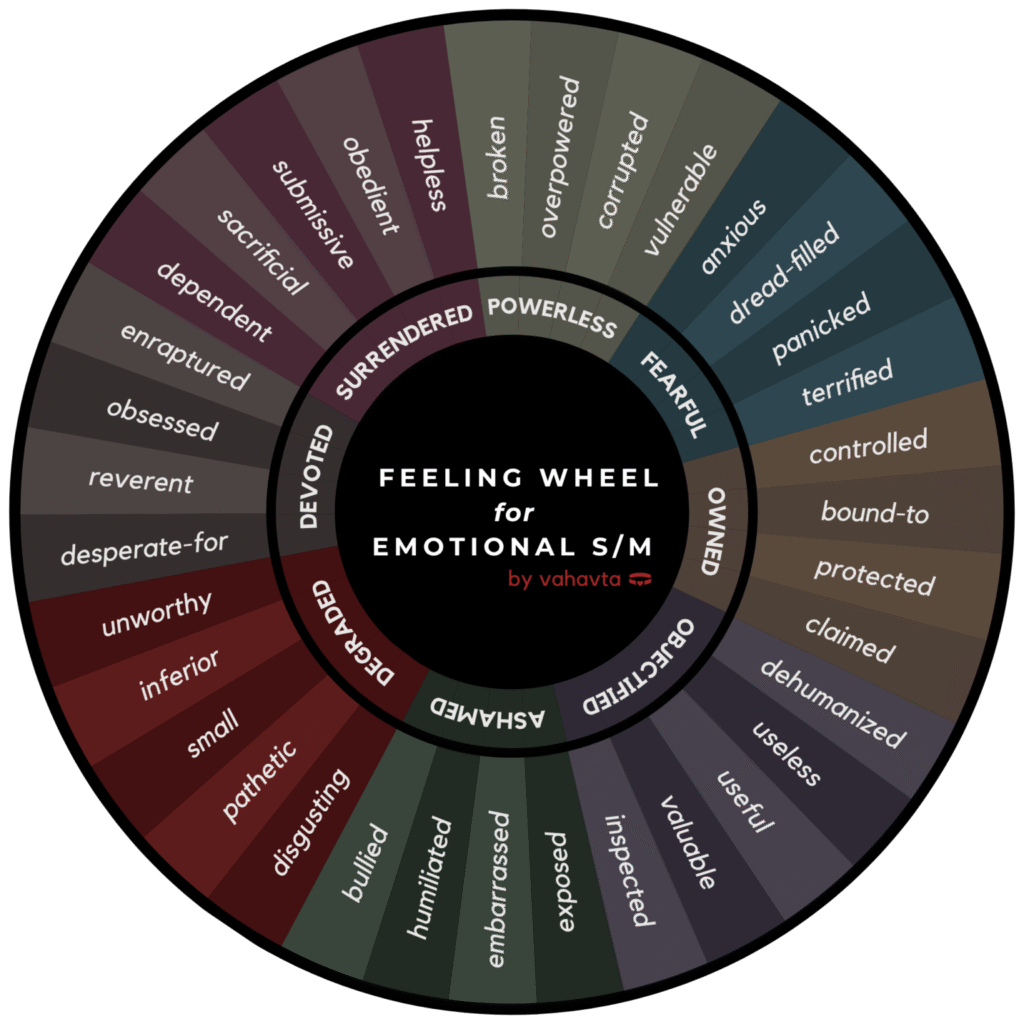
Emotion wheel for emotional S/M negotiation and degradation play - showing relationships between feelings like shame, disgust, fear, and humiliation
Use this tool to target the exact flavor of degradation, humiliation, or other emotions you’re looking to add to your BDSM play!
Want your very own sticker of this wheel? You can get one on Etsy here.

What’s important is you get specific: not just “degraded” or “humiliated,” but flavors like dehumanized, exposed, made disgusting.

Maybe you know this answer innately. If not, you might ask yourself questions like…

  • If I could only keep one word from the emotion wheel, which is it and why?
  • When I’ve fantasized about emotional play, which feelings am I chasing?
  • Are there feelings that I’ve experienced accidentally in play which I want to recreate intentionally?
  • Are there feelings that seem hot in fantasy but I suspect would be devastating in reality?
  • If I imagine the perfect scene for what I want right now, what emotion am I left with at the peak moment, and what emotion am I left with after it’s over?
  • Is what I want to be seen as [word], or being made [word]?
  • Are there adjacent feelings on the wheel that I’m not interested in, even though they’re close? (This helps identify boundaries within a category!)

STEP 2: Mine Your History for What’s Created This Before

Helping someone else create this emotion in you means giving them some kind of framework of how. Sometimes, we can mine this from past memories, with or without them being ones we’d call play.

I recommend looking in the following places:

Kink experiences: Scenes that worked, dynamics that hit right, porn/erotica that made you go “oh, yeah, that

Vanilla experiences: Moments of genuine shame, fear, exposure, worthlessness, etc. (yes, even the painful ones, to the extent that is safe for you — you’re looking for data, not trying to relive these memories (unless you *are* trying to, of course))

Fantasies: Even ones you’d never actually do, as they often reveal what your psyche is actually responding to

To get to these, you might ask yourself:

  • In a kink scene or dynamic moment where I felt something close to this target emotion, what specifically was happening? Who was there? What did they say or do?
  • In a vanilla experience where I felt this way (even if you I didn’t want to at the time), what were the conditions then?
  • Is there a specific memory I keep returning to—even if it wasn’t kink—that has the emotional flavor I’m chasing?
  • Which story/porn/fanfic beat made my chest pull tight in the right way, and what was the narrative meaning of the emotion (punishment, use, entertainment, devotion)?
  • When have people tried to create this feeling in me and missed? What was different about those times?
  • If I could direct a film scene of this happening to someone, what would I include? What would be essential vs. optional?
  • Have I ever felt [target emotion] and found it erotic vs. felt it and found it devastating? What was different between those times?

And don’t censor yourself here, seriously. Something might have worked in your head that you’d never actually do, and that’s totally fine. The point is to notice patterns.

Which then brings me to…

STEP 3: Pattern Recognition and/or Choosing New Context on Purpose

From your notes, look for repeat details. These might be sensory (e.g., public vs. private; verbal vs. physical; eye contact vs. averted; posture/position), relational (e.g., who can say/do this? Someone whose respect you’ve earned? Someone who holds power over you? Anyone? Does it require them to really believe or clearly not believe something?), narrative (e.g., the meaning/why it’s happening, like for someone’s amusement, a sadist’s pleasure, “because you deserve this”), or contextual (e.g., timing, setting, what comes before/after). Ask yourself questions like:

  • What sensory elements appear most often? (Words in a particular tone? Being positioned a certain way? Being watched? Physical touch or lack of it?)
  • Who delivers the experiences that work? What’s true about those people/relationships that isn’t true of the times it didn’t work?
  • What meaning does the degradation/humiliation/fear/whatever carry in the moments that land right? What is whatever is happening meant to signify about me?
  • Do I need buildup or does it work better when it’s sudden?
  • Does this need to be “deserved” somehow or does it work better when it’s arbitrary?
  • Do words or actions get me here quicker?

Quick aside: Meaning matters most.

If you could only answer one of these, make it meaning. Meaning is what can get fuzziest in between these emotions, which means it’s actually the most important part. Different “meanings” in ESM might be things like…

  • “You are less than others.”
  • “You failed/disappointed.”
  • “You are only useful for X.”
  • “You are disgusting/shameful.”
  • “You are beneath notice.”
  • “You deserve this treatment.”
  • “You exist for my entertainment”

…but this is a very non-exhaustive list!

And also, meanings interact with relationships. Some may feel safer for you inside steady devoted commitment (“only useful for X” can feel like worshipful utility) but dangerous inside more brittle attachments, or some other contingency. It’s okay to say this outright in your negotiation.

Step 4: Communicate it!

Now you put your shiny new well-articulated desires into practice! This could be in any number of ways, but here’s a framework if it’s helpful:

“To make me feel [specific emotion], I need [sensory/relational/narrative context]. What tends to work is [primary patterns you discovered], especially when [meaning/undertone].”

For example, I might say…

To make me feel humiliated, I need to be turned into someone who isn’t the way I’d want You to see me, and I need to be laughed at for it. What tends to work is something being done to me physically or being commanded to take actions I find embarrassing, followed by laughter and verbal degradation — especially when it’s delivered like You find my shame entertaining and like this is the most use I could possibly have. For this to feel erotic instead of erosive, I need it to not impact Your usual level of physical affection toward me, even if it’s framed as happening for a reason which is different than usual.”

(And heyyyy, if you need a reason to practice getting your final statement here out in the open… feel free to link this writing to your person along with some kind of “thought I’d try this just for funsies, here’s what I came up with”! Jus’ saying, happy to be your bold ESM moves excuse 👀)

What if the scene still doesn’t feel quite right?

Sometimes, everyone will do everything “right” and it still won’t hit the way you thought it would. The “close but not quite” problem is actually incredibly valuable here, though. It helps you to determine the boundaries around making your desires come true more precisely. “Oh, I thought I wanted to feel worthless, but what I actually needed was to feel worthless in this specific way, and when they made me feel worthless in that other way, it just felt bad.”

You might ask yourself questions like:

  • Which dial was off (e.g., meaning, intensity, context)? Which ones weren’t?
  • If we keep these actions or words but flip tone, does it become right?
  • Was the meaning right, but the tone off?
  • Did something about the relationship context shift recently? (Trust level, recent conflict, life stress)
  • Did I need something different before or after?
  • What would have shifted it from “close” to “yes, that”?
  • Do I need to add this to my explicit boundaries, or was it just about calibration?

And then you know. And then you can communicate it before next time.

For those who desire it, emotional S/m can be some of the most intense, intimate, potentially even transformative play there is. It’s also some of the riskiest, precisely because we’re working with elements that can’t be cleanly removed once introduced. There are plenty of important considerations as far as whether its risks are ones you’re willing to take.

But that doesn’t mean we shouldn’t do it. It just means we owe it to ourselves and our partners to discuss it as skillfully and as well-informed as possible.

Learning to reverse-engineer desires is one of the most important skills I’ve developed as a bottom. It won’t eliminate all risk. Nothing can. But it will dramatically reduce the chances of these desires being knowable — to yourself, and to your partners. Your desires are valid. And the more you can turn “I want to feel […]” into something specific—the more you can translate vague wants into concrete, context-driven asks—the closer you get to bringing them to life.


Want to join in on the conversation? You can find the original Fetlife version of this writing—and the comment section—by clicking here.
Posted by vahavta

The Shame Game: A Primer to Playing with Shame in BDSM

Of everything that comes up in that intersection between psychology and kink that I’m so fond of, shame play might be one of the most powerful. Maybe that’s because it is so flexible and so related to so many kinds of Emotional S/m (ESM), binding to other parts of play and wrapping around them in unique ways that make them into something more. That power itself is what draws many of us to it: the cathartic release, the reclamation of emotions we previously tried to avoid, the liberation from our social conditioning around desires and acceptability, the extraordinary connection that can come from exploring it with someone you trust. It’s also this power that makes it dangerous.

The way that shame can cause or result from nearly any emotion you can think of is what makes many researchers and educators (including but not limited to Brene Brown) refer to it as the “master emotion.” And most certainly, with all the subcategories we think about when we think about ESM—objectification, degradation, fear, others—the psychological mechanics of shame can enter in.

I’ve been thinking and learning about shame for a bit now in a few different realms of life (and have even been considering a 102 level for my ESM class that really focuses there) because that power is just so great, and to me, that makes it really cool. So this is a little bit of a primer on the matter, for those who may not have thought about the workings of shame in-depth… Or maybe for exactly the people that have.

As with anything I write about ESM, I may use examples that could be triggering for some, so please do care for yourself and step away from the writing whenever needed.

What We Talk About When We Talk About Shame in BDSM

Shame operates differently in our brains than other emotions we might consider when it comes to play, or even when it doesn’t. While emotions like fear and anger stem more from our basic survival cues (and certainly there’s a lot of overlap that can happen here), what we think of as “shame” links more directly to our social-emotional circuitry—that is, the parts that evolved to help us better navigate complex social communities. That’s part of why shame is often very culture-specific, from the norms that cause it to how one is expected to respond (both to their own and to others).

During a scene, basic emotions that get brought up (fear, anxiety, arousal) may activate your social circuitry, adding shame which can persist past when those basic emotions subside. This makes a lot of shame play really memorable and makes it build up over time to different effects, but it’s also what makes it tricky: social emotions don’t simply disappear when the present situation ends, unlike with something like fear where the adrenaline rush subsides once the threat is removed.

Shame can also develop “meta-shame,” where we are ashamed of feeling ashamed. And in that, it can become integrated into our identity, our sense of self, in ways we might not intend. When we experience meta-shame, this creates patterns of avoidance that operate subconsciously and prevent addressing the original issue, affecting you and your experience in and out of scenes without you necessarily even realizing it is there. Meta-shame magnifies the perceived gap between the “ideal self” and the “actual self” in our heads and the greater this gap, the more intense the shame experience. Which can be used for a lot of fun in kink contexts, when done carefully! But it can also lead to situations where no amount of endurance, submission, or service ever feels like “enough” to close that gap, and this can have wide-reachinf effects that we just don’t want.

This is why emotional S/m that plays with shame is always edge play that requires a ton of consideration. It it risky even for those who communicate well 99.99999% of the time — it can compromise communication in a number of ways, and there’s no safeword that can stop this process once it begins because it happens in the psyche, not at the hands of the top. So before even consider playing with shame, we should do whatever we can to really get our communication and negotiation skills up to speed. But with everyone informed of the extra risks and and consenting, it sure as fuck can be a very good time.

Different Types of Shame

Shame manifests in various forms depending on our history and psychological makeup, and we start to form these on the identity level at different developmental stages (which I’m not going to get to into in this writing). Understanding these possibilities can be something we can use to negotiate shame play and ESM beyond broad level categories, honing in more on what we do and don’t want to approach at that point in time — and I say that because this definitely can and even should vary based on what point in time we are playing, who we are playing with, and individual preferences.

To name just a few:

Judgment shame creates feelings of being fundamentally “bad” or “wrong” for desires or actions that contradict. It often gets talked about in combination with taboo play, if we are talking about societal norms, but might take other forms (like going against internal ideals or value systems) as well.

Control shame connects to one’s ability to competently express and enforce one’s personal agency, and can come into play either as “taming”/overriding of rebellion against authority or shame being attached to the complete surrender of autonomy some of us go for in our relationships.

Perfectionism and autonomy shame, which may or may not be closely related to the above, plays with the idea of the bottom being able to succeed at certain actions or respond in certain ways, whether or not those actions are even possible. Messing with this can lead to hopelessness and confidence loss when meta-shame and identity integration kicks in. On the other hand, it can be really, really liberating in some cases and lead to an increased sense of external or self-acceptance.

Social status shame centers on feeling inferior to others. This can be about embarrassment, power, “measuring up,” or something else — power exchange in the D/s sense may be an element but does not have to be. It also can be particularly risky for those who are prone to fawning or to excessive people-pleasing outside scenes, especially when linked with play that goes near those boundaries, because one might stop feeling that speaking up is even something they deserve to do.

Unworthiness shame centers on the core belief that one is inherently flawed, unlovable, or bad as a person, or that an action or behavior could make them so. That inherent vs. action element is important, because there’s a big difference for many between playful degradation (“you’re such a dirty slut”) and identity-level condemnations like “nobody could ever want to someone like you around long-term.”

…and there’s more of these where that came from, and just what kinds of shame someone experiences (and how) are going to shift with different individuals and their dynamics. So observation and awareness, both of the self and of others, is really the key to drawing lines between them and deciding which you want to touch, and which you’re leaving the hell alone.

Kink Risk Profile Considerations for Shame Play

There are a few specific risks I think are especially important to consider in shame play, among others. These include that identity integration risk I’ve mentioned, but also risks of emotional binding (how shame might permanently bind to other emotions like arousal or affection, or even identities or activities (including sex or play as a whole)) and relationship “contamination” (where the shame between two people spills over into their interactions outside of play, whether that’s a romantic, friendly, sexual, or simply community-level relationship). This is where shame can start to really spill into other contexts of life, with sexual shame in one relationship impacting someone’s other sexual relationships (present or future), impacting job performance, or creating long-term issues in a whole variety of other ways.

For each element of shame play you introduce, consider which of these risks might be activated, how to mitigate them with the specific people you play with, and how to evaluate if other elements of life have been affected. Mitigation may look like creating clear “containers” for shame play (e.g., particular locations, explicit beginnings and endings, specific language that only exists within the play context), incorporating identity-affirming elements or pieces which connect those playing to the core of their relationship to each other, or scheduled check-ins with one’s support network as part of ongoing aftercare. For emotion binding risks, mitigation might include things like ensuring experiences of pleasure, arousal, affection, or whatever else might be combined also occur without shame elements—both in that particular scene and in scenes that are not meant to focus on shame at all—or doing the same with particular roles or kinds of play that you want to ensure don’t codify as “a thing that inherently causes feelings of shame.”

This is also where developing emotional resilience practices becomes super important for bottoms engaging in shame play, some of which I talked about in part of this AMA answer on Fetlife. This also might include working to recognize your own shame triggers and response patterns, practicing grounding techniques, and developing a clear sense of who you are and what you love and value in yourself so that you can more clearly draw internal boundaries between play experiences + what an external party might say or cause and your more persistent self-concept. Mindfulness of meta-shame—noticing when you begin feeling ashamed of your shame responses themselves, and especially when you may be hiding them—might also be a warning that play may be crossing into potential harm.

Aftercare Considerations for Shame Play

I’ve written a bit about a framework I like for potentially-traumatic play but there are some intentional integration techniques that might be especially useful with shame play.

One of these is to include, create opportunities for, or emphasize acts of witnessing, which I know may seem a bit backwards when we think about shame’s social origins… But that’s exactly why it matters. Shame is about what we perceive as a social inadequacy, but that shame can be counteracted by those perceptions being proven wrong. Shame thrives in secrecy, but that means it dissolves when brought into the light. (There’s a reason that effective addiction recovery support models usually include sharing stories with others who share the same experiences.) The witnessing that occurs during the scene itself can begin this process, as a top acknowledges and accepts the vulnerable expressions of shame that emerge there, and can continue in processing the scene together and/or underscoring the ways that the scene felt intimate, like an act of service, or otherwise positive to the top. Beyond the scene, sharing the experience with trusted others—with appropriate consent, of course—provides opportunities for renarrativization, allowing the experience to be processed not just as a source of shame but as a moment in time. Writing and sharing the story of the scene with (one’s own or the extended) kink community can help to avoid or counteract the meta-shame and decrease the long-term risk.

Self-integration is the other big consideration here. Taking time for solitude (which I wanna note is distinctly different from isolation) allows for honest reflection and processing that isn’t always possible when still in with others. This might mean identifying specific shame thought patterns (e.g., “I should be better,” “I’m not good enough,” “no one would want me if they knew”), but that isn’t a skill that necessarily comes naturally to most of us, and a therapist or even just a CBT workbook of some kind may help if you’re not used to catching these sorts of things. Structured reflection or journaling on things like specific triggers, reaction patterns, contained versus lingering elements, etc. also help prevent shame from remaining an Amorphous Cloud of Bad to transform it into more specific, manageable elements that we feel capable of addressing and moving past.

In all cases, you mitigate the most risk when aftercare is not an afterthought. Consider and negotiate aftercare needs with the same care and specificity you bring to scene negotiation itself, recognizing that shame’s particular risks often require aftercare that addresses both immediate emotional states and the longer-term impact of this play.


Shame play exists in paradox, like other forms of ESM (or I might even argue with BDSM at all): we consensually engage with some of the most destructive and challenging human emotions for purposes of pleasure, catharsis, and connection. Trying to fully resolve this paradox is a losing battle, with ESM, and may just lead to losing sight of the risks until they reach a critical mass and explode (something else that I hope to write about and share experiences with at some point in the future). So the mark of someone who is mindfully engaged with shame play isn’t based on who can create or endure the most intense reactions, but who can hold the paradox consciously and with grace—being in experiences that are genuine and powerful in the moment while maintaining the psychological grounding necessary for integration afterward, reaching for support wherever it is needed.

Playing with shame in kink isn’t unlike learning skills for any kind of edge play. It begins with respect for its power and the ethical considerations it demands, it develops through careful preparation, and practice, and it continues and evolves with awareness and reflection. If I’ve learned anything these past few years, it’s that I don’t know how much here I don’t know, that the ways this pops up in ugly ways can be unexpected and brutal, even for someone that might be called “experienced” here.

But what I want to leave you with is that this idea of “shame thrives in secret but dissolves in the light” is one that also can explain what makes it feel so profound, for those of us who love it. In those darker, duller spaces of our psyches where life has taught us to feel shame and hide some part of ourselves, consciously-engaged shame play within the context of connection says “this part of you is valid and it gets to be seen without that compromising anything else about who and where you are.” Not just from one person to another, but to ourselves. This witnessing—this refusal to look away from the parts of ourselves we’ve been taught to hide—becomes a radical act of intimacy and ownership. And for lack of a better way to end this…

Well, hell. I just think that’s really fuckin’ pretty.


Join in on the comments of the Fetlife version of this post by clicking here!

Posted by vahavta

What Age or Experience Level Does a Dark Dynamic Require?

I was asked

Someone really young and new in my community is trying to be in a dynamic like yours and looks up to you. How old and how much experience do you think someone should have before attempting that? How should I bring it up to them?

“Welp,” I started my reply, “if anything is gonna get me canceled here, this is it.”

I’ve seen the commonly-held beliefs about this kind of thing change drastically during my time in the Scene. Early on, I was often thought of as being in a 24/7 CNC TPE too young, too soon — and at the time, there was absolutely nobody I knew of online was saying it was okay at all. These days, it feels like it goes more the other direction, pehaps because those of us who were once too young and too new are now older and less new, and we remember how it felt.

That’s not to say there aren’t still a lot of folks out there who feel similarly to you, just that it isn’t the only voice anymore. And to be clear, I don’t think you’re wrong for thinking it. I think people have these concerns out of genuine care, experience-based concern, and caution. But it’s a belief I want to challenge nonetheless.

Here’s my confession, which many of you already know but some surely do not: when I entered a dark dynamic, I couldn’t even legally drink yet. It was intense, it was HIGHLY risky, and I found it both fulfilling and sustainable. (Still do.) I’d been manipulated before and abused before at that point, but neither occurred in the context of a dark dynamic. And while this also isn’t to say that my kink relationships have always been healthy or that I’ve never been taken advantage of, this too has never had anything to do with my age or numbers of years of experience in the scene. Problems my relationship has had + healed from were not caused or disguised by our power exchange. Not being in a dynamic this intense wouldn’t have prevented or changed them at all.

I don’t regret entering a dark dynamic I knew I wanted and I won’t tell anyone “don’t follow in my footsteps,” because I simply don’t believe that. I don’t believe I was” too young” and I don’t believe should have had “more experience first.” In fact, I happen to believe entering it for the first time right now would be JUST as intense and risky. I was young and new, yes, but I was also self-aware, capable of clear communication, and knew my own mind. These made a dark dynamic work for me, neither because nor in spite of my age. Heavy power exchange, casual fear play being woven into the everyday of a relationship, and psychological dynamics may be ones that that many would consider “too intense” or undesirable for themselves, and that is always totally valid! But nobody’s youth or years of experience makes them any less potentially capable of navigating these things.

Age simply isn’t the determining factor in readiness. Neither are years of experience in kink.

As long as somebody is able to give informed consent, there is no line one must be taller than to ride the train of “pursuing what will fulfill their desires.”

This doesn’t mean all young kinksters are ready for dark dynamics — they’re not. But neither are all experienced kinksters. These dynamics can go wrong for anyone, and they require specific skills and awareness that develop independently of years lived or scenes played.

I’ve seen people with decades in the scene enter toxic dynamics, where either their experience actually became a barrier—they were so sure they knew what they were doing that they missed red flags, thinking they knew how to spot and handle them and wouldn’t be biased by the relationship—or it turned out that the years and years of experience they had built up wasn’t actually experience that had anything to do with what skills were needed to construct and maintain that dynamic healthily.

Likewise, I’ve seen plenty of relatively new kinksters create and exist within rather complex dark dynamics beautifully (some far more gracefully than I!) from both the top and the bottom, because they approached these relayionships with humility, self-awareness, and a willingness to pay attention to and communicate what they were thinking and feeling. Soft skills that can be built in other life experiences are what actually matter here: things like emotional intelligence, self-awareness, communication skills, openness to learning more or that you were wrong, ability to maintain boundaries. And also access to resources, including but not limited to support – coming back to that shortly.

That said, safety in dark dynamics does require cultivating certain skills.

These skills might include ones like…

  • Understanding and articulating your needs, including being able to recognize when those needs change
  • Setting and abiding by boundaries (both yours and the other parties’), even when those boundaries feel inconvenient – including for yourself
  • Recognizing that every dynamic is individual and should be consciously constructed for those in it, not based on anyone else’s relationships past or present
  • Willingness to take accountability for your own behaviors (no more, no less)
  • Being able to take the time and energy to learn, evaluate risk realistically, and make informed decisions
  • Maintaining connections and a life outside the dynamic that keep you grounded
  • Having the confidence to speak up when something feels wrong, even if you can’t quite articulate why
  • Willingness to attempt to communicate everything necessary, as immediately and clearly as possible
  • Understanding your own triggers and trauma responses
  • Being able to distinguish between consensual power exchange and actual control
  • Having the emotional stability to handle intense experiences or the wherewithall to seek resources when needed
  • Knowing how to access and use resources when needed
  • Curiosity to learn more about yourself

And some other things too.

And none of these skills are inherently tied to age or years of experience. They’re developed through self-work, through learning from relationships (vanilla or kinky), through therapy, through life experiences that might come early or late.

Is it more common to grow them with time and experience? Yes. Sure is. There are places here where I got incredibly lucky in crisis not occurring before I was able to build them up more. But they won’t the same things that others need to work on, nor develop at the same rate or trajectory as anybody else. Some 20-year-olds have done this work extensively. Some 60-year-olds haven’t started.

Now, about how you approach your concerns about them:

When I look back at my first year or so in this scene after entering a dark dynamic now, I understand that the community’s concerns came from a place of knowledge and perhaps even caring. But that wasn’t how they were expressed to me. They didn’t feel caring at all. They either came through attacks launched toward my D-type for dating people as new as I was—which were often pretty much just insults that caused me to feel defensive and makes others unreceptive—or… well, that’s it. That’s the only way that concerns were put in front of me directly. It was as if people didn’t realize I could read and hear and see what they were saying around but never TO me, in a way that made me feel like I was being watched and judged or deemed invalid of having agency myself or as if I was The Problem for being young and new, not like I was being looked at with care or concern.

Only one person approached this effectively, though she was someone I barely knew: she simply reached out to make sure I knew that resources were available if I ever needed them – for anything, not just dynamic-related issues. She didn’t push, didn’t judge, just opened a door. That door meant so much to me, even though I never needed to walk through it.

I’ve always said that the public shaming or what’s effectively an abstinence-only approach to darker dynamics and no-safeword play doesn’t actually do anything but push people underground, and it’s true. Those who are interested in CNC like mine don’t just not do it after they’re told it’s way risky. But if you help give those same people access to education on that topic, they then have a way to do it more safely and mitigate risks, and they’re more aware of what those risks might be.

I have been so glad to see a lot more efforts these days as far as community leaders reaching out to the potential-manipulators there are worries about, neutrally going over what patterns are being observed and offering friendly considerations, resources, educational sources, and so forth (though certainly, there’s still room to grow here). I still don’t see a lot of understanding of how and why to reach out gently to the potentially-manipulated when people have these worries — there’s much more than what I encountered all those years ago, but I do so often see it phrased harshly and as commands and edicts as to Why Thing is Bad, rather than with actual support to help that person do it more safely. But the increase in public discussions of dark dynamics, out in the open as opposed to behind a wall of experience level, has also meant it isn’t as needed. People with experience in “dangerous” relationship types and kink activities are making themselves more visible and are being allowed to by their communities, and it gives newbies with similar interest people to talk to and places to go to learn. We aren’t pretending these things simply don’t exist until people have collected enough XP, anymore.

Back then, if I HAD needed to leave my dark dynamic… with what I was encountering around me? Oof. I certainly wasn’t looking for support in the people who made comments implying I was too naïve to think for myself or who were objectifying me as just one of an evil D-type’s Newbie Collection. Those weren’t people who’d have my back, not at all. I felt they thought I was stupid. Reckless. Immature. That… didn’t make them safe people to ask questions to, and especially not to ask for help from. They weren’t interested in keeping me safe, it seemed to me. They were interested in talking shit.

And that’s where that thing I said would come back later enters in: the ability to potentially navigate these things includes that “access to resources, including but not limited to support.” Here are the ways you can approach your concerns:

1) Encourage and provide education in your local area, especially bottoming education. Talk about consent in the many forms it can look like, and if your community only practices certain models and risk levels, considering hiring any one of the many fabulous bottoming educators out there as a way to get other voices in. Support those who hire online educators and consider bringing up how many online classes there are at event orientations new folks frequent. Consider mentioning some specific resources that might help them as well (may I suggest the free Risk Evaluation Database?) Because not providing the education doesn’t mean people won’t do things anyway, but the education IS there. Help those with less knowledge out by providing a map to those educators that they could learn from, when you know of them yourself.

2) Open doors, don’t build walls. Offer resources without pushing. Express care without judgment. Create space for honest dialogue without assuming you know better than they do about their own readiness. Ask questions that help them reflect on their choices rather than telling them what those choices should be.
Whether approaching someone acting problematically towards others OR those others with concerns, don’t do it full of insults and judgment, but instead with a mind to pointing out an observation you’ve made and a willingness to hear them out if you didn’t have the full story. Consider pointing them to education or suggestions on what skills they might want to acquire, especially if you can come at it as a friend sharing their own stories and not a unilateral belief about what’s always-good or always-bad. Maybe you even invite them to go to a class with you and have dinner or something after. Make it an event. Ask questions about how what you learned together applies to their dynamic, and share how it applies to your own. Start the conversations.

3) Be careful of how you talk about people you have concerns about. There are lots of valid reasons to speak negatively about someone who is acting carelessly, manipulatively, or who has harmed others in the past. But ad hominem character attacks don’t teach or offer to support to anyone those Bad Actors or careless people are currently close to or playing with. Specific examples of their actual behaviors do. If you’re speaking about someone who you have concerns over the behavior of and that someone has current partners, don’t insult the partners along with these statements unless the partners themselves are doing harm to others. Don’t assume they’re choosing to do something reckless that puts them in harm’s way. They may not have the context to know what you’re talking about, they may have more skills than you’re imagining, or there may be more to the story that you’re unaware of which make them in need of support. And if they ARE being abused? Isolation is a huge tool of abuse that keeps people from getting help, and speaking about someone being abusive by putting down the currently-abused shuts off exit routes. When you write a comment about someone you’re concerned about the behaviors of and you implicate the partner, ask yourself: if this were said about me, would I ever be able to trust the person who said it if I needed help? Would I feel comfortable reaching out to them? If not, consider if your comment is helpful to the person you’re allegedly fearing is in danger or if it isolates them further.

^ and do all of the above for everybody. Regardless of age. Regardless of how long you THINK they’ve been doing kink (there’s a lot of kink that happens outside the realm of “the scene” or Fetlife, so don’t assume the amount of time you’ve known of them is experience level, either).

Because ultimately, we all make our own choices regardless of anyone’s opinion, so that’s what we can do to keep each other safe. Not arbitrary rules about who should or shouldn’t explore certain dynamics, but open dialogue, genuine support, and respect for each person’s journey at whatever rate it progresses at.

But what do you think? What other skills do you think those exploring dark dynamics should already have and/or be actively working on? Click here to go to the post on Fetlife if you’d like to join the conversation in the comments!

Posted by vahavta

Fear Responses: Risks, mitigation, and/or use in escalation

Fear play is one of those topics I’m lucky enough to get to approach on multiple levels. There’s what I have learned and experienced as a bottom to some pretty intense stuff here, but there are two other layers for me, too: one where I’ve coached horror writers and written horror myself, giving me a different lens on the storycrafting of it all and how fear can be created in the mind of another, and one where I’m a creator of remote immersive horror experiences and where with basically two exceptions, every person on my “I talk to them nearly daily” list of friends is either a creator of or actor in an extreme haunt or immersive terror experience, or they’re someone who attends every one of those they can possibly get a ticket to.

Though the people in this latter category are, importantly, not engaging in kink, there’s still lots to learn from what they’re doing: in creating a for-profit immersive terror experience, they have legalities and publicity to contend with that kinksters don’t always have to approach, which means that they often put much more into the training of the actors, the considerations of safety and ethics, and the care that goes into the creation of the experiences.

On all levels, I’ve seen the incredible power of consensual fear experiences to push comfort zones in exciting ways, explore intimate depths of our psyches, and create profound connections between people… and I’ve also witnessed how easily things can go awry when fear is misunderstood or mishandled.

Fear is powerful, and delicious, and hard. And I love it. But something that has come up again and again and again when I discuss and teach about these things ~~(like I’m doing this weekend)~~ is the way that different fear responses might change interactions, especially as pertains to risk, communication, and consent — and so that’s what I’ve created a little resource on below.

NOTE: That class has passed, but there may be another coming up! if I have a fear play class scheduled in the near future, I’ll mention it at the bottom of this writing ❤

Some fear responses are very physical in nature.

There are different types of fear, and some are more individual. (I’ll get to those in a second.) Others are engrained in most humans. It’s well-acknowledged in the extreme haunt sphere, for example, that water is often used to “break” participants and that drowning and waterboarding scenes are where many hit their limit – and though the risk on it should not be understated (in either case, really), many of us do “enjoy” drowning or waterboarding in kink. But I happen to think of it as a culmination of a scene, in my fantasies, and not an entire scene… once it begins, it ends up being “over” relatively quickly if not handled within a larger “narrative,” so-to-speak.

This is because survival-based panic is an instinct, one that can only be thought its way out of and “managed” for so long. Mindfulness techniques can help some, and there are things I can teach bottoms in this class about how to manage these reactions a bit better… but ultimately, our bodies are built to respond in such a way that keeps us alive. And so, when a core function like breathing is compromised, there’s often a very strong panic response.

On a physical level, this can be one of the most risky moments in a scene because bodies are likely to writhe, buck, and flail in efforts to get out of the moment. Tops who are playing with conscientious bottoms that are usually quite unlikely to behave or move in ways that put themselves in greater danger may suddenly need to take more physical precautions to avoid someone hitting their head on porcelain, for example.

But then there’s another kind of fear, and that’s what most people are asking about when they ask me about this question:

The psychological fear responses of fight, flight, freeze, or fawn

When we’re confronted with intense fear, our bodies and minds instinctively react in certain ways, and these are four that I see discussed semi-regularly. These are where things get really tricky, as each can display in ways that are highly individual and have their own effects on communication and consent. The below information is not meant to be all-inclusive or comprehensive – not on how it can be recognized, how to de-escalate, or even how to escalate! – and as in near every other realm I teach in, I’ll say that communicating for in-scene enjoyment and safety begins long before your scene and continues long after.

But vahavta, isn’t the solution to all of this “use a safeword”?

Well… not quite. I say that partially because I don’t (which doesn’t mean I don’t communicate!), and I know there are many who follow me or come to my classes who also don’t.

But even if you *do* use safwords, it’s important to realize that’s a tool, not a sure thing, and that fear responses inherently impede rational thoughts and actions. Add to that how emotional S/m play of any kind (including fear) can impede their use and it’s clear that while a safeword in your toolbox for the scene can HELP you stay aware of needs…it should never be the only thing you keep in mind, or you’re setting yourself up for trouble.

But! There are *some* broad-strokes guidelines I can give you for each response here, so that’s what I’m going to do.

Below, you’ll find a few different ways to recognize and respond to each of these categories.

Keep in mind that we rarely ever end up engaging in *only* one fear response all the time, and it’s a good idea to have a watchful eye on the way they might shift over the course of the scene. Even if you know what you or your bottom tends to default to, that doesn’t mean that another won’t pop up, so it behooves everyone to learn about each possible direction things might go.


The first two of these are what I’ll call “active” fear responses. These are ways we try to regain power in a situation where we feel threatened.

Fight

Recognizing: When someone goes into fight mode, they may become aggressive, confrontational, or physically resistant. They might lash out verbally, try to push the threat away, or even attempt to “take control” of the scene. Some, not all, will show signs first that are similar to an animal raising its hackles, with tensed shoulders and clenched fists. This also might look like “bratting.”

Heightened risks: Similar to the physical danger panic response, there is a greater amount of risk to play when someone is physically fighting back because there is less control the top can have over the situation. From a consent perspective, a fight response can make communication harder whether it’s a physical or an emotional fight, as the bottom may be so caught up in their own emotional state of fight that rational thought is impaired and the defense becomes more important to them than simply articulating needs and/or boundaries.

Response to the response:

Tops, you have a few options when you identify a fight response.

If you want to escalate the fear, you can meet their aggression with your own, pushing back against their attempts to gain control (maybe physically; maybe via verbal taunts or something else). This can create an intense power struggle that heightens the adrenaline and the sense of danger.

If you simply want to mitigate risk as far as what comes with this, this might be time to add (or increase) restraints, particularly if you are planning to use anything that requires precision as to location on the body (like blades, for example!) You can also refuse to continue a scene without the bottom giving you some kind of check-in that requires they actually take a breath and respond verbally and with thought, perhaps with some kind of count-down or limit, which can add its own fun fearplay pressure while still serving to allow them to opt-in to continuing (“if you don’t tell me you’re good to continue before I count from 10 to 1, we don’t go forward”).

And if you want to de-escalate without ending the scene, remove any aggression coming from your end. Speak in a calm, soothing voice, and back off from anything combative. This might be a time to leave the bottom to think for a bit and play into one of the TYPES of fear we’ll also discuss Sunday, dread. (Of course, if there’s any kind of restraint, you’ll want a way to also keep monitoring what’s happening with the bottom and remain within earshot either way.) You could also empower them to see the scene as a challenge and redirect the fight impulse away from you and toward their own willpower – “You’re so aggressive, surely you must be strong enough to keep going” – but this should be done with caution, as it can shift some into a fawn response and get messy as far as consent.

Flight

Recognizing: We often think of flight mode as simply “escape,” but that’s not always physical, nor does it always actually result in an escape *attempt.* Someone in flight mode may start towards an exit or back away from the danger, but they also might have eyes darting around looking for exits (whether they’re conscious of that or not!), become restless or agitated, or start to dissociate from their surroundings – this last one, particularly, will happen with psychological fear and this gets tricky as it is not *exactly* the same as a freeze response but can look that way. This response, however it presents, is rooted in an effort to get away from the perceived danger and find safety.

Heightened risks: A flight response can *also* increase physical risk, depending how they attempt to “escape,” and can make it harder for a participant to communicate their needs (sensing a pattern?). They may be so focused on escaping that they don’t take the time to check in with themselves or express their boundaries. While this is a very different kind of risk, someone in flight mode may also end a scene out of panic in a way that they will regret later (and this is why I don’t personally play with safewords!)

Response to the response:

If you want to use a flight response to escalate the fear, you can play into their desire to escape. Block their exits, corner them, or create a sense of being trapped. This can heighten their panic and make the experience feel more intense. Maybe you add restraints, if they aren’t already there… or, if you are confident you can express greater strength and control a situation, you might even challenge them to go ahead and *try* to move while holding them in place.

To mitigate risk, figure out what is making them feel a need to escape and respond accordingly: remove restraints, take a physical step backwards so they feel less cornered, or even move to a larger room. Maybe you can open a door. Maybe this is taking a metaphorical step backward, if the scene is more emotional. Make continuing the scene require an active opt-in of following you somewhere or making a choice (discussed more in the Freeze section). If they’re escaping via disassociating, demand eye contact or ask open-ended questions that require thought to answer.

To de-escalate, both remove anything that makes them feel restrained or cornered and provide reassurance that they can stop any time they want (assuming that’s how you play) and that any sense of being “trapped” is only within the confines of the theme. Remind them that when the scene is over, it’ll be over: this *will* end. Breathe calmly and encourage them to follow your breathing to reduce panic. Set up situations that require them to *approach* (both physically and emotionally) to continue. If they’re disassociating, a gentle hand on the back or the knee can be grounding for some, but can make this worse for others – so discuss first, if possible.


The second two responses here are the more “passive” ones, and these come when someone no longer believes that a threat is escapable. In fact, switching from active to passive fear response may be a way to monitor the pacing of how fear is escalating for a bottom — they’re signs of acceptance, in a way!

Freeze

Recognizing: When a participant freezes, they may become silent, unresponsive, or appear to “check out” of the experience. They might stop engaging with the scene entirely, become passive, or seem emotionally distant. They may become very still, end up with a blank face void of emotion, or fail to respond to stimuli. Though the lines can blur, the difference between dissociation here vs. in the flight response is that this isn’t really dissociating; it’s freezing without responding in a way that seeks to camoflauge (which sometimes also looks like not reacting), but often still involves fully experiencing the moment under that facade – for some, not all.

Heightened risks: From a consent perspective, a freeze response can be particularly challenging because a bottom may go nonverbal. A freeze response is one that literally exists for prey to try and *not* be perceived by a predator, so the cues a bottom gives may decrease here and they’re unlikely to be able to communicate needs at all. Tops need to be very attentive to their nonverbal cues and err on the side of caution, and bottoms who do freeze and know they freeze should do themselves a favor by paying close attention to what happens in their head in those moments, communicating to your top before the scene what your freeze response means and what, historically, has snapped you out of it.

Response to the response:

If you want to use a freeze response to escalate the fear, you can capitalize on the sense of helplessness. Take control of the bottom’s body, move them around like a doll, or put them in positions that make them feel vulnerable. This can create a sense of powerlessness that heightens the fear. To this end, much in the “flight” section for this applies.

To mitigate risk without stopping the scene, this might be a good moment to give them some sense of autonomy via choices that they have to respond to, even if both choices are “bad” as in predicament play. I’d suggest requiring a verbal response along with whatever physically is required from a choice that is given, myself, with the same approach that I recommended above: not making a choice is the same as opting out and the scene ends. You might also ask yes/no questions until you can get them to a place where they’re able to articulate needs and boundaries more clearly.

To de-escalate, slow down the pace of the scene to give opportunities to process, removing the tension of time pressure and reminding them you’ll wait for them to respond – “When you’re ready, let me know how you’re feeling.” You might remind them they’re in control and can choose to end the scene at any time, if that’s a choice given. In general, freeze responses seem common when there’s a stimulus overload, so slowing down the onslaught of events in the scene or reducing stimuli (like bright lights or music) can help de-escalate this one, too.

Fawn

Recognizing and heightened risks: Fawn response is a coping mechanism that aims to decrease a perceived threat by doing what it wants, more or less. In short, it’s when someone in danger becomes particularly submissive. It’s the answer to when people ask the (incredibly naïve) question of “but if you were being abused/raped, why did you say yes and keep going along with it?” and that’s what makes it one of the most difficult parts of fearplay: the things that characterize it are inherently also heightened risks. In fawn mode, someone may become overly compliant, agreeing to things they normally wouldn’t, or trying to appease the threat to avoid further fear and danger. They may be more concerned with pleasing the top than advocating for their own needs or boundaries.

Response to the response:

If you want to use a fawn response to escalate fear, you can take advantage of the bottom’s compliance. Push them, make increasingly extreme demands, and/or put them in situations that feel degrading or humiliating then deepen that by pointing out what they’re saying yes (or not saying no) to. (This is my favorite time for that, probably. Not when it’s happening, though! Brought to you by the number of times I had to repeat “because I’m fucked up” just the other day, until it sounded matter-of-fact enough and no longer like a question or attempt to appease. And make eye contact the whole time. Yeesh.)

Mitigating risk: Tend toward open-ended questions here, “How do you feel about…?” as opposed to the yes/no, red/green, rate from 1-10 types. You can also give them a piece of paper (or keyboard) to write their answer down, which sometimes subverts the “just say yes!!” signals for long enough to get an actual answer. And though I’d normally put something like this in the de-escalating bit, this is a time to remind them that there is no punishment for ending a scene or for speaking up about not wanting to do something. Fawning happens because we see a decreased threat if we please the other party, and so reminding them that going along with things *isn’t* actually necessary to end the threat can help with some of the inherent problems that arise. You might also offer autonomy, like I mentioned with the Freeze response.

De-escalating: Remind them how much you are enjoying what you are doing already and how much you enjoy playing with them in general, making it clear that they have already pleased you and don’t HAVE to keep saying yes in order to have done so. You might want to even let them know they please you when they are clear about their boundaries and say no, that this is a way of helping you make it a good experience. You could also switch to an activity that you know they actually enjoy and feel somewhat less fearful of, de-escalating the actual fear response before you ask those open-ended questions again in an effort to encourage honesty over appeasement. When you do check in again, be sure to do so in a non-threatening way to the extent that you can.

However, I want to underline once more how important it is to be very mindful of the power dynamics at play here. A bottom in fawn mode may not feel able to say no, even if you’re pushing them beyond their limits and even if they are usually a fantastic communicator. It’s not a character flaw; it’s just how this works. They may go along with things that they’re not truly comfortable with out of a desire to please you or avoid punishment.

And so it’s extra, extra important with fear play scenes to debrief several times after play so that you can continue getting and sharing information that arises with more distance from the scene, as both parties are able to reflect without the heightened arousal that comes from the charged environment.


Conclusions

Navigating fear responses isn’t a 101-level task, and it’s not one that I (or anyone) can cover comprehensively — not in a writing, nor in a 2-hour class. So please, use this as a start to your toolbox… but then let the real learning start. This is a skill that requires empathy, attunement, and a willingness to adapt, as well as a great deal of self-awareness (both emotionally and as to where you are in space) – and that entire sentence was directed to both bottoms and tops.

At the same time, fear responses can be a really powerful way to make these scenes and experiences even more intense and transformative. And so for all these reasons and more, learning as much as you can about these fear responses will make scenes both safer and more enjoyable for everyone. Like with any other skill, you’ll do best with patience, practice, ongoing education, and an approach of mutual respect and curiosity.


Housekeeping

Update, April 2026: If this framework resonates, I go deeper into all of it in Playing with Fear: Empowered Navigation of Thrills and Risks, which I’ll be teaching virtually with Praxium on Tuesday, April 14 ❤️ We cover fear response types, how to read them in real time, designing scenes that land, and what to do when things go sideways. If that’s of interest, be sure to save your seat and receive your Zoom link by getting your ticket here.

Want to join in on the conversation in the comments? Find the Fetlife version of this post by clicking here.

Posted by vahavta

Good vs. Bad Pain (for safety and as a pain processing tool)

Pain, at its essence, is a multifaceted experience: it’s how we intertwine physiological responses with psychological interpretations. To our bodies, pain is often a warning sign that tells us, “Hey, something’s wrong! Alert!” But for those who tend to lean *towards* some consensual discomfort and suffering, as opposed to away, the difference between “this is what I want!” and harmful damage can often be razor-thin.

This becomes more and more true with certain kinds of edge-play or with capital-S Suffering, but truly, this matters for any of us: one of the things that we go over in my class on pain processing is the role that our own natural fear of damage plays in catastrophizing what’s happening in a scene. For me, something that’s been particularly helpful in processing pain is taking a moment to tell myself, “Okay, I’m responding this way because my body wants to prevent harmful damage, but I know some ways to evaluate if this pain is ‘okay’ or not… and when I go through those measures, it is — so I can now eliminate the panic element of this and allow myself to enjoy it” (whether “it” means the pain itself or the act of Suffering for my partner).

I recently asked my mailing list for their questions about pain and masochism, and this question came up more than any other – and I’m glad, because this is both a pain processing tool in that way I described above and a way that both tops and bottoms can evaluate when something *does* need to stop so that we can stay safer and within our risk profiles as much as possible. So while there are exceptions to everything you read here (or in most of my writings, tbh), here’s are some of the ways you might distinguish between the “good” and the “bad” when it comes to pain.


1. Intensity

Pain we can usually manage:

This is the easisest measure, because pain we can usually manage often feels like “hey, this is pain I can manage!! When it doesn’t, it’s something that you might describe as “challenging,” like what some of us experience during an intense workout. It’s the kind of discomfort that makes you grit your teeth and push forward, not the kind that makes you want to throw in the towel.

Pain that’s more of a warning sign:

This is the kind of pain that stops you in your tracks. It’s sharp, severe, or simply unbearable. If you find yourself seeing stars or unable to focus on anything else, that’s often your body waving a big red flag – and it’s true, some of us *do* still want that feeling of unmanageable (guilty), but we can try thinking about it this way instead: consider your reasons for engaging in this play (whether that’s pushing yourself, bonding/intimacy with your partner, a new experience, or whatever else). In the moment of the pain that feels unmanageable, can you still remember your intention and place your attention there, even through the intensity? If not, it could be time to end the scene.

2. Duration

Pain we can usually manage:

Particularly with impact, good pain happens as it is happening and quickly backs off, at least a teeny tiny bit. Most of what we do in play will hurt past the moment of hitting the skin (or piercing or whatever it might be), but it’s like a wave and backs off in between. If you pause to get a drink of water, you shouldn’t be hurting the same amount you are at the moment of contact. And though this writing is meant to be more about evaluating in-the-moment during play, good pain usually follows a predictable healing timeline. You might experience some muscle soreness for a day or two, but it shouldn’t overstay its welcome.

Pain that’s more of a warning sign:

Bad pain persists even during breaks. There is no “wave” to the sensation, or maybe it even worsens (in ways that aren’t expected based on the kind of play you’re doing). This may be a flare indicating that something unintentional has occurred.

3. Location

Pain we can usually manage:

Good pain largely shows up exactly where you’d expect it to. Your upper back is being flogged, and your upper back hurts. You are receiving an electric shock to the calf, and you feel it on your calf. It *makes sense*. And though there are exceptions, we most often feel it on our skin and in our muscles.

Pain that’s more of a warning sign:

When pain shows up in unexpected places, it’s nearly always cause for concern. If the discomfort is radiating to other parts of your body than where the play is happening, there may be something else going on. And even if they’re *near* that location, feeling pain in bones and joints when it’s happening on soft tissue is usually a warning sign. This also applies to pain felt unevenly: if you’re being hurt the same amount on either side but are feeling it asymmetrically, this is sometimes Not Good. (Though to be fair, it also is sometimes a sign that your top is not right-handed/left-handed and you’re at a bad angle for their good arm.)

4. Quality

Pain we can usually manage:

This does depend on what you’re playing with, and “pain that makes sense” applies for this measure too. Sharps feel sharp. Thuddy toys feel thuddy. Stingy ones sting. During breaks, you might describe this kind of pain as an “ache” or “soreness,” or sometimes as a “burn.”

Pain that’s more of a warning sign:

If you try to describe your pain and the first words you reach for are ones like “stabbing,” “shooting,” or “electric,” these are potentially problem signs (excepting, of course, where they would make sense – yes, needles feel stabby and electricity feels electric, don’t @ me). And if you’re experiencing numbness, tingling, or unusual weakness alongside the pain, that’s nearly ALWAYS your body telling you something’s amiss.

5. Impact on performance

Pain we can usually manage:

There are more exceptions to this category, but while good pain might take some focused processing or even come with a feeling of “I don’t know how much longer I can take this,” it doesn’t necessarily bring you to an abrupt feeling of “STOP THIS NOW!” Where it does, you can still take a moment to consider and recognize that part of this impulse comes from fear of the next strike or escalation, not just from the physical sensation. We may associate words like “pushing through” with this kind of pain, and we often adapt to it and can enjoy it more over time (both in the immediate and in the long-term).

Pain that’s more of a warning sign:

Unlike its “good” counterpart, bad pain tends to cause an immediate and significant drop in your enjoyment of a scene. (Notice I didn’t say of the activity — like how I mentioned being able to re-focus on your reason for play in the “intensity” section, you might really be suffering through something but still able to enjoy that act in the “good pain” category, whereas maybe not so much here.) It might also come with other symptoms, like nausea or blurred vision. Bad pain isn’t the only thing that can cause those items by any means at all, but it certainly *can* cause them.

6. Psychological response

Note: this is the one with the MOST exceptions, because some of us really do love playing with Suffering, fear, and other emotional “negatives.” If you don’t play that way, however, you might consider the following:

Pain we can usually manage:

Good pain often comes with a sense of accomplishment. You might find yourself energized, focused, or turned on by the sensation. It’s challenging, sure, but in a way that makes you feel alive and empowered (even if you integrate power exchange elements and don’t feel *powerful*).

Pain that’s more of a warning sign:

Bad pain often comes with a side of dread. If you find yourself feeling anxious, fearful, or regretting your decision to engage in the activity, listen to those instincts. They’re often your subconscious picking up on signals that something isn’t right.


These measures allow us to introspect as to if the pain we are feeling is really connected to its physiological cause, or if the psychological of “pain = warning” is making it seem worse than it is. You’d be surprised how much better you’ll find you are at pain processing if you can say, “Okay, nervous system: I know that this physical sensation is you trying to tell me we’re in danger, but here’s why *I* think you’re wrong.” And there are other things we can do to help ourselves and our partners tell the difference between these two kinds of pain too, like establishing personal baselines and paying attention to posture and other elements that could be exacerbating pain unnecessarily – but as a very, very general guide, those are a few of the things I think about.

Finally, I’ll say what I always am sure to at the end of this section of the class: pain that doesn’t meet these warning sign descriptions doesn’t automatically mean there isn’t harm being caused (especially with damage that accumulates, like nerve compression), and “good” pain may STILL be something that you reach an “I don’t want to be doing this anymore” point with, for any of a vast multitude of reasons… and that’s okay! Certainly, harm isn’t the only reason to end a scene, and I’d say that in an ideal world, that’s never what causes us to end a scene. So please don’t take from this that you shouldn’t stop if you are only falling in the “pain we can usually manage” zone.

Learning to differentiate between productive discomfort and harmful pain is a skill that develops with experience, and there’s no one-size-fits-all. I Love consensual pain (obviously), and I personally find that Suffering in a way that pushes back on what my brain wants to tell me is okay is exhilarating, and transformative, and incredibly intimate. And that’s something that’s most certainly achievable without it coming at the cost of long-term health or the activities we value most. The key, as with anything else that happens between people, is awareness, communication, and aiming to never stop learning about your (or your partner’s) own body and mind.

————–

Want to join in on the conversation? Click here to go to the original post on Fetlife and add to the comments section!

Posted by vahavta

Qualities of Unhealthy vs Healthy TPE (Part II of IV, Unhealthy vs Healthy TPE and Dark Dynamics)


START HERE: Unhealthy vs Healthy TPE: Context and Definitions
Part II: What makes for a healthy/unhealthy TPE (according to me and others)
Part III: Questions to ask yourself to tell if *your* dark dynamic or TPE is unhealthy or not
Part IV: You know someone whose dynamic seems unhealthy, or yours is and you want to stay. Now what?

This writing is part of a series of them, and it is the longest. For this reason, I’ll avoid an over-long introduction. Below, you’ll find a compilation of answers I received when asking kinksters what the difference was between unhealthy and healthy TPE (total power exchange), particularly when it comes to what I will call “dark dynamics.” For definitions and further context, and rules of engagement, please see the “Start Here” post.

I’ve tried to delineate the responses into set categories as much as possible. Quotes do not represent the only things said or the only people who spoke about each category, not by far — they simply are the ones I determined to best represent a point.

Without further adieu…

Traits of Healthy vs Unhealthy Total Power Exchange (TPE) in BDSM


Discussing needs, interests, and motivations in prep work/the dynamic being consciously constructed between individuals vs being placed in a dynamic in a cookie-cutter mold

While many people said this in some form, @CarterBrulee named as a particular red flag:

attempting to jump immediately into high levels of power exchange without getting to know me or my needs and desires

It’s specifically that “without getting to know me or my needs and desires” that made me quote Carter here. This is the root. For some, it may be fine to jump in fast—I did, and this is something I *do* stand by because while it was fast, our first discussions were “what do you want out of kink?” and “what does having a submissive mean to you?” and “what would a collar indicate to you?” and these sorts of essentials. Jumping in without those discussions happening out the gate without a continual conversation on how certain things are affecting the bottom may be unhealthy, and at best, is bound for more miscommunications and mismatches.

Conscious construction, it should be noted, doesn’t have to mean doing everything a submissive wants if that isn’t what appeals to those involved. This is underlined by the fact that this category came more from those who engage in dark dynamics than not. Interests, desires, and the like being considered does not always mean these are “given in to”. But as @Aerin put it to me, “even abandonment play requires some kind of attention. It requires reminders that it’s happening.” Any kind of play is a process of reaction and response. When there is no longer a response, even if it is one that does not give you what you desire, you may be experiencing something unhealthy.

For each individual matters too, and its opposite, a cookie-cutter dynamic, was named as a red flag by many (frequent in “harem” abuse situations).

@SuspendDisbelief said:

Good TPE takes into account the natural desires of the sub, if for no other reason than to ignore them. Bad TPE is fully built around shoving a sub into a premade box using cookie cutter methods, burning the coffee to standardize it like starbucks (no shade). Good TPE, if involving “changes/training” (which I do not believe TPE must, to be clear!) might involve agreement upon the recipe, laying out the ingredients, and cooking together. Like, the sub should be a willing participant in their own subversion, such that they have a full understanding of what that end goal means. I don’t want to say the personalization is what makes it good, because I’m certain a predatory dom could personalize the grooming process, but there’s got to be something in there about keeping the “why” of both partners at the forefront of the dynamic, even if the “what” and “how” is completely up to the whims of the dom. I completely understand (and experience) a submissive’s desire to be slowly, unconsciously molded into their dominant’s image of perfection, but there needs to be a baseline materials science-type understanding of what the unique substance being fucked with can safely do.

@CarterBrulee said:

If you can never see how your dominant considers you in their choices. Even if it is to disregard intentionally and purposefully in ways that serve parts of the dynamic. Then it’s likely not a good dynamic.

@Chayla said:

It’s actually totally fine with me if this relationship is genuinely very centered around the dominant and includes some amount of disregard for me and my preferences and isn’t about “helping” me — but it still needs to consider me as an individual. I’m not going to be able to provide the same things as the next person, nor be motivated the same ways, nor want the same things, nor be fulfilled in the same ways.

@Aerin also pointed out that a dark dynamic being what a submissive wants can still be a red flag of unhealthy behaviors if it comes without prior discussion. This is a particularly important point, as “perfect-for-me-and-we-didn’t-even-have-to-talk-about-it” often may seem like romance or destiny or other positive things at first—but that can turn into a nightmare fast. They offered this thought experiment as a potential measure:

If they successfully used the same process on somebody else who didn’t have the same level of interest in ESM and consensual abuse play as their bottom, would they be violating consent? In other words, is their treatment of the bottom only OK because the bottom is making it ok? If they don’t have mechanisms in place to gather specific information before they do the horrible things that the horrible things will be welcome and consensual, the fact that the bottom enjoys those horrible things is irrelevant.

@Darren_Campbell made a related observation to the cookie-cutter discussion (emphasis mine):

These rigid structures [that we often see in serial abusers] come pre-conceived and then ask subs (usually women) to slot into these fantasy roles. Leadership isn’t cookie-cutter, it’s an act of inspiration in response to meeting circumstances and people that drive us to build and co-create something new. In its purest form it’s an act of serendipity and wonder. “Look at this amazing person that has offered me their service/suffering/obedience/whatever. I wonder what amazing thing we can do with that.” If you go in certain, YOU MISSED THE FUCKING POINT.

I bolded that “in response” because response isn’t a one-time thing; it’s a process. The needs and desires conversation is not just a one-and-done before a partnership but is a continual process of discovery and response throughout.

@LillyKoi- pointed out how these discussions can also be of benefit throughout a partnership:

I frequently go back and read our discussions prior to ESM engagement as a form of checking in. Getting to know each other – especially wants, needs, desires, intentions, self care systems, triggers, what is known to work, what is known to fail, curating our own specific vocabulary/definitions, current boundaries, etc. in writing is a prerequisite for this kind of engagement with me because I want a work around for any “during engagement headspace” that might be clouding someone’s judgement or ability to communicate authentically.

An environment of care vs selfishness or detachment


Consideration of the needs of the bottom also overlapped with a topic I’ll refer to as an environment of care. @Aerin gave these great thoughts around care that might be relevant in preparatory discussions:

Do the top’s actions provide for both parties in the dynamic, or only for themselves? This question gets complicated when the bottom’s needs are met specifically by serving the top’s interests, or by having their needs denied. Defining one’s personal limits on how much the bottom will sacrifice for the relationship can help. In particular, it can help to identify what elements of the bottom’s identity and life, those parts of it that aren’t the dynamic itself, are more important to the bottom than their identity as a bottom to that top. But in a truly abusive dynamic, knowing the answer to this question is unlikely to be enough on its own for the victim to recognize what’s happening to them. An effective abuser can convince a victim they’re meeting the victim’s needs.

When it comes to evaluating this, one anonymous respondent said (emphasis mine):

I think there are specific things I look for, mostly in how a person communicates. Do they listen to actually understand or to build the best reply? Are they capable of shelving their own agenda in a given moment to put somebody else’s issue first, only temporarily? Are they able to express their wants and needs? Do they even know what they want?

@CarterBrulee offered an example of a dark dynamic operating with care in response to individual:

I had a dominant who never once told me he liked me. He had high levels of control over my life but he used that control and structure in ways that supported me and showed he valued me. […] He was basically always mean and cruel with words but he structured his power in a way that demonstrated that he was always thinking about what would also be good for me. Like part of our dynamic was he has to be offered any big decisions. So he chose where I did my post doc. Even though one of the positions was in his city he chose the one furthest from him because it was the best for my professional goals.

@owlfinch said:

One of my core values as a leader in the workplace is that if your primary motivation to be a leader is about what you can make other people do for you, you’re fundamentally going to be a terrible leader. I think this can be pretty much copied and pasted into a D/s context.

I’ll also highly recommend this post by @owlfinch, titled “My Dominance is not caregiving, but it is caring.” In it, owlfinch specifically names caring about understanding masochists’ suffering, the impact of her dominance, and the person themselves. “I do what I do with care, because I need to be careful,” she writes. It’s worth reading for yourself.

She also says, “My play has many edges, one that cuts both ways. In caring for my partners, I care for myself.” This is worth consideration of its own. If a sadist, particularly an emotional sadist, does not believe that their play could hurt them as well, they may not understand the gravity of what they are doing or be doing it without necessary investment.

Relationship structures that are or are not honest or respectful about how people connect and love

You’ll notice that’s oddly phrased. There’s a reason. Yes, I am talking about needs within the relationship on the polyam-mono spectrum, but other things as well.

Red flags for unhealthy dynamics here *may* include: the top dictating relationship structure without discussion because “tops have that privilege,” being told that if you were truly submissive/kinky/progressive/in Love you’d be okay with something that you aren’t, being “outvoted” and made to feel your preference hurts multiple people and you shouldn’t leave and pursue happiness, or being told you’re a “secret submissive.” (If you’re okay being the secret, please consider that this places your willingness above the existing relationships’ abilities to have informed consent to their reality.) This of course excepts mutually-consented-to DADT policies… which must include the full knowledge of the “secret” partner so that they may give full consent, too.

There were also mentions of rules being set that affect *other* relationships without those parties’ consent, be those romantic, sexual, play, or outside of kink entirely. Examples might be a rule to always pick up the phone within 3 rings regardless of where an s-type is and then that being used specifically when the D-type knows that s-type is doing important tasks or having quality time with others, or the D-type asking the s-type to never, ever share a specific fetish with anyone else, then or in the future — this may be healthy and desired, or it may be a vehicle of isolation. In particular, limiting relationships with other people who are expressing care is a frequent tool of abusers. As @Mad_Star writes in this analysis of the abuse she was confronted with by one of our old local formerly-missing-stairs,

When your partner gives you a growing list of people we “shouldn’t trust” or “should be wary of interacting with,” you take it at face value, with the assumption that they’re just looking out for your best interests. Most significantly when it is to state that the Other Two, after they have [wisely] left, are just crazy, dramatic, attention-seeking, not to be trusted. Producing wedges between us only served to give him more power—this is clear to me now.

Finally, OPP (one-penis policy) structures came up no less than a dozen times in respondents’ thoughts on what made dynamics they had been in unhealthy, and even *more* in their observations of trends among publicly outted abusers. It’s why I phrase this one as respecting “how people connect and love,” not just the people *within* the relationship. At one time, I defended OPP with “I want to do what T wants and I should have that right.” I don’t inherently disagree with that today, and plenty of mono-poly relationships do this just fine. (I also am not talking about polycules that just so happen to include only one penis.) But I now realize that a restriction placed on the line of “you can pursue relationships with people with vaginas, but not penises” is inherently disrespectful of non-heteronormative connections and indicates a conscious or unconscious belief that relationships between people with vaginas are not threats (read: not serious) in the same way as when one person has a penis. (Tell me it’s about no partners the same gender as the cismale top and not about the genitals at all, and I’ll tell you to find an OPP cismale who is cool with their partners dating transwomen who haven’t had bottom surgery.)

If you are a non-penis partner in OPP, I think your duty in not being unhealthy with *your* outside partners is to let them know your top’s restrictions and beliefs, as they deserve to know if that metamour will never see them as an equal. If all are cool with this and the implications, this may not be as much of a problem.

Appropriate coping mechanisms vs rage and playing in rage

Inappropriate coping methods can come in many forms. Tops who are able to be honest and upfront about their own issues and disappointments, with themselves at the very least, are likely to be healthier overall—anyone is, really. But in particular, punishments or “play” being an instantaneous emotional response to a negative feeling was mentioned several times, most often in the context of anger.

@sinsational said:

I enjoy partners essentially pretending to be upset with me over some random thing (like for breaking “protocol” that doesn’t exist yet, or for food being too bland or honestly “just because” is great) and hurting me in actual real terrible ways that distress me. Being kept in a semi fear state that I may get hit at any time is like a drug and I’m hooked. BUT during these interactions my partner should always be mindful of my well-being by staying in control and not acting this way during times they may ACTUALLY wish to harm me.

She told me of a time that she and a former partner slapped her in the middle of an argument as an example of this when it’s unhealthy. This is something that I see going along with the consideration and care elements mentioned above, as well as having the well-being of the bottom in mind.

This is different than play being for catharsis, which may be quite common in some forms and can be done by tops as well. However, play or things allowed in play coming from a reactionary temper is not normal, even in dark dynamics.

A dynamic that appreciates and supports your health efforts vs one that inhibits it and/or one expected to be that support itself.

Many, many, many responses said this in some way. This was one of the most striking elements for me in @SillyHilly’s abuse story, that “X even claimed [their] obsession with him would help [their] neurodivergence, as any spare moment or thought [they] had could purposefully turn to him.” This was absolutely abuse in their case. In others, it could be—at its very best—a complete misunderstanding of what neurodivergence is, which may well point to a lack of caring enough to do research about the things that impact one’s partner.

@SuspendDisbelief pointed to the difference:

good TPE: “Can we try to do D/s in a way that works with my neurodivergence by focusing me?”
bad TPE: “Obsessing over Me while I keep you secret will cure your neurodivergence”

There were several mentions I count in this section of tops telling bottoms what they want, need, or feel being a red flag — though sometimes outsiders can see us better than we can see ourselves, your own thoughts on your wants/needs/feelings being denied because a top “knows better” is likely an unhealthy trait. One anonymous respondent mentioned:

There have been times when I was not prepared to make statements about my own wellbeing because I thought it was against the dynamic. In fact, that was an indication that the dynamic was damaging me in an unintended way.

On the other hand, I personally feel very strongly that dynamics that integrate health or self-improvement measures as commands or tasks can also be unhealthy in their own way, even if not purposefully so. Your results, as always, may vary.

Partners who work on themselves and their self awareness vs those who believe they have it all figured out, often to the extent of presenting their lack of curiosity about self-improvement as a benefit.

Nobody is perfect.

AA, my abusive ex, thought he was. He used to flirtily joke that we shouldn’t go out together because there wouldn’t be enough room in the car for us and both our egos. Somehow in this, he presented his own as attractive while simultaneously deflating mine (which was bigger than now but not abnormally big—but he thought it would should be because I was with him.)

Other partners may not have thought this, but did not always show curiosity around being more self-aware. The times when I have felt both most fulfilled with and attracted to people I Love over the years have almost universally lined up with times they’re in therapy (me, too).

@zeehonk said:

When knowing yourself stops, we can quickly veer into territory that becomes unhealthy and hard to come back from.

This especially matters when it comes to how people respond to traits of their own that lead to hurt. @CarterBrulee gave as an example of healthy TPE that “when genuine problems occur or I’ve been hurt in unexpected ways, my partner wants to find ways to address them.” However, I’d personally argue that even if hurt is not presently occurring, someone who sees nothing in themselves to improve simply is not able to evaluate their behaviors with appropriate consideration for darker forms of play.

Intention vs autopilot

This overlaps with much of what has been said. But @BlackBoxOnFet helped me to further define autopilot: “it’s more than complacency because neglectfulness and insecurity on the part of the dom can really contribute to it.” BlackBox said:

an absolutely critical ingredient is the ability to look me in the eyes and say “yes, this bad/negative/unhealthy/scary thing that’s happening to you as a result of what we’re doing, I choose that. That’s what I want.” If they can’t look me in the eyes and say that, they have no business doing the thing. And if they can, I very possibly will consent. I can’t think of any examples of really painful memories on the right side of the slash that didn’t involve my partner repeatedly missing, ignoring, second-guessing, or being hostile to me sharing my actual experience of it.

On the other hand, @zeehonk said:

I had a relationship for 3ish years that could be described as a dark power exchange. It mimicked a lot of the abuse that I survived in my youth but with intention, and I thrived in it. To be able to ask for things that were scary, to learn how to feel big feelings, to recognize that I was strong, and that being weak was okay made a huge difference in my life and outlook in the world. Things turned unhealthy after we decided to dissolve our D/s dynamic because we had kept communicating with each other, but forgot to check in with ourselves. He forgot to drop the dark part of our relationship and it was no longer consensual.

This goes for any relationship. Any thing. Autopilot is death. I don’t mean it has to be exciting and hot and magic and scary all the time. Comfort is good. Comfort is not autopilot. Comfort that turns to autopilot quickly becomes discontent for someone. And dark dynamics that turn to autopilot end in serious harm, for so many reasons.

Then again, magic is distilled intent, said a dear friend to me once when they were not on this website. Today they are, and the partner of another dear friend who is attracted to the dark same as I. So I take it back. Do things with intent, and they will be magic all the time.


These, of course, are not all-encompassing. I tried to get in as many of the most–often-named elements as I could. Other thoughts worth considering but not directly linked to the above include:

  • “telling you that their educator status is evidence that they are safe and can be trusted. Basically every educator that I find good and trustworthy would never call out their status as a teacher as a reason to play with them,” from @CarterBrulee
  • “It is very risky for people to engage in any sort of power exchange or authority transfer without having an understanding of power differentials and intersectionality. Even if people know how to negotiate, people need to know that, most of the time, we don’t come to the “negotiation table” on even footing. The more power someone holds over someone, the more potential there is for manipulation and coercion to occur (sometimes even unintentionally),” from @-Cosmopolite-
  • Insistence on substance use before play, alongside a pattern of only pushing for more than had been previously discussed once the bottom is in an altered headspace (As someone who consensually plays with forced intoxication, I want to point to the word “insistence” in that especially)
  • Inconsistencies, mentioned both in regards to what one says/writes/teaches vs what one does, and in regards to oneself.

Now, I know some (perhaps many) of you may be asking:
Isn’t it possible that some of this is done without some awareness from the other party?

Sure.
One anonymous respondent says (in the context of communication):

It is never fair to expect someone perfect, or to expect someone to have perfect mastery over these skills. Masters are human too. But a person who cultivates these skills is cultivating themselves to be a successful human in a relationship, which is a necessary element, in my experience, of a successful power exchange of any intensity.

I agree and will say this more in part IV. Nobody starts from 100%. Nobody should be expected to. Taking feedback and working on it is what a healthy person does.

Another shares:

I’ve definitely seen D-types have serial relationships, just one after a fucking another, where their partners mental health, one after another, dissolves during the dynamic. The first one or two times, maybe that’s a learning curve or bad fit. More than that starts to look really, really bad. I find it very hard to believe that they’re actually unaware of the effects of their actions in power exchange once I see it happen to three or more people.

But this may not be helpful if you don’t know their past or you actually are the first to go into a dynamic like this with them. (And seeing or not seeing these things also doesn’t mean they aren’t capable of change, but they will need to put in work, likely with a therapist.)

And I’m not saying that if you or your partner are on the wrong side of some of the “vs” here that you are absolutely unhealthy.
But I’m asking you to stay curious and to consider often what makes you sure.
For more on this, please see Part III.

Should you want to join in on the conversation in the comments of my writings, you can find the original Fetlife post of this one here.

Posted by vahavta

Tips for Kinking with Chronic Illnesses

1. Practice describing what is going on in your body, early and often. I used the McGill Pain Scale to learn to do this better (for both fun and not-fun pain)! Whether or not you use traditional safewords, there will come a time when you’ll have to say what you’re feeling — whether after calling red, or in-scene. There may even come times where your tops ask you to describe what you’re feeling even if you have *no* desire to stop (and as number 1.5, I’d suggest you explicitly ask that they do this every so often!)

2. Practice describing what is going on in your body, early and often. But I don’t just mean the words… I mean the lack of shame and filter. If you have any fear around saying that you’re about to have explosive diarrhea when you’re not playing, you certainly aren’t going to be willing to in the charged dynamic and fear of CNC.

3. And find other ways of making partners aware of your state, especially if you’re the type to want to do something like CNC as a “surprise” scene or in a longer-term relationship where sex and play might not have full negotiation every time. With some illnesses/disabilities, this may not be a thing you can do anymore, period. But getting in the habit of emailing daily check-ins as to specific symptoms, having a piece of clothing that indicates go/no-go, etc. can be helpful tools.

4. Keep your partner(s) informed about your medical visits and team. My partner knows my different doctors’ comfort levels with kink, and all those appointments go on a shared calendar, and He can use that for His planning in a lot of ways.

5. …and keep your medical team informed about kink before they need to be, unless you’re in a position where your symptoms are totally stable for you and you are unlikely to have anything new pop up. I tell every doctor I have about my sex life on the first visit. I have stopped seeing doctors after that first visit before based on reactions. Better that than for there to be an issue later on.

6. Practice gentleness with yourself. The hard part for me hasn’t actually been the during or even the after. It’s the last minute cancellations. I’ve had to retrain myself into believing I have time, something which I had previously trained myself *out* of. A “seize today; tomorrow isn’t promised” mentality just doesn’t go so much with disability and chronic illness, even though it also inspires it in many of us. The first few times… hell, the first few *years* I had to cancel playdates last-minute that I had gotten excited for, I made myself feel like absolute shit about it. That helps no one.

7. If it’s something that works for you, see if emotional types of play (even just fearplay mindfucks) are a good route. See if there are physical types of play you aren’t already doing. When I can’t do rough body play because everything keeps dislocating, needles can happen with me being still. When I can’t do that, I can still be hypnotized into thinking something much more physical is happening… more than I had any idea until very recently. But that’s me. Kink doesn’t look just one way, and getting out of a rut we’d fallen into as to how our kink played out really opened up so much more than I had any idea it would and has been nothing but positive.

8. And finally — labbing isn’t just for rope! Any kind of toy or play can be done as a “lab” to figure out what someone’s base-line reaction is. and because different tops use different tools differently, I think it’s important to do this with each play partner. We will go through new toys and what a “1” would feel like, what a “5” would feel like, and working up from there until i’m like NAH. I can handle my partner giving His “10” on some things, but not every thing, and He doesn’t have any way of knowing that I’ll react that way with a new toy (even if we’ve played with other versions of that same toy). With chronic conditions that change state, if there are states that aren’t “I’m feeling great!” but also don’t = “we can never ever play if I’m like this,” it can be worth it to name those states and lab things out there when you’re feeling them, too. If I’m not at my best and we want to play, I can say I’m at something we know like “my bones are crunchy” (or just do a small lab earlier that day) to help my partner gauge how I’m experiencing things. Now, the charged environment of a scene does change how things can feel and how people respond, so this is not a catch-all. But it is still helpful for Him to know my baselines so that deviations from said baseline can be judged accordingly.

And I guess I’ll end reiterating 6 again. Be gentle with yourself. Disability and illness are spectrums and our places on them change. What doesn’t work right now might tomorrow. What you don’t know about yet could be your favorite thing in the future.
And don’t forget to hydrate.


If you want to join in on the conversation in the comments, this post can be found on Fetlife here!

Posted by vahavta

Questions to ask yourself to tell if *your* dark dynamic or TPE is unhealthy or not (Part III of IV; Unhealthy vs Healthy TPE and Dark Dynamics)

START HERE: Unhealthy vs Healthy TPE: Context and Definitions
Part II: What makes for a healthy/unhealthy TPE (according to me and others)
Part III:
Questions to ask yourself to tell if *your* dark dynamic or TPE is unhealthy or not
Part IV: You know someone whose dynamic seems unhealthy, or yours is and you want to stay. Now what?


If you’re here, you probably have read the list of elements commonly named as differing in unhealthy vs healthy TPE (total power exchange). (If you haven’t, go read that first.) Still, particularly in “dark dynamics” where the s-type is very intentionally entering into and desiring something that may have heavy emotional S/m, CNC, mimicking of abuse cycles, or other similar elements, it is especially difficult to tell when you have crossed the line into something that is actually abusive. In the answers I used to compile that first post, several mentioned how difficult it can be to see from inside the dynamic. They mentioned what one of my three big answers (or rather questions) to the title question here: how you can tell if you’re in an unhealthy or abusive dynamic isn’t necessarily how the relationship is going. It’s how it affects everything else.

How is the dynamic affecting your life?

@jessie suggested considering if someone is “thriving” to evaluate this, though @SillyHilly pointed out that in dark dynamics, one may not want to feel that they are thriving all the time. Still, it’s a question worth asking yourself along with if that’s what you want.

Those I spoke with mentioned changes in sleeping patterns, in how much you enjoy solo activities that you used to, in performance at work, in ability to stay connected to old friends and family. This, like everything else here, is tricky — I can imagine scenarios for every one of these where, on a short-term basis, changing this in a dark dynamic could be consensual and hot. My key is intentionality. If it is not the intention to do these because it is *desired*, and they are affected… that’s a big red flag. And let me note that this goes for tops too, particularly if more is placed in their laps than they can handle.

@just_heather said:

When BDSM is healthy, I feel empowered, stronger, fierce AF, and generally thrive in my life. When BDSM is not healthy for me, I feel more insecure, I neglect my self-care, I may isolate due to depression, or not exercise/eat healthy, etc. I know some people might give me shit about this due to placing too much pressure on the dominant regarding the submissive’s mental, emotional, physical well-being but if the dynamic is TPE/CNC including ESM this is everything for my life.

Is this a dynamic you defend, or are you a proactive clean-up crew?

I once read a writing from someone who managed to leave an abusive relationship about how they often felt part of a “clean-up crew.” (If you know who wrote this, let me know so I can give credit!) They went in when things happened with their partner that might cause a public shitstorm and through their writings, pictures, and the like, subverted it. I recognized my former self in it immediately–and parts of what was my self at the time, too. I see it now in others all the time.

Now, when you’re in a dark dynamic, or if you engage in edge play, or any number of things, people will sometimes make insensitive and rude comments that make you feel the need to defend yourself, your partner, or your relationship to them. I don’t see anything wrong with that. The difference is this: when things were unhealthy, with *both* T and AA, I felt like I needed to come forward and justify things I knew would ruffle feathers before any pitchforks came. I wasn’t asked to by either. I didn’t need to be. It isn’t the *fact* I was the clean-up crew that was unhealthy. I just knew, when they did some things, that I should do this “service”–not for me, but for them.

What I should have seen is that by the very fact that there were times I felt I needed to do that, some part of me knew that things that were happening needed to be justified. This is certainly a potential red flag.

Yes, Loving someone makes you not want to see them attacked for something they shouldn’t be. But their own behaviors will speak to that. And if you are ever finding yourself pre-emptively thinking how you will explain something they have done… that’s worth asking yourself about.

Are you open to bringing up the things that are unhealthy and how they might be fixed?

You’ll note that I didn’t mention what the response is here. This is a question about willingness to have those discussions.

@owlfinch said:

More practically speaking, the only difference between dark TPE dynamics and abuse is consent. The corollary to this is that both parties should feel like they have the ability to negotiate for a change in the shape of the relationship without fear of harm. And I think “feel” is a super key term here. If either party feels unsafe about bringing up issues in the dynamic, oops you done an abuse.

@Darren_Campbell** said:

I think the hallmark of any good relationship is “I feel safe to share my fears and concerns with you, especially the ones that will be hard for you to hear”. The more extreme the risk profile of the relationship is and the higher the stakes are, the more this becomes an issue if that safety isn’t there.

The response matters too, of course. But it’s so easy to tell ourselves nothing goes unseen by our domlier and wiser partners and they must have a grand plan and it will adjust with time and in all these ways, to never bring it up and avoid the issue. Let me tell you this much: any partner worth their salt will be able to at the *very* least explain why they disagree, calmly and in a way that doesn’t harm you. If you do not feel sure they can’t, ask yourself what makes you sure they won’t harm you in other ways at other times.

While some things are unequivocally non-debatably abusive, such as intentional consent violations, I’m not saying that if one person is unhappy with a structure, the relationship should autoshift to how THEY want, **or** that someone should go along with someone else’s desire to do something when they know they want the opposite. I know this is complicated. My point here is that in healthy dynamics, the structure has been mutually agreed upon—up to and including “we mutually agree all calls on this are this person’s.” Likewise, if anyone has any shifts in needs, all are made aware as soon as that person is sure of it. It is truly a deep sign of respect for you to say “I have determined I need [this]” and then trust that if all parties don’t feel able to do that, it will be in everyone’s best interest to step away.

Do you have a support system? Do you see their concern as caring or threatening?

In collecting answers for these writings, @mondkatze said:

It was the realization that this was steadily deteriorating me as an entity (mostly through uncontrolled emotional violence outside of specific episodes) that made me realize it was toxic and needed to end (therapy and friends really helped with getting an outside baseline on this–it’s really hard when you’re inside of a dynamic to figure out what’s up and what’s down).

If you can’t put together one or two people who can monitor the situation, then you don’t have the experience or support network to do something this intense, and should start with more constrained expressions of D/s.

Support is important for way more reasons than determining whether or not something is toxic. They’re people who you can share joys with and who you can go to in times of drop or low confidence. They’re people who you can gush with about great scenes. They’re people who care about you and want to see you happy.

In one of the answers quoted in the prior writing, a dear friend of mine mentions how in her abusive dynamic, there was an ever-growing list of “people we shouldn’t trust.” (I was one of them. This wasn’t solely because I was publicly excited about and knowledgeable around the darker forms of play they engaged in, but it definitely wasn’t NOT a part of that.) And sure, there are absolutely people that are not trustworthy with your relationships. Some people out there will actively undermine your happiness for any of a myriad of reasons. That’s true. But you’re an individual, so if someone tells you “we” shouldn’t trust someone… Ask yourself: are those people ones who you’d previously called friends? What makes you not want to anymore? Did their behaviors change somehow? Would these behaviors have been things you *independently* drew away from, if a partner didn’t tell you to?

This one is *tough,* because it absolutely hurts if loved ones judge us or the people we Love. It can seem like a personal affront. But it’s important. It’s important to have people that care about you and are concerned about you, even if that concern is misguided. It’s especially important with dark dynamics. If someone tells you “don’t ask people about this, because they don’t understand us and why we do what we do,” I assure you. There are plenty of us who understand it and more. And honestly, your partner should want you to have an external support system for their safety too. A good friend or ally can call you out on the things you do that sabotage your relationship.

And if that concern *is* misguided? Please don’t let that be a reason to cut them off. Good friends don’t judge by association, either, so if the concern isn’t about you, it isn’t about you, beyond the fact that they care about your safety. If there’s really nothing unhealthy going on, over time, your partner will be able to redeem themselves in the eyes of your friend as your friend sees that you are not negatively affected by this situation. If you don’t trust that that will happen, you *definitely* have something to consider. It’s up to you if it’s about not believing your partner will impact your life in positive ways, or your friend being closed off to the idea of being wrong about someone.

Support may also look like supporting yourself through ongoing kink education. AA didn’t understand the desire to educate myself and involve myself in community. As a submissive, as a bottom, why would I have any need? I needed to trust that he was educating himself. He was the one who was acting upon me, and so only he needed to know anything about anything.

If it is not obvious, this is incredibly untrue. And in fact, a top may be thoroughly educated about a kink, but that does not mean a bottom shouldn’t educate themselves too–this is the only way they can ever *know* they are risk aware. This is why I value being empowered over simply informed. You can’t *give* someone informed consent, not fully. They cannot verify they really are informed without also informing themselves, with consideration to their own mind, body, and needs.


So then what?

Beyond these questions? Well, my answer is imperfect. I know that. But it is the only real one I have.

I don’t know other people’s brains, so I can’t say if this will be for you how it is for me. But I have known, somewhere inside myself, every time I have allowed myself to be mistreated. If you find yourself making excuses for why they are doing that to you, if you find yourself searching for things you did that justified it, if you catch yourself asking questions like are presented in these writings and then turning the volume down on those thoughts before you can answer–I want you to pay attention to those moments. I want you to turn that volume back up and ask if you are being listened and responded to. I want you to ask if you feel free to communicate authentically with your partner at all.

And if the answers are no, I want you to message me, when you’re ready. These posts are a novella as they are, and I don’t know if I will have answers or that you even have questions. But at the very least, I’d like to be someone who you know is listening.

Should you want to join in on the conversation in the comments of my writings, you can find the original Fetlife post of this one here.

Posted by vahavta

You know someone whose dynamic seems unhealthy, or yours is and you want to stay. Now what? (Unhealthy vs Healthy TPE; Part IV of IV)

CONTENTS:
START HERE: Unhealthy vs Healthy TPE: Context and Definitions
Part II: What makes for a healthy/unhealthy TPE (according to me and others)
Part III: Questions to ask yourself to tell if *your* dark dynamic or TPE is unhealthy or not
Part IV: You know someone whose dynamic seems unhealthy, or yours is and you want to stay. Now what?

What can you do if you know someone whose dynamic seems unhealthy?

You can be their friend.

You could send them red flag lists out the wazoo. You could send them this post, even. You could tell them you’re concerned, or flat out what you think — but none of these are likely to get them out. In some cases, depending on the level of control, this may even cause them to be cut off from you by the abuser.

Part of the problem here is the nature of dark dynamics themselves. If they entered interested in that and were not coerced into it, they likely can look at a typical list of red flags and see a list of things that they are into. Hell, I still can. It is my belief that with vigilance, that is totally okay. I support the kind of empowerment that comes from following your true desires. It does not have to be your belief. But you should know that one of the biggest things that keeps people in abusive situations is shame.

No one wants to be told their interests and turn-ons are 1:1 what makes something abusive (and they aren’t.) If it isn’t abusive, being their friend is what will allow you to see how the relationship affects them over time and figure out it isn’t harming them. You may even learn a thing or two.

But people also don’t like to be wrong about their hearts. They don’t want to hear “I told you so.” They don’t want to say “I’ll leave next time” to you and prove themselves wrong. They are afraid you will get frustrated with them. They are afraid you won’t understand. They don’t understand.

But they may need someone to talk to one day. They may need a couch to sleep on. And so your unconditional support and building them up continually, for as long as that takes and even if it doesn’t, means so much.

Whatever you do, though, please be careful about your phrasing. When people finally told me their concerns about AA… Well, it was after, because they only saw the hearts in my eyes. The few who did see it at the beginning said things like “he’s such a dick.” And he was, but I loved him. So people who talked about my love to me like that… How could they be my friend, I wondered. Nobody ever brought up that it could be affecting me too. Nobody ever told me there were red flags about a relationship. They just talked shit. When I needed people, I’d already cut them off.

When someone came directly to me about T, I’d already figured it out, and things were improving — but you know, I had already heard their concerns through the grapevine, and they did not flatter me. I heard of being the next in the harem, new meat, easily manipulated. Everyone was talking. If you are talking like that about someone’s partner, don’t think they don’t know. Do you think I was going to reach out to people talking about me like that?

Be a friend. Talk to that person. Leave breadcrumbs, sure. Bring them to educational events if you can. But most of all, support them. Ask good questions. Don’t push too hard. And build them up. Their self-esteem is taking a heavy hit. They need to hear that they deserve to feel as gorgeous as they are. They need to hear that they should be heard.


I think I might be in an unhealthy TPE. But it’s not abusive, and I don’t want to leave. Is it hopeless?

Here we are at the big question.

I do not live or Love within a fantasy.
This is what I start to get at in my context post.
I say I am in my dream dynamic, and I am. But this was not a perfect path and we are not perfect people, and I have been hurt in more distant and more recent ways and I am always doing the work to be authentic with my hurt and to keep expecting that “healthy” means my partner is always doing the work to listen and respond to that accordingly.

The relationship I entered a decade(ish) ago is not the relationship I speak of when I teach. The same person, yes. But it feels different. I behave differently. I give feedback on (undesirably) painful things without bracing to be shut down. I am not pitted against anyone past or present. I am not fighting for my place anymore. I am living my life for me, and it includes my partner. My life isn’t for my partner. It’s with Him. Yes, I submit. Yes, I enjoy being forced to. Yes, I do service. However, my existence itself and my choosing to stay in a dynamic is *not* an aspect of that submission or service.

Today, things that support my mental health are not merely in existence, but encouraged. I have a support system that knows even the worst of Him and when I am hurting He reminds me I can talk to them. They know the details in the weeds. But what’s most important is that He does not need to remind me. I feel empowered to reach out about bad things, when before, there was an unspoken code of silence in public — it would look too bad to say things weren’t perfect. Way back before, I would have been terrified to post something like all this. Today… I don’t care? I know why I feel I need to post it. And no, this doesn’t make me a bad submissive. Because I also *know* that if I believe something is important, a healthy partner will trust me on that.

This is a dark dynamic, but it is one of mutual respect and understanding. It is one where I am empowered to communicate, and where I believe what I communicate will be considered, even if it is not the outcome I expect. Domination and romance is not on an autopilot. It is responsive to me.

I remember a moment in the Bad Times where I made some sort of vow to the universe: if he keeps me, I will hide any of my depression, I said. Any of my mercurial nature, my passing boredom that has nothing to do with circumstances and everything to do with my miswired brain—I will fake it. T will never know. I will always be additive and positive and lift him up.

God, I remember it so well. It hurt so much to be.

Planning to fake it. I didn’t know then about the fawn response. If I wasn’t fighting or fleeing, it wasn’t a trauma response. That’s what I thought. But it’s not that simple. Back then, this, for me, was a reaction to trauma.

So what changed?

This is a long and complicated answer, and these writings are a novella on their own as is. I originally did plan to tell the whole story here, but to give all the nuance and history, I will need to write something *much* more in-depth. And I plan to.

In the meantime, I have a few answers.

I firmly believe you cannot change another person. You can only change yourself. So what’s different between a toxic and a healthy relationship? Between AA and T, but also in earlier years with T from later on? Within or without it being the same person, the difference is… me. It’s what I feel. It’s how I act.

It’s important to know that I did not feel our connection was unhealthy at the time. I say in the writing before this one that I have come to believe that I have known, somewhere inside myself, every time I’ve been mistreated. And that’s true: I knew I felt bad and there was something going on in the relationship causing it. But it was buried deep, and back then, with a low level of self-confidence, I could always ascribe that to something I’d done. I could always tell myself it might not happen again. And for the majority of the cases I can remember, they didn’t. So I didn’t bring up the ones that did.

Even now, I have never felt abused. I have, in retrospect, seen times that I was coerced or otherwise felt unable to communicate. I couldn’t see those then. I had to learn how. This is one of the many reasons I believe everyone should be in therapy. Engrained patterns of silencing myself and blaming myself were there before the relationship, and the behaviors in the relationship allowed that to thrive, which allowed the behaviors to thrive, which meant that I, as a person, did not.

We had jumped right into dark TPE, and I don’t regret that and I still don’t think that new people shouldn’t, if that’s what they want. And we did have some of the prep-work conversations very early on: what does this collar mean to you? What’s an interest and what’s not? Do you understand that no-safeword play comes with a risk?

But we didn’t discuss things like what we’d do after unintentional consent violations or what could happen for either of us if degradation play stopped a little past when it should. We didn’t talk about the way both our mental health and relationship patterns could react to D/s. We didn’t talk about our romantic or companionship needs from each other. We didn’t know to; I didn’t know enough of my needs because I didn’t talk about my relationship in therapy until after I could see the problems for myself.

Finding a kink-aware professional is incredibly important in dark TPE, if you have the means. Even if things are good. Because yes, I changed, but what allowed *me* to change—not just the relationship and how it affected me—was therapy. And it remains therapy today—importantly, on both sides and as individuals. (Which is not to say that relationship counseling can’t be effective as well, but it has not been right for our particular challenges.)

Once I started working on myself, the second thing that changed was my confidence in bringing things up. I’ve told a few of you that I don’t think any of this would have gotten better had we not switched to monogamy. But I don’t say that to imply monogamy is WHY things became healthy. (Unhealthy and healthy exist in all forms of monogamy and polyamory.) It’s that it was the realization of my need for monogamy that brought me to a boiling point of “I have to state this.” It was the one that I couldn’t not (though I should have valued other items just as much.) He thought about it over a few days. And then we tried. We hit roadbumps for a while, and as a result, had more discussions about operationalizing our definitions of monogamy. From there, we had more and more discussions that we never had at first. The strength I mustered up to understand that if I couldn’t have a need filled, it’d be the best thing for both of us for me to leave; the validation of that feeling heard and actively considered—these then made it possible for me to go on to state other things as a result.

Things became really good. *Really* good. Fairytale good, or so I thought.
Both our therapists (at different times for different reasons) stopped practicing, and we didn’t get new ones. Why would we? Everything was fantastic.

If you can’t see where this is going, things got bad again for us both, at different times for different reasons. Not bad-bad. Not like it was. Still, not good either.

With the help of my (new) therapist, I recently newly noticed some Things I Didn’t Say. As one example, my partner and I had a discussion about going out and hanging out with other people, something we don’t do much. If you’ve invited us somewhere in the last two years, we’ve probably declined. Or rather, I have. Because after a lot of “no” answers from Him, I stopped ever asking.

I had made that decision for Him. I did it to avoid conflict. I did it to avoid disappointment of my own.

This is codependency, old patterns I’d worked myself out of, and their rising again was a symptom of toxicity. We weren’t unhealthy in the way we *used* to be, but it was a sign I wasn’t bringing enough up. It meant discussing the ways that He turns things down, how I respond to those responses and what He doesn’t pick up on and what I hide; it meant we don’t discuss the social aspect of life enough. And look, this is something I didn’t figure out I was doing for a while. This is just one example, but I give it to show how things that are bothering you about a relationship can be considered and addressed… or not. Not addressing them can be a symptom that there’s more that runs deeper.

So that’s what I’d recommend for next steps: therapists and hard work and a lot of awareness and analysis and discussion and thinking and doing it all over again. What’s more, while it’s important at first, when things are good, it’s still important. I will never again be comfortable with either of us not being in therapy. We both need to work. We both need to know beyond a fraction of a doubt that I wouldn’t stay and wait for unhealthy things I noticed to change on their own again. That I’d bring it up once, and then, if discussed solutions didn’t start, I’d leave. I hope He’d do the same.

When it was really unhealthy before, I would never have done that. I would have “known,” no doubt in my mind, that the problem was me. I would have suffered willingly because I would have told myself that if it keeps happening, that’s on me. I would have told myself that since that was on me, I wouldn’t leave for something so small as being mistreated.

That’s the difference.

Being mistreated is never small.
And it’s never your fault.

You may need to do the work to recognize just what the core is and to be ready to communicate what’s going to change going forward, and to leave if it doesn’t.

There’s happiness on the other end. That, I believe most of all.


This was the last of these writings (for now). Thank you so incredibly much for whatever amount of time you’ve put into reading them.

Should you want to join in on the conversation in the comments of my writings, you can find the original Fetlife post of this one here.

Posted by vahavta

Decreasing Pain Tolerance for Masochists

Major nerdery ahead. You’ve been warned.

If you’ve been around for a bit, it won’t be much of a surprise to you that I’m frequently asked how to increase pain tolerance – that is, how to increase endurance and lessen the kind of pain sensitivity that requires one to disengage from a scene before one is ready. In fact, I teach these S&M bottoming coping mechanisms in classes regularly. But recently, my friend @BlackBoxOnFet asked me a question that I have actually thought about often:

How can masochists safely decrease their pain tolerance for play?

And while it’s not the first time I’ve been asked, that one’s definitely a bit rarer.

It’s something I think about sometimes myself. I am a masochist in the sense that consensually-provided acute pain often actually feels like pleasure to me, but I also enjoy suffering as service, something that I can’t do when I’m enjoying everything that’s happening to me. (My tolerance and simultaneous desire for suffering is part of why I love emotional S/m so much.) People might also want to decrease their pain tolerance because they are recognizing that in an effort to hurt more, their play is getting more dangerous than they’d like (or than their partner is okay with). And having a high pain tolerance is not without its risks, either — biologically, pain exists to warn us that something is wrong, and when we are used to ignoring pain, we may be less likely to notice signs of trouble that require urgent adjustments or treatments — so there may be safety *benefits* to decreasing tolerance in some cases.

Takeaway: Pain tolerance is trainable in both directions, and masochists can use certain techniques to decrease their pain tolerance and fuel suffering-focused masochism—but it’s a high-stakes change requiring explicit consent, careful planning, and awareness of psychological and physical risks.

Still, decreasing pain tolerance could be a tricky, dangerous game with big ethical implications. So let me be clearer than ever: consent is paramount. If you are a top, please do not engage in any of the following without your bottom requesting you to or other intensive negotiation. Without active initiative of the masochist, this is something that could result in anything from distrust to loss of self-esteem to an increase of sensitivity to chronic pains that that person hasn’t told you about, reducing their quality-of-life. So please understand this is but one simple blog post of ideas. Actively implementing them is an undertaking that should come with careful ethical, logistical, and end results-based consideration.

Method One: Changes to the Play Itself

This came as no surprise to me, but research confirms that pain is less well-tolerated when it is A) unexpected or B) something that cannot be avoided — something that happens in bondage of some sort. I think of a scene I once had in which I was pulled right out of a shower and zip-tied into a chair, meaning that I was both surprised by the pain to come (versus my usual planning, where I know when a scene will occur and can consider it and prepare mentally) and I was unable to engage in some of my movement-based coping. The feeling of being trapped also can increase fear, which does correlate to a lower tolerance.

Variety is another easy answer that maybe not everyone considers. I don’t just mean between toys that do basically the same thing as each other, though that too, but where on the body something is being inflicted, or what kind of play. I love impact. I love needles. I don’t so much love electricity. Though I’d say that subjectively, much of the impact I’ve engaged in has *hurt* more, I am less able to tolerate even less-painful electricity, partially because it isn’t something I’ve spent as much time getting used to.

Impact on wet skin, anecdotally (and from a bunch of people I’ve talked to as well), has decreased tolerance for me—or at least increased pain intensity (which is a bit different, but I think is still what people are sometimes asking with this).

And finally, there’s simply taking a break… hitting the reset button. Anecdotally, this has looked like anything from a few months to nearly a year in order to make a difference. Time away from intentional pain both recalibrates your body and mind to the sensations, and decreases the “I know what I’m doing; I can handle this” factor (and confidence in your ability to “take” pain absolutely increases your tolerance.)

Takeaway: Pain sensitivity drops when the pain is unexpected or inescapable. Change play conditions to reset your baseline.

Method Two: Simply Not Engaging in Tolerance-Increasing Activities

Another approach is consciously choosing not to engage in activities that can increase pain tolerance. Stripping away familiarity creates a more raw and intimate experience with pain and it often also demands a deeper level of self-awareness that’ll benefit you as a bottom in multiple realms. (There are lots of things here that just have to do with “healthy choices increase pain tolerance” and I am 100% NOT advocating you intentionally do the opposite. There are other options.)

Some of the research I share in my pain processing class is relevant here, but in looking at studies for this one, I found a few interesting things I’ll be implementing in my own play. Swearing, for instance, can increase pain tolerance by 33% (Stephens and Robertson, 2020), so purposefully abstaining from this linguistic release might take away that previously-used coping mechanism and make for a lower pain tolerance. Similarly, listening to preferred music has been found to increase pain tolerance (Timmerman et al., 2023). Though I don’t know that *disliked* music will *decrease* your pain tolerance, it’s worth knowing things like this, if a lower pain tolerance is your goal, so that you can purposefully avoid putting that extra buffer around your scenes.

Similarly, one study found that playing an FPS game *increases* pain tolerance as compared to a golf game — this attributed it to the higher arousal (Stephens and Allsop, 2012) — and another one found that it increases it as compared to a racing game, but did *not* attribute it to arousal (Teismann et al, 2014). (CW – this study, should you want to look it up, is about suicidality, but pain tolerance was one of the measures they used. I think it’s a flawed study in a number of ways but the pain thing is interesting to me.) So if you warm up for play with a nice lil game of Apex Legends or GTTOD or Titanfall 2, maybe don’t.

There are probably other safe-ish options here. One study found that the consumption of sweet foods increased pain threshold in adult males (Kakeda et al., 2008), so perhaps that falls under the “avoid this because it’ll give a buffer” category. And though this isn’t part of this category exactly, another study I found interesting gathered that “extended exposure to palatable food followed by abstinence from it induced a significant change in pain perception, leading to increased pain sensitivity” (Cifani et al., 2020), where palatable meant food that was high in sugar, fat, and salt — but this study was done in rats sooo I have no idea if it would replicate (and any kind of diet control has inherent risks that can be quite major, depending.)

Takeaway: Research has uncovered activities which increase pain tolerance, including wearing, listening to preferred music, playing high-arousal video games, and consuming sweet foods. Consciously avoiding these is helpful for masochists who wish to lower their pain tolerance.

Method Three: Things that Require Extreme Caution

There are a lot of those “research shows this increases pain tolerance things” that I would never, ever, ever recommend you purposefully engage in denying yourself/your bottom for a whole variety of reasons and will not mention here. But there are other things that could be done ethically and with fewer possible health risks. Still, note that these do have an increased level of risk, so once more… let this be a bottom-led initiative, and consider your risk profile very carefully.

Things in this category might include playing with less warm-up, which can intensify the impact of sudden, hard hits. But let me emphasize here that I’m talking about neglecting to warm-up with toys, not neglecting to warm up your body. It remains paramount to joint health that you bring your body through its full range of motion in order to both check in with yourself and your body awareness and to ensure that you are never making a sharp, sudden movement in a scene for the first time that day, increasing the chance of pulled tendons and the like.

Negative moods are also correlated with decreased pain tolerance (Tang et al., 2008), and one could intentionally choose to place scenes at these times by negotiating ahead of time. However, depending on the individual and the cause of the mood, these factors may also reduce the ability to accurately judge a situation and potentially leading to consent issues or trauma responses — or to a dependency on using kink to cope, rather than actually dealing with and managing your negative emotions. If you are a bottom, be sure that you discuss these with your top and get their consent just the same as they should be doing when it comes to things that’d affect you, as they may not be comfortable with these possibilities and their implications.

The last thing I’ll put here is that simply receiving threatening information about impending pain can decrease tolerance (Jackson et al., 2010). This could take the form of a top exaggerating, or telling the bottom about real risks without how likely they are. I know some might not see this as one of the “caution” options. However, I also strongly believe in bottoming education and that masochists must remain educated about the type of pain play they’re engaging in so that they can accurately judge if it’s within their risk profile and evaluate warning signs in the moment, so I wouldn’t personally recommend this with any kind of new partner. Research every new thing you try just as much as you expect your top to — otherwise, you have no way of verifying that said top actually did do this research and learn what they needed to to keep you safe.

⚠️ Takeaway: Playing with less in-scene build-up, timing scenes during negative moods, or using threatening information can work to decrease pain tolerance but are especially high-risk methods requiring partner expertise, emergency planning, and careful ethical consideration.

Method Four: Mind Tricks

And that brings me to the realm of mind tricks — mindfucks, if you prefer — intentional manipulations that do require careful negotiation and enthusiastic consent, as they often take the same form as gaslighting. And hey, I’m into that, but if you don’t take caution here, you could destroy trust in a relationship (or at all) or induce a number of other negative psychological consequences.

The most obvious of these, to me, is hypnosis. I’ve recently had some of the most terrifying scenes of my life in this realm. It also has fucked with me in a number of ways. I love it; don’t do it without talking to far more experienced hypnosis bottoms (and tops!) than I about the challenges, methods, and risks.

There’s also the option of using conditioning — associating something you want to be more painful with a known phobia or perceived threat. Be careful, because conditioning is… well… effective. While fear of pain does decrease tolerance to that pain, that might not stay in the play-only realm, and we do need to be able to accept some amount of pain in our daily lives.

Finally is a fun one I learned about from @Neuromancer28: complimenting someone right before hurting them makes it hurt more. I haven’t tried this myself, buuuuut I did let my Owner know about it today so I imagine I’ll be testing it soon, heh. There’s incentive here for sadists to build their bottoms up, in general, and that’s the one thing in this list I think that sadists should feel totally free to go for without negotiation, heh. Better self-esteem, in general, seems to be linked to a decreased pain tolerance (Hooley et al., 2010).

(That citation is listed in this amazing list of Neuromancer28’s on Fetlife, along with many other pieces of interesting pain tolerance research that will likely be of interest to you if you’ve been liking this writing so far. He’s my go-to when it comes to science-backed kink stuff and also just generally awesome.)

Takeaway: Mind-based techniques (hypnosis, conditioning, strategic compliments) are highly effective but can carry psychological risks because they can create lasting effects outside kink play. Strategic compliments are the safest option and benefit both sides while achieving the desired effect of decreasing pain tolerance.


So to my friend who asked and anyone else, those are my thoughts. Thanks for the prompt. It was a great way to look at some more recent research and update the class, and I read all sorts of things that I’ve found really interesting (like this one, which found that pain tolerance in men goes up after a success and down after a failure, but the opposite is true in women) and got to really nerd out over here (Goldberg et al., 2000).

Once more, every method discussed should only be employed with full consent and a thorough evaluation of associated risks — but there are very valid reasons bottoms may want to reduce pain tolerance for a period of time, and if that’s you, maybe there’s something new to try here. For those more interested in the opposite (or those looking to learn more about things that increase tolerance to make use of in my second method group here), I hope I’ll see you at “Make Me a Masochist: Changing Your Relationship with Pain” at some point in the future.


FAQ: Decreasing Pain Tolerance & Increasing Sensitivity in S/m Play

Why would a bottom want to decrease their pain tolerance?

Suffering-focused masochism: If you enjoy service-based masochism (suffering for someone), high pain tolerance can prevent you from achieving the feeling you want.

Safety recalibration: High pain tolerance can mask warning signs of injury or nerve damage. Decreasing it re-tunes your pain-as-warning system.

Exploring different experiences: Lowertolerancemay create additional opportunities for power dynamics via struggling and vulnerability.

Will my pain tolerance decrease if I take a break from BDSM play?

Totally pausing pain play is one of the most effective ways to decrease pain tolerance, but also may be time intensive—in order to make a difference, avoid S&M scenes for at least three months. Time away from intentional pain both recalibrates your body and mind to the sensations, and decreases the ‘I know what I’m doing; I can handle this’ factor, and physiologically uses mechanisms similar to nervous system recalibration or like athletes needing recovery weeks. Once you resume pain play, tolerance will begin to build again.

Can a Dom use these methods to decrease their sub’s pain tolerance?

With explicit consent, a dominant partner can absolutely use or command certain techniques to help decrease their submissive’s high pain tolerance. However, manipulating someone’s pain tolerance as a punishment tool or without discussion and consent is unethical due to safety risks and in some circumstances may even be abusive.

How do I know if my pain tolerance is decreasing or increasing over time?

BDSM bottoms can evaluate if their pain play tolerance is changing by counting strikes/impacts or time spent before “tapping out,” tracking subjective 1-10 ratings of pain intensity, noticing emotional responses (does struggle feel more authentic?), or looking for changes in coping ability (e.g., if you need movement/swearing/music less during play).


But what about you? Do you have any safe-ish methods to reduce pain tolerance to share?
Join the conversation in the comments on Fetlife!

Posted by vahavta