
degradation

Feeling Ranges, or, a Field Guide to Feeling Authentically Degraded by Someone Who Doesn’t Think Poorly of You

People will ask me often, in my classes on Emotional S/m:
“How can I degrade my bottom in a way that feels authentic to them when we both know I don’t mean it?”

When they do, I often think: You may be asking the wrong question.

It isn’t “how do I fake disdain for someone I hold in enough regard to go there with them?”

It’s “What kind of pleasure can I take in their shame that clearly isn’t fake at all?”

And I’ll think: Perhaps authentic degradation doesn’t have all that much to do with what you think of that bottom.

Because while yes, true, I wouldn’t care about most of this if it came from anyone but my Owner—and yes, it is the look on His face, the sound of the words in His voice—really, in the end, it’s more about what I think. About what I already think about myself, in my most pathetic moments, and His willingness to stage those moments on purpose for us both.

I’ll think: What those bottoms want—what I want—is to be known. To have someone understand me well enough to know exactly which humiliation will crack me open. To be entertaining enough, precious enough, funny enough that someone would put in that much work…

I’ll think: The answer may be that you have to actually like them—a lot. To cherish them enough that even their worst moments are precious. Enough that you want to pin each one of those moments on to your wall like butterflies.

Trapped.
Helpless.
Fragile.
Stabbed through the heart.

Forever on display.

——

Livejournal post, January 13, 2014. My now-Owner and I, at this time, have known each other for 38 days.

I couldn’t say why exactly, but I felt it needed to be asked. “This is going to sound very strange, but what do you think of me?”

“Uh. Okay, these aren’t going to be full sentences.”

“Okay.”

“That smile. Beautiful. Amazing. Intelligent. Mercurial. Confused. Intelligent, intelligent, intelligent. Opinionated. Opinionated about weird things. That smile. Those eyes… fuck. Intelligent. Confused. Doesn’t know what she wants. Wait, knows what she wants, but won’t admit it. To me. Out loud. But… to herself. Intelligent. Really, really fucking confused. Wonderful. That cute laugh. Those looks. That smile. Those eyes, fuck. Intelligent. Gets angry about weird things. Gets happy over weird things. Sarcastic. Challenging. Confused. Beautiful. Really amazing writer, writes like beat poetry… speaks like it, too. Presence. Such amazing presence. Intelligent. Beautiful. …that smile. Those eyes.”

By then, my hand covered my mouth and I turned to hide my eyes.

“Why did that cause the reaction that it did?” he asked.

I turned to him, smiling and laughing with tears running down my face.

“I’m feeling ranges,” I replied.

——

Would she recognize you like this?

He says it referring to me: to the person I was back when we met. The old version of me, He means, all full of her righteous self-certainties and so many dignified ideals.

What would she say to you now?

He invokes her like a confessor. He commands I recite a rosary I never remembered to learn.

What would she think?

He makes me do the answering, both prosecutor and defendant. He makes me do the math between who I was and what I’ve become. He never has to insult me Himself—even if He sometimes will.

What would she think of you? He asks. And of course, I’m the only one who really knows.

But He knows me well enough to know that I do.

That I don’t ever need to hear it from His mouth.

That in this way, He can degrade me without a word of insult. That I’ll convict it of myself in my head. That I’ll know He can hear what’s in my head.

——

People will ask me, “How can I insult my bottom if we both know I don’t mean it?”

But I’ve never stopped hearing the tone of His voice that day. (That smile. Those eyes. Fuck.) I’ve never stopped believing it. (Intelligent, intelligent, intelligent.) I’ve never doubted those words for a second, not even when I have.

The moments when I feel most stupid are, importantly, moments. It’s not that I’m actually stupid. They’re moments: the difference between who I am and something I’ve done—or been made to do. They’re when He’s engineered it so being smart is redundant, irrelevant. When all my cleverness just gives me more ways to be wrong. When I’m thinking three moves ahead and He’s still already won.

And you need not ever degrade someone yourself to help them feel so thoroughly degraded. To show them that part of themselves clearly. In impressive, exquisite detail.

Oh, all the ways He shines His flashlight in all the places I don’t want to look, and then how He holds my eyes open until I stop trying to blink then shut.

——

Would she recognize you like this? He says it referring to me. The old version of me, from back when we met.

No, that’s not it—not from when we met. I know that. I knew that, confused as I was.

So does He, of course: Once we met, she was dead. She was gone within days, swept under entirely by the curious sense I had then that if this man—for whatever reason—never wrote me back, there was something I’d be missing out on the rest of my fucking life.

Oh, I gave them away so easily. My self-righteousness. My high-and-mightiness. The put-on personality I had years and years ago. The one about which someone once said, “There’s not room enough in this car for both of our egos.” Conceited thing. Little liar. How lucky I am that He took that all away. Cleansed me of it before I even knew I was offering.

Maybe I never offered.

What would she think of what you are now?

“Pathetic.” “Easy.” “A shadow of herself.” She’d think “This is beneath you” and “You used to have self-respect” and “Look what you’ve let yourself become.”

He doesn’t have to say it all outright. I even hope He doesn’t. Not yet, at least.

Because—once He does—I know we’ll there’ll be no thinking left for me tonight at all.

——

And what is a toy if not something to be played with?

And what is play if not “whatever amuses Him most”?

And isn’t that one of the most degrading things about it all, that He cares enough to remember my specific weaknesses? That I’m worth that kind of attention? That He’d put in that kind of work to hurt me better, to know me more? To make me feel exactly what He wants me to feel?

People think degradation is about making them believe you think they’re worthless. Sometimes, I think it’s about being worth something very specific: To be worth studying. Worth breaking carefully. Worth the enormous careful effort it takes to really do it right.

——

He knows the particular flavor of shame that floods me when I can’t find the thing I was just holding. He knows what I have feared since my disabilities first became evident, the things that could very well break us for Him to ever say aloud—because although I don’t believe them, and though I know that neither does He, they simply hit too close to the wrong kinds of wounds.

Lazy. Slob. A joke of a service sub.

So when He says I should be in my BRIDE shirt—the one I know I put somewhere, the one I’m certain is in the drawer—

And I look, and it isn’t there—

All He has to say, at first, is Check again.

And I do. Of course I do. And still, it isn’t there.

“It might be in the laundry,” I say.

I’ll wait.

It isn’t there.

Best try harder. Be sure you look through each piece one by one as you put everything back in, then.

And so I do. Slowly. Carefully. Under His gaze that doesn’t waver.

We both know it won’t be there.

But I do it because He told me to. I want to be good. I want to be obedient. I want to be successful.

Start over, He says. Slower. In case you might have missed it.

——

A question, asked well, need not be answered outright. In this way, He can make me feel undone without any untrue insult ever crossing His lips. The alchemy happens in my head, not His. His job is to know the ingredients: words like How fucking pathetic is that? or What must be wrong with you if you like this? Like How do you even show your face, knowing what you really are?

His job is to know, and He does. He knows my tricks better than I do. He knows the face I make when I’m pretending I don’t care, and He knows the pressure point where pretending stops. He knows the things I said I wanted back when I thought I knew what I wanted. The things I said I’d never want, before I learned what I’d become.

He knows the dark hidden corners where I shove the unacceptable thoughts. He knows where the blades and the bodies have been long, long-buried. He knows the worst of my fears. He installed most of them Himself.

And He remembers all of it, stores it away for safekeeping until He uses it—weaponizes it—to take me apart piece-by-piece and rearrange me to His will.

And how I always glow afterward to know I was worth that effort.

——

Maybe I put that shirt on the closet shelf, I suggest. Or the pile in the back corner. Or maybe it’s in the ones that have been pushed under the side of the bed.

I hope He will leave the room to let me look by myself, and I am glad to know He absolutely will not.

Every piece. One by one. Put it back. Start again.

He watches me standing so far above, a mountain, a thousand miles tall. Tapping his foot in impatience. Sighing at my mess.

When I finally look up, flushed and breathless from my own humiliation, He’s smiling, just a little—the way one smiles when they’re just a bit disappointed in a thing. When they know they never really expected it to do anything differently.

——

People will ask me often:

“How can I degrade my bottom in a way that feels authentic to them when we both know I don’t mean it?”

But I’m not sure they ever ask what it could mean to mean it.

Yes, it’s true, I am out at the first sign of any kink that rings fake. And yes, it’s true, we’re married and I’m collared. So how could I believe it when He calls me useless or worthless?

And He will tell me I’m useless, worthless, stupid, all of it; I’ll not pretend otherwise. But we both know He never needs to use a single cruel word—no, I’ve felt plenty of things at His hand with no false insults said at all.

The problem with the question, really, is I don’t think we see it as “not meaning it.” More like what He means is more or less a love language. Like a man making His wife’s dreams/nightmares all come true.

It’s never been as simple as saying something false, nor of my having to suspend disbelief and choose to believe what I don’t. It’s a challenge He excels at, instead creating the conditions where I temporarily do believe.

But that’s the thing; it’s easy to believe something that is demonstrably true. And how turned on He is at seeing me cry is clearly very authentic—and so are my tears, my crawling, my shrinking and cringing away.

When I am ashamed, He leans in, moves closer. He’s not ashamed of my shame; He’s delighted.

The secret, as far as I’m concerned, is that it could all be true and I’d be okay with it, as long as that delight is there. If it makes Him grin like that, then I could be lesser. Sure. I’m down.

No problem there. As long as I am His’.

——

On our mirror, an imprint of my face where He pressed it in once—an evening I tried to look away while He was still proving a point. Messy. Disgusting. Covered in fluids. Look at yourself. Don’t look away.

And also, He calls me beautiful. And He believes it, gets flustered sometimes to look at me in that way that gets me flustered right back. Never have I doubted that He finds me truly beautiful.

But I’ve also never doubted His ability to arrange my world until I feel, for a time, quite a bit differently.

And I’ve never washed off those marks on our mirror.

——

And isn’t it beautiful, how easily I’ll do it for Him? How I’ll pull my own shame out of its hiding place and lay it at His feet like an offering, simply because He pointed at the drawer and said check again?

He doesn’t think I’m stupid or lazy.

But He knows when and how to make me remember that sometimes, I do think that.

——

Disgusting said like “you’re so fucking hot.”

Disgusting said like “good girl.”

Disgusting said like “bow to me.”

Disgusting said like “little one.”

Disgusting said like “look how weak you are right now.”

Disgusting said like a smirk, like laughter.

Disgusting, said to me as I strain to watch His cock gets harder in His hand.

——

What isn’t a lie is the absolute entertainment of me, my responses, my desperation, my moans. My always futile attempts to predict what will come next.

You thought you were clever, He says, and He’s right, I did. I was. I was clever, for a bit. That’s what makes it so—

But He can take my cleverness and turn it into a punchline I don’t understand until I’ve always been the joke.

——

It’s true, in how we play, He does sometimes call me things that I know He doesn’t believe. But the part that’s hot isn’t in the pretending or the lie. When He calls me stupid, it isn’t that I’m stupid. It’s that I’ve done something that’s stupid. Or that He’s created the circumstances where I will. Not who I am, but what I’ve done.

Or else, it’s that He’s rearranged my mind until I am whatever He says.

We both know how much I can think my way out of.

We both know that He knows how to take that possibility away.

When He calls me stupid, what He means is this: I have decided that—in this moment—what sounds like the most fun is if we both focus on the most stupid parts of you I can bring out. And I have decided that You are going to let me do just that.

And I am.

——

He need not pretend to despise me, nor to perform disappointment or tell me lies. He’s not contemptuous with any of it. Even His insults have no malice. He’s simply… entertained. By my suffering, by my shame. By my complete inability to not become exactly what He wants.

The way my body contradicts my words. The way I can’t stop responding even when I try. The way I fight and fail and fight and fail and—

More powerful than disgusting, He simply finds me funny.

And oh, that laugh.

——

I Love you, He says after, and I know—

I know He means it.

(That smile. Those eyes.)

And I know He meant the other thing, too. Whatever it was He never had to actually come out and say.
Posted by vahavta

How to Communicate About Your Degradation Kink

Degradation kink and humiliation play can be some of the most intense forms of emotional S/M—but they’re also some of the hardest to negotiate. Telling a top “I like degradation” before a scene doesn’t actually clarify if you mean playful objectification, true humiliation, CNC, or something else. This guide will show you how to translate your personal “I like degradation” into clear, negotiable steps so that you can fulfill more of your BDSM dreams.

My friend Courtney and I have something in common: we both like appearance-based degradation. (Hey shut up weird thing to bond over but I’ve bonded over weirder and so have most of you.) But it turns out this looks… really different for us.

See, Courtney loves having “date” scenes where a play partner takes her out, whispers to her all evening about how unflattering her dress is and how ugly her freckles are, and then cuckolds her. Then, she wants them to be clear as to how gorgeous she is.

That wouldn’t work for me for a variety of reasons. I remember once, after mentioning degradation to an ex, having sex while he tried to tell me how unattractive I was to him and being like “yeah except the past three years of you telling me I’m hot kinda makes this feel just like lying?” as I totally checked out of the evening. And then nobody got off and everyone was in a Mood.

On the other hand, Courtney once told me about a scene where someone stripped her down, sat her on newspaper on top of a washing machine, and turned it on. They then circled in marker everywhere on her body that jiggled and played some kind of porn as they pointed out when the newspaper started to show how wet she was.

From her perspective, this was just “mean girl bullying” and didn’t land. Sure, she jiggled on top of a washing machine. So what? Don’t all of us? Besides, in what other situations would she end up on a washing machine? Meanwhile, I ended that conversation and immediately added “bullying” to my fetish list.

For me, appearance-based degradation is about being made disgusting. The degradation is the play. I want my face fucked with. I want my hair rubbed in cum or worse. I want to feel like I’ve been put in a position where any innate hotness I have doesn’t even matter, because I’m more useful to my Owner as a source of amusement.

For her, appearance-based degradation is about being unattractive in some way, and it’s more like foreplay where the scene = the consequences of that. And she wants to know afterwards that it was all made up.

Both are degradation.
But when we said it, we meant very different things.

This is because while traditional negotiation in kink is often activity-first—“I want spanking,” “I want rope,” and so forth; you can say yes to “flogging” and both people usually know what to expect—emotional S/m doesn’t work that way. “I want degradation,” “humiliation,” or any other -ation can have *completely* different implications and emotional effects depending on how it’s delivered, why it’s happening, and what it means in the context of the scene or dynamic.

Reverse-Engineering from “I Like Degradation” to “Here’s How to Degrade Me”

Here’s what I know after over a decade of bottoming to emotional play, and half of that teaching classes like my “Negotiating and Communicating for Emotional S/m” (and for CNC!): most of us into Emotional S/m (ESM) have highly specific desires. We just often lack the language to communicate them. We say things like “humiliate me” or “degrade me” or “break me down,” and we genuinely mean something by those words. But those phrases are like saying “I want to feel good” — technically true, but useless in practicality.

Your partner can’t read your mind. Sometimes, things just don’t translate. But guessing and getting it wrong with emotional play doesn’t just mean the scene wasn’t hot. It can also mean serious psychological harm. As I’ve written before, you can’t safeword out of your own head. A scene might stop escalating, but the impact of what happened doesn’t necessarily stop with it. All the more reason to articulate what we want as clearly as possible.

So here’s a bit of a process to help you narrow down what you do and don’t desire in this realm. (This can be done from either side, but I personally speak from the right side of the slash.)

STEP 1: Name the Target Feeling Precisely

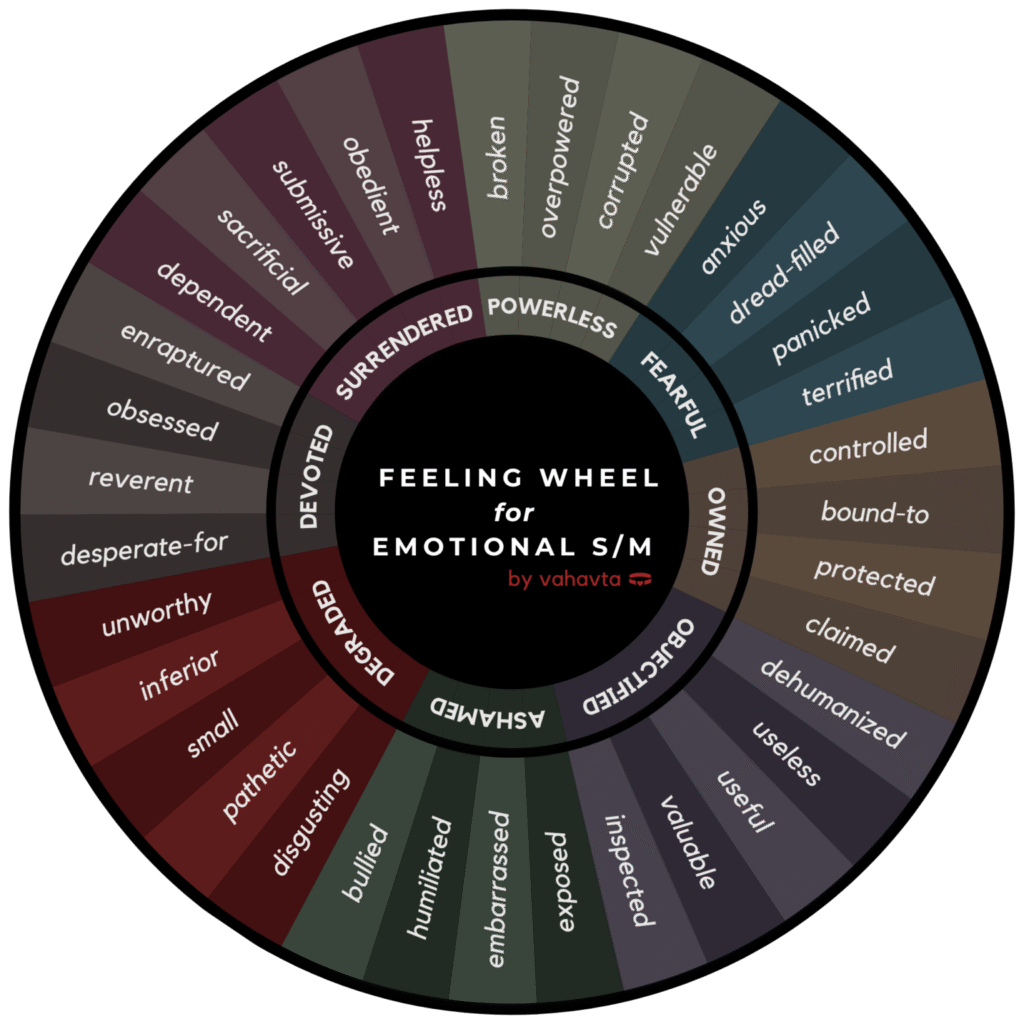
So to do this, we start with the emotion, not the activity. What do you want to feel during or because of this scene? If you need inspiration, you might use the ESM-adapted emotion wheel I made (or write out your own), or even use a thesaurus… an ESM negotiator’s best friend, IMO!

Emotion wheel for emotional S/M negotiation and degradation play - showing relationships between feelings like shame, disgust, fear, and humiliation
Use this tool to target the exact flavor of degradation, humiliation, or other emotions you’re looking to add to your BDSM play!
Want your very own sticker of this wheel? You can get one on Etsy here.

What’s important is you get specific: not just “degraded” or “humiliated,” but flavors like dehumanized, exposed, made disgusting.

Maybe you know this answer innately. If not, you might ask yourself questions like…

  • If I could only keep one word from the emotion wheel, which is it and why?
  • When I’ve fantasized about emotional play, which feelings am I chasing?
  • Are there feelings that I’ve experienced accidentally in play which I want to recreate intentionally?
  • Are there feelings that seem hot in fantasy but I suspect would be devastating in reality?
  • If I imagine the perfect scene for what I want right now, what emotion am I left with at the peak moment, and what emotion am I left with after it’s over?
  • Is what I want to be seen as [word], or being made [word]?
  • Are there adjacent feelings on the wheel that I’m not interested in, even though they’re close? (This helps identify boundaries within a category!)

STEP 2: Mine Your History for What’s Created This Before

Helping someone else create this emotion in you means giving them some kind of framework of how. Sometimes, we can mine this from past memories, with or without them being ones we’d call play.

I recommend looking in the following places:

Kink experiences: Scenes that worked, dynamics that hit right, porn/erotica that made you go “oh, yeah, that

Vanilla experiences: Moments of genuine shame, fear, exposure, worthlessness, etc. (yes, even the painful ones, to the extent that is safe for you — you’re looking for data, not trying to relive these memories (unless you *are* trying to, of course))

Fantasies: Even ones you’d never actually do, as they often reveal what your psyche is actually responding to

To get to these, you might ask yourself:

  • In a kink scene or dynamic moment where I felt something close to this target emotion, what specifically was happening? Who was there? What did they say or do?
  • In a vanilla experience where I felt this way (even if you I didn’t want to at the time), what were the conditions then?
  • Is there a specific memory I keep returning to—even if it wasn’t kink—that has the emotional flavor I’m chasing?
  • Which story/porn/fanfic beat made my chest pull tight in the right way, and what was the narrative meaning of the emotion (punishment, use, entertainment, devotion)?
  • When have people tried to create this feeling in me and missed? What was different about those times?
  • If I could direct a film scene of this happening to someone, what would I include? What would be essential vs. optional?
  • Have I ever felt [target emotion] and found it erotic vs. felt it and found it devastating? What was different between those times?

And don’t censor yourself here, seriously. Something might have worked in your head that you’d never actually do, and that’s totally fine. The point is to notice patterns.

Which then brings me to…

STEP 3: Pattern Recognition and/or Choosing New Context on Purpose

From your notes, look for repeat details. These might be sensory (e.g., public vs. private; verbal vs. physical; eye contact vs. averted; posture/position), relational (e.g., who can say/do this? Someone whose respect you’ve earned? Someone who holds power over you? Anyone? Does it require them to really believe or clearly not believe something?), narrative (e.g., the meaning/why it’s happening, like for someone’s amusement, a sadist’s pleasure, “because you deserve this”), or contextual (e.g., timing, setting, what comes before/after). Ask yourself questions like:

  • What sensory elements appear most often? (Words in a particular tone? Being positioned a certain way? Being watched? Physical touch or lack of it?)
  • Who delivers the experiences that work? What’s true about those people/relationships that isn’t true of the times it didn’t work?
  • What meaning does the degradation/humiliation/fear/whatever carry in the moments that land right? What is whatever is happening meant to signify about me?
  • Do I need buildup or does it work better when it’s sudden?
  • Does this need to be “deserved” somehow or does it work better when it’s arbitrary?
  • Do words or actions get me here quicker?

Quick aside: Meaning matters most.

If you could only answer one of these, make it meaning. Meaning is what can get fuzziest in between these emotions, which means it’s actually the most important part. Different “meanings” in ESM might be things like…

  • “You are less than others.”
  • “You failed/disappointed.”
  • “You are only useful for X.”
  • “You are disgusting/shameful.”
  • “You are beneath notice.”
  • “You deserve this treatment.”
  • “You exist for my entertainment”

…but this is a very non-exhaustive list!

And also, meanings interact with relationships. Some may feel safer for you inside steady devoted commitment (“only useful for X” can feel like worshipful utility) but dangerous inside more brittle attachments, or some other contingency. It’s okay to say this outright in your negotiation.

Step 4: Communicate it!

Now you put your shiny new well-articulated desires into practice! This could be in any number of ways, but here’s a framework if it’s helpful:

“To make me feel [specific emotion], I need [sensory/relational/narrative context]. What tends to work is [primary patterns you discovered], especially when [meaning/undertone].”

For example, I might say…

To make me feel humiliated, I need to be turned into someone who isn’t the way I’d want You to see me, and I need to be laughed at for it. What tends to work is something being done to me physically or being commanded to take actions I find embarrassing, followed by laughter and verbal degradation — especially when it’s delivered like You find my shame entertaining and like this is the most use I could possibly have. For this to feel erotic instead of erosive, I need it to not impact Your usual level of physical affection toward me, even if it’s framed as happening for a reason which is different than usual.”

(And heyyyy, if you need a reason to practice getting your final statement here out in the open… feel free to link this writing to your person along with some kind of “thought I’d try this just for funsies, here’s what I came up with”! Jus’ saying, happy to be your bold ESM moves excuse 👀)

What if the scene still doesn’t feel quite right?

Sometimes, everyone will do everything “right” and it still won’t hit the way you thought it would. The “close but not quite” problem is actually incredibly valuable here, though. It helps you to determine the boundaries around making your desires come true more precisely. “Oh, I thought I wanted to feel worthless, but what I actually needed was to feel worthless in this specific way, and when they made me feel worthless in that other way, it just felt bad.”

You might ask yourself questions like:

  • Which dial was off (e.g., meaning, intensity, context)? Which ones weren’t?
  • If we keep these actions or words but flip tone, does it become right?
  • Was the meaning right, but the tone off?
  • Did something about the relationship context shift recently? (Trust level, recent conflict, life stress)
  • Did I need something different before or after?
  • What would have shifted it from “close” to “yes, that”?
  • Do I need to add this to my explicit boundaries, or was it just about calibration?

And then you know. And then you can communicate it before next time.

For those who desire it, emotional S/m can be some of the most intense, intimate, potentially even transformative play there is. It’s also some of the riskiest, precisely because we’re working with elements that can’t be cleanly removed once introduced. There are plenty of important considerations as far as whether its risks are ones you’re willing to take.

But that doesn’t mean we shouldn’t do it. It just means we owe it to ourselves and our partners to discuss it as skillfully and as well-informed as possible.

Learning to reverse-engineer desires is one of the most important skills I’ve developed as a bottom. It won’t eliminate all risk. Nothing can. But it will dramatically reduce the chances of these desires being knowable — to yourself, and to your partners. Your desires are valid. And the more you can turn “I want to feel […]” into something specific—the more you can translate vague wants into concrete, context-driven asks—the closer you get to bringing them to life.


Want to join in on the conversation? You can find the original Fetlife version of this writing—and the comment section—by clicking here.
Posted by vahavta

The Shame Game: A Primer to Playing with Shame in BDSM

Of everything that comes up in that intersection between psychology and kink that I’m so fond of, shame play might be one of the most powerful. Maybe that’s because it is so flexible and so related to so many kinds of Emotional S/m (ESM), binding to other parts of play and wrapping around them in unique ways that make them into something more. That power itself is what draws many of us to it: the cathartic release, the reclamation of emotions we previously tried to avoid, the liberation from our social conditioning around desires and acceptability, the extraordinary connection that can come from exploring it with someone you trust. It’s also this power that makes it dangerous.

The way that shame can cause or result from nearly any emotion you can think of is what makes many researchers and educators (including but not limited to Brene Brown) refer to it as the “master emotion.” And most certainly, with all the subcategories we think about when we think about ESM—objectification, degradation, fear, others—the psychological mechanics of shame can enter in.

I’ve been thinking and learning about shame for a bit now in a few different realms of life (and have even been considering a 102 level for my ESM class that really focuses there) because that power is just so great, and to me, that makes it really cool. So this is a little bit of a primer on the matter, for those who may not have thought about the workings of shame in-depth… Or maybe for exactly the people that have.

As with anything I write about ESM, I may use examples that could be triggering for some, so please do care for yourself and step away from the writing whenever needed.

What We Talk About When We Talk About Shame in BDSM

Shame operates differently in our brains than other emotions we might consider when it comes to play, or even when it doesn’t. While emotions like fear and anger stem more from our basic survival cues (and certainly there’s a lot of overlap that can happen here), what we think of as “shame” links more directly to our social-emotional circuitry—that is, the parts that evolved to help us better navigate complex social communities. That’s part of why shame is often very culture-specific, from the norms that cause it to how one is expected to respond (both to their own and to others).

During a scene, basic emotions that get brought up (fear, anxiety, arousal) may activate your social circuitry, adding shame which can persist past when those basic emotions subside. This makes a lot of shame play really memorable and makes it build up over time to different effects, but it’s also what makes it tricky: social emotions don’t simply disappear when the present situation ends, unlike with something like fear where the adrenaline rush subsides once the threat is removed.

Shame can also develop “meta-shame,” where we are ashamed of feeling ashamed. And in that, it can become integrated into our identity, our sense of self, in ways we might not intend. When we experience meta-shame, this creates patterns of avoidance that operate subconsciously and prevent addressing the original issue, affecting you and your experience in and out of scenes without you necessarily even realizing it is there. Meta-shame magnifies the perceived gap between the “ideal self” and the “actual self” in our heads and the greater this gap, the more intense the shame experience. Which can be used for a lot of fun in kink contexts, when done carefully! But it can also lead to situations where no amount of endurance, submission, or service ever feels like “enough” to close that gap, and this can have wide-reachinf effects that we just don’t want.

This is why emotional S/m that plays with shame is always edge play that requires a ton of consideration. It it risky even for those who communicate well 99.99999% of the time — it can compromise communication in a number of ways, and there’s no safeword that can stop this process once it begins because it happens in the psyche, not at the hands of the top. So before even consider playing with shame, we should do whatever we can to really get our communication and negotiation skills up to speed. But with everyone informed of the extra risks and and consenting, it sure as fuck can be a very good time.

Different Types of Shame

Shame manifests in various forms depending on our history and psychological makeup, and we start to form these on the identity level at different developmental stages (which I’m not going to get to into in this writing). Understanding these possibilities can be something we can use to negotiate shame play and ESM beyond broad level categories, honing in more on what we do and don’t want to approach at that point in time — and I say that because this definitely can and even should vary based on what point in time we are playing, who we are playing with, and individual preferences.

To name just a few:

Judgment shame creates feelings of being fundamentally “bad” or “wrong” for desires or actions that contradict. It often gets talked about in combination with taboo play, if we are talking about societal norms, but might take other forms (like going against internal ideals or value systems) as well.

Control shame connects to one’s ability to competently express and enforce one’s personal agency, and can come into play either as “taming”/overriding of rebellion against authority or shame being attached to the complete surrender of autonomy some of us go for in our relationships.

Perfectionism and autonomy shame, which may or may not be closely related to the above, plays with the idea of the bottom being able to succeed at certain actions or respond in certain ways, whether or not those actions are even possible. Messing with this can lead to hopelessness and confidence loss when meta-shame and identity integration kicks in. On the other hand, it can be really, really liberating in some cases and lead to an increased sense of external or self-acceptance.

Social status shame centers on feeling inferior to others. This can be about embarrassment, power, “measuring up,” or something else — power exchange in the D/s sense may be an element but does not have to be. It also can be particularly risky for those who are prone to fawning or to excessive people-pleasing outside scenes, especially when linked with play that goes near those boundaries, because one might stop feeling that speaking up is even something they deserve to do.

Unworthiness shame centers on the core belief that one is inherently flawed, unlovable, or bad as a person, or that an action or behavior could make them so. That inherent vs. action element is important, because there’s a big difference for many between playful degradation (“you’re such a dirty slut”) and identity-level condemnations like “nobody could ever want to someone like you around long-term.”

…and there’s more of these where that came from, and just what kinds of shame someone experiences (and how) are going to shift with different individuals and their dynamics. So observation and awareness, both of the self and of others, is really the key to drawing lines between them and deciding which you want to touch, and which you’re leaving the hell alone.

Kink Risk Profile Considerations for Shame Play

There are a few specific risks I think are especially important to consider in shame play, among others. These include that identity integration risk I’ve mentioned, but also risks of emotional binding (how shame might permanently bind to other emotions like arousal or affection, or even identities or activities (including sex or play as a whole)) and relationship “contamination” (where the shame between two people spills over into their interactions outside of play, whether that’s a romantic, friendly, sexual, or simply community-level relationship). This is where shame can start to really spill into other contexts of life, with sexual shame in one relationship impacting someone’s other sexual relationships (present or future), impacting job performance, or creating long-term issues in a whole variety of other ways.

For each element of shame play you introduce, consider which of these risks might be activated, how to mitigate them with the specific people you play with, and how to evaluate if other elements of life have been affected. Mitigation may look like creating clear “containers” for shame play (e.g., particular locations, explicit beginnings and endings, specific language that only exists within the play context), incorporating identity-affirming elements or pieces which connect those playing to the core of their relationship to each other, or scheduled check-ins with one’s support network as part of ongoing aftercare. For emotion binding risks, mitigation might include things like ensuring experiences of pleasure, arousal, affection, or whatever else might be combined also occur without shame elements—both in that particular scene and in scenes that are not meant to focus on shame at all—or doing the same with particular roles or kinds of play that you want to ensure don’t codify as “a thing that inherently causes feelings of shame.”

This is also where developing emotional resilience practices becomes super important for bottoms engaging in shame play, some of which I talked about in part of this AMA answer on Fetlife. This also might include working to recognize your own shame triggers and response patterns, practicing grounding techniques, and developing a clear sense of who you are and what you love and value in yourself so that you can more clearly draw internal boundaries between play experiences + what an external party might say or cause and your more persistent self-concept. Mindfulness of meta-shame—noticing when you begin feeling ashamed of your shame responses themselves, and especially when you may be hiding them—might also be a warning that play may be crossing into potential harm.

Aftercare Considerations for Shame Play

I’ve written a bit about a framework I like for potentially-traumatic play but there are some intentional integration techniques that might be especially useful with shame play.

One of these is to include, create opportunities for, or emphasize acts of witnessing, which I know may seem a bit backwards when we think about shame’s social origins… But that’s exactly why it matters. Shame is about what we perceive as a social inadequacy, but that shame can be counteracted by those perceptions being proven wrong. Shame thrives in secrecy, but that means it dissolves when brought into the light. (There’s a reason that effective addiction recovery support models usually include sharing stories with others who share the same experiences.) The witnessing that occurs during the scene itself can begin this process, as a top acknowledges and accepts the vulnerable expressions of shame that emerge there, and can continue in processing the scene together and/or underscoring the ways that the scene felt intimate, like an act of service, or otherwise positive to the top. Beyond the scene, sharing the experience with trusted others—with appropriate consent, of course—provides opportunities for renarrativization, allowing the experience to be processed not just as a source of shame but as a moment in time. Writing and sharing the story of the scene with (one’s own or the extended) kink community can help to avoid or counteract the meta-shame and decrease the long-term risk.

Self-integration is the other big consideration here. Taking time for solitude (which I wanna note is distinctly different from isolation) allows for honest reflection and processing that isn’t always possible when still in with others. This might mean identifying specific shame thought patterns (e.g., “I should be better,” “I’m not good enough,” “no one would want me if they knew”), but that isn’t a skill that necessarily comes naturally to most of us, and a therapist or even just a CBT workbook of some kind may help if you’re not used to catching these sorts of things. Structured reflection or journaling on things like specific triggers, reaction patterns, contained versus lingering elements, etc. also help prevent shame from remaining an Amorphous Cloud of Bad to transform it into more specific, manageable elements that we feel capable of addressing and moving past.

In all cases, you mitigate the most risk when aftercare is not an afterthought. Consider and negotiate aftercare needs with the same care and specificity you bring to scene negotiation itself, recognizing that shame’s particular risks often require aftercare that addresses both immediate emotional states and the longer-term impact of this play.


Shame play exists in paradox, like other forms of ESM (or I might even argue with BDSM at all): we consensually engage with some of the most destructive and challenging human emotions for purposes of pleasure, catharsis, and connection. Trying to fully resolve this paradox is a losing battle, with ESM, and may just lead to losing sight of the risks until they reach a critical mass and explode (something else that I hope to write about and share experiences with at some point in the future). So the mark of someone who is mindfully engaged with shame play isn’t based on who can create or endure the most intense reactions, but who can hold the paradox consciously and with grace—being in experiences that are genuine and powerful in the moment while maintaining the psychological grounding necessary for integration afterward, reaching for support wherever it is needed.

Playing with shame in kink isn’t unlike learning skills for any kind of edge play. It begins with respect for its power and the ethical considerations it demands, it develops through careful preparation, and practice, and it continues and evolves with awareness and reflection. If I’ve learned anything these past few years, it’s that I don’t know how much here I don’t know, that the ways this pops up in ugly ways can be unexpected and brutal, even for someone that might be called “experienced” here.

But what I want to leave you with is that this idea of “shame thrives in secret but dissolves in the light” is one that also can explain what makes it feel so profound, for those of us who love it. In those darker, duller spaces of our psyches where life has taught us to feel shame and hide some part of ourselves, consciously-engaged shame play within the context of connection says “this part of you is valid and it gets to be seen without that compromising anything else about who and where you are.” Not just from one person to another, but to ourselves. This witnessing—this refusal to look away from the parts of ourselves we’ve been taught to hide—becomes a radical act of intimacy and ownership. And for lack of a better way to end this…

Well, hell. I just think that’s really fuckin’ pretty.


Join in on the comments of the Fetlife version of this post by clicking here!

Posted by vahavta

Fear Responses: Risks, mitigation, and/or use in escalation

Fear play is one of those topics I’m lucky enough to get to approach on multiple levels. There’s what I have learned and experienced as a bottom to some pretty intense stuff here, but there are two other layers for me, too: one where I’ve coached horror writers and written horror myself, giving me a different lens on the storycrafting of it all and how fear can be created in the mind of another, and one where I’m a creator of remote immersive horror experiences and where with basically two exceptions, every person on my “I talk to them nearly daily” list of friends is either a creator of or actor in an extreme haunt or immersive terror experience, or they’re someone who attends every one of those they can possibly get a ticket to.

Though the people in this latter category are, importantly, not engaging in kink, there’s still lots to learn from what they’re doing: in creating a for-profit immersive terror experience, they have legalities and publicity to contend with that kinksters don’t always have to approach, which means that they often put much more into the training of the actors, the considerations of safety and ethics, and the care that goes into the creation of the experiences.

On all levels, I’ve seen the incredible power of consensual fear experiences to push comfort zones in exciting ways, explore intimate depths of our psyches, and create profound connections between people… and I’ve also witnessed how easily things can go awry when fear is misunderstood or mishandled.

Fear is powerful, and delicious, and hard. And I love it. But something that has come up again and again and again when I discuss and teach about these things ~~(like I’m doing this weekend)~~ is the way that different fear responses might change interactions, especially as pertains to risk, communication, and consent — and so that’s what I’ve created a little resource on below.

NOTE: That class has passed, but there may be another coming up! if I have a fear play class scheduled in the near future, I’ll mention it at the bottom of this writing ❤

Some fear responses are very physical in nature.

There are different types of fear, and some are more individual. (I’ll get to those in a second.) Others are engrained in most humans. It’s well-acknowledged in the extreme haunt sphere, for example, that water is often used to “break” participants and that drowning and waterboarding scenes are where many hit their limit – and though the risk on it should not be understated (in either case, really), many of us do “enjoy” drowning or waterboarding in kink. But I happen to think of it as a culmination of a scene, in my fantasies, and not an entire scene… once it begins, it ends up being “over” relatively quickly if not handled within a larger “narrative,” so-to-speak.

This is because survival-based panic is an instinct, one that can only be thought its way out of and “managed” for so long. Mindfulness techniques can help some, and there are things I can teach bottoms in this class about how to manage these reactions a bit better… but ultimately, our bodies are built to respond in such a way that keeps us alive. And so, when a core function like breathing is compromised, there’s often a very strong panic response.

On a physical level, this can be one of the most risky moments in a scene because bodies are likely to writhe, buck, and flail in efforts to get out of the moment. Tops who are playing with conscientious bottoms that are usually quite unlikely to behave or move in ways that put themselves in greater danger may suddenly need to take more physical precautions to avoid someone hitting their head on porcelain, for example.

But then there’s another kind of fear, and that’s what most people are asking about when they ask me about this question:

The psychological fear responses of fight, flight, freeze, or fawn

When we’re confronted with intense fear, our bodies and minds instinctively react in certain ways, and these are four that I see discussed semi-regularly. These are where things get really tricky, as each can display in ways that are highly individual and have their own effects on communication and consent. The below information is not meant to be all-inclusive or comprehensive – not on how it can be recognized, how to de-escalate, or even how to escalate! – and as in near every other realm I teach in, I’ll say that communicating for in-scene enjoyment and safety begins long before your scene and continues long after.

But vahavta, isn’t the solution to all of this “use a safeword”?

Well… not quite. I say that partially because I don’t (which doesn’t mean I don’t communicate!), and I know there are many who follow me or come to my classes who also don’t.

But even if you *do* use safwords, it’s important to realize that’s a tool, not a sure thing, and that fear responses inherently impede rational thoughts and actions. Add to that how emotional S/m play of any kind (including fear) can impede their use and it’s clear that while a safeword in your toolbox for the scene can HELP you stay aware of needs…it should never be the only thing you keep in mind, or you’re setting yourself up for trouble.

But! There are *some* broad-strokes guidelines I can give you for each response here, so that’s what I’m going to do.

Below, you’ll find a few different ways to recognize and respond to each of these categories.

Keep in mind that we rarely ever end up engaging in *only* one fear response all the time, and it’s a good idea to have a watchful eye on the way they might shift over the course of the scene. Even if you know what you or your bottom tends to default to, that doesn’t mean that another won’t pop up, so it behooves everyone to learn about each possible direction things might go.


The first two of these are what I’ll call “active” fear responses. These are ways we try to regain power in a situation where we feel threatened.

Fight

Recognizing: When someone goes into fight mode, they may become aggressive, confrontational, or physically resistant. They might lash out verbally, try to push the threat away, or even attempt to “take control” of the scene. Some, not all, will show signs first that are similar to an animal raising its hackles, with tensed shoulders and clenched fists. This also might look like “bratting.”

Heightened risks: Similar to the physical danger panic response, there is a greater amount of risk to play when someone is physically fighting back because there is less control the top can have over the situation. From a consent perspective, a fight response can make communication harder whether it’s a physical or an emotional fight, as the bottom may be so caught up in their own emotional state of fight that rational thought is impaired and the defense becomes more important to them than simply articulating needs and/or boundaries.

Response to the response:

Tops, you have a few options when you identify a fight response.

If you want to escalate the fear, you can meet their aggression with your own, pushing back against their attempts to gain control (maybe physically; maybe via verbal taunts or something else). This can create an intense power struggle that heightens the adrenaline and the sense of danger.

If you simply want to mitigate risk as far as what comes with this, this might be time to add (or increase) restraints, particularly if you are planning to use anything that requires precision as to location on the body (like blades, for example!) You can also refuse to continue a scene without the bottom giving you some kind of check-in that requires they actually take a breath and respond verbally and with thought, perhaps with some kind of count-down or limit, which can add its own fun fearplay pressure while still serving to allow them to opt-in to continuing (“if you don’t tell me you’re good to continue before I count from 10 to 1, we don’t go forward”).

And if you want to de-escalate without ending the scene, remove any aggression coming from your end. Speak in a calm, soothing voice, and back off from anything combative. This might be a time to leave the bottom to think for a bit and play into one of the TYPES of fear we’ll also discuss Sunday, dread. (Of course, if there’s any kind of restraint, you’ll want a way to also keep monitoring what’s happening with the bottom and remain within earshot either way.) You could also empower them to see the scene as a challenge and redirect the fight impulse away from you and toward their own willpower – “You’re so aggressive, surely you must be strong enough to keep going” – but this should be done with caution, as it can shift some into a fawn response and get messy as far as consent.

Flight

Recognizing: We often think of flight mode as simply “escape,” but that’s not always physical, nor does it always actually result in an escape *attempt.* Someone in flight mode may start towards an exit or back away from the danger, but they also might have eyes darting around looking for exits (whether they’re conscious of that or not!), become restless or agitated, or start to dissociate from their surroundings – this last one, particularly, will happen with psychological fear and this gets tricky as it is not *exactly* the same as a freeze response but can look that way. This response, however it presents, is rooted in an effort to get away from the perceived danger and find safety.

Heightened risks: A flight response can *also* increase physical risk, depending how they attempt to “escape,” and can make it harder for a participant to communicate their needs (sensing a pattern?). They may be so focused on escaping that they don’t take the time to check in with themselves or express their boundaries. While this is a very different kind of risk, someone in flight mode may also end a scene out of panic in a way that they will regret later (and this is why I don’t personally play with safewords!)

Response to the response:

If you want to use a flight response to escalate the fear, you can play into their desire to escape. Block their exits, corner them, or create a sense of being trapped. This can heighten their panic and make the experience feel more intense. Maybe you add restraints, if they aren’t already there… or, if you are confident you can express greater strength and control a situation, you might even challenge them to go ahead and *try* to move while holding them in place.

To mitigate risk, figure out what is making them feel a need to escape and respond accordingly: remove restraints, take a physical step backwards so they feel less cornered, or even move to a larger room. Maybe you can open a door. Maybe this is taking a metaphorical step backward, if the scene is more emotional. Make continuing the scene require an active opt-in of following you somewhere or making a choice (discussed more in the Freeze section). If they’re escaping via disassociating, demand eye contact or ask open-ended questions that require thought to answer.

To de-escalate, both remove anything that makes them feel restrained or cornered and provide reassurance that they can stop any time they want (assuming that’s how you play) and that any sense of being “trapped” is only within the confines of the theme. Remind them that when the scene is over, it’ll be over: this *will* end. Breathe calmly and encourage them to follow your breathing to reduce panic. Set up situations that require them to *approach* (both physically and emotionally) to continue. If they’re disassociating, a gentle hand on the back or the knee can be grounding for some, but can make this worse for others – so discuss first, if possible.


The second two responses here are the more “passive” ones, and these come when someone no longer believes that a threat is escapable. In fact, switching from active to passive fear response may be a way to monitor the pacing of how fear is escalating for a bottom — they’re signs of acceptance, in a way!

Freeze

Recognizing: When a participant freezes, they may become silent, unresponsive, or appear to “check out” of the experience. They might stop engaging with the scene entirely, become passive, or seem emotionally distant. They may become very still, end up with a blank face void of emotion, or fail to respond to stimuli. Though the lines can blur, the difference between dissociation here vs. in the flight response is that this isn’t really dissociating; it’s freezing without responding in a way that seeks to camoflauge (which sometimes also looks like not reacting), but often still involves fully experiencing the moment under that facade – for some, not all.

Heightened risks: From a consent perspective, a freeze response can be particularly challenging because a bottom may go nonverbal. A freeze response is one that literally exists for prey to try and *not* be perceived by a predator, so the cues a bottom gives may decrease here and they’re unlikely to be able to communicate needs at all. Tops need to be very attentive to their nonverbal cues and err on the side of caution, and bottoms who do freeze and know they freeze should do themselves a favor by paying close attention to what happens in their head in those moments, communicating to your top before the scene what your freeze response means and what, historically, has snapped you out of it.

Response to the response:

If you want to use a freeze response to escalate the fear, you can capitalize on the sense of helplessness. Take control of the bottom’s body, move them around like a doll, or put them in positions that make them feel vulnerable. This can create a sense of powerlessness that heightens the fear. To this end, much in the “flight” section for this applies.

To mitigate risk without stopping the scene, this might be a good moment to give them some sense of autonomy via choices that they have to respond to, even if both choices are “bad” as in predicament play. I’d suggest requiring a verbal response along with whatever physically is required from a choice that is given, myself, with the same approach that I recommended above: not making a choice is the same as opting out and the scene ends. You might also ask yes/no questions until you can get them to a place where they’re able to articulate needs and boundaries more clearly.

To de-escalate, slow down the pace of the scene to give opportunities to process, removing the tension of time pressure and reminding them you’ll wait for them to respond – “When you’re ready, let me know how you’re feeling.” You might remind them they’re in control and can choose to end the scene at any time, if that’s a choice given. In general, freeze responses seem common when there’s a stimulus overload, so slowing down the onslaught of events in the scene or reducing stimuli (like bright lights or music) can help de-escalate this one, too.

Fawn

Recognizing and heightened risks: Fawn response is a coping mechanism that aims to decrease a perceived threat by doing what it wants, more or less. In short, it’s when someone in danger becomes particularly submissive. It’s the answer to when people ask the (incredibly naïve) question of “but if you were being abused/raped, why did you say yes and keep going along with it?” and that’s what makes it one of the most difficult parts of fearplay: the things that characterize it are inherently also heightened risks. In fawn mode, someone may become overly compliant, agreeing to things they normally wouldn’t, or trying to appease the threat to avoid further fear and danger. They may be more concerned with pleasing the top than advocating for their own needs or boundaries.

Response to the response:

If you want to use a fawn response to escalate fear, you can take advantage of the bottom’s compliance. Push them, make increasingly extreme demands, and/or put them in situations that feel degrading or humiliating then deepen that by pointing out what they’re saying yes (or not saying no) to. (This is my favorite time for that, probably. Not when it’s happening, though! Brought to you by the number of times I had to repeat “because I’m fucked up” just the other day, until it sounded matter-of-fact enough and no longer like a question or attempt to appease. And make eye contact the whole time. Yeesh.)

Mitigating risk: Tend toward open-ended questions here, “How do you feel about…?” as opposed to the yes/no, red/green, rate from 1-10 types. You can also give them a piece of paper (or keyboard) to write their answer down, which sometimes subverts the “just say yes!!” signals for long enough to get an actual answer. And though I’d normally put something like this in the de-escalating bit, this is a time to remind them that there is no punishment for ending a scene or for speaking up about not wanting to do something. Fawning happens because we see a decreased threat if we please the other party, and so reminding them that going along with things *isn’t* actually necessary to end the threat can help with some of the inherent problems that arise. You might also offer autonomy, like I mentioned with the Freeze response.

De-escalating: Remind them how much you are enjoying what you are doing already and how much you enjoy playing with them in general, making it clear that they have already pleased you and don’t HAVE to keep saying yes in order to have done so. You might want to even let them know they please you when they are clear about their boundaries and say no, that this is a way of helping you make it a good experience. You could also switch to an activity that you know they actually enjoy and feel somewhat less fearful of, de-escalating the actual fear response before you ask those open-ended questions again in an effort to encourage honesty over appeasement. When you do check in again, be sure to do so in a non-threatening way to the extent that you can.

However, I want to underline once more how important it is to be very mindful of the power dynamics at play here. A bottom in fawn mode may not feel able to say no, even if you’re pushing them beyond their limits and even if they are usually a fantastic communicator. It’s not a character flaw; it’s just how this works. They may go along with things that they’re not truly comfortable with out of a desire to please you or avoid punishment.

And so it’s extra, extra important with fear play scenes to debrief several times after play so that you can continue getting and sharing information that arises with more distance from the scene, as both parties are able to reflect without the heightened arousal that comes from the charged environment.


Conclusions

Navigating fear responses isn’t a 101-level task, and it’s not one that I (or anyone) can cover comprehensively — not in a writing, nor in a 2-hour class. So please, use this as a start to your toolbox… but then let the real learning start. This is a skill that requires empathy, attunement, and a willingness to adapt, as well as a great deal of self-awareness (both emotionally and as to where you are in space) – and that entire sentence was directed to both bottoms and tops.

At the same time, fear responses can be a really powerful way to make these scenes and experiences even more intense and transformative. And so for all these reasons and more, learning as much as you can about these fear responses will make scenes both safer and more enjoyable for everyone. Like with any other skill, you’ll do best with patience, practice, ongoing education, and an approach of mutual respect and curiosity.


Housekeeping

Update, April 2026: If this framework resonates, I go deeper into all of it in Playing with Fear: Empowered Navigation of Thrills and Risks, which I’ll be teaching virtually with Praxium on Tuesday, April 14 ❤️ We cover fear response types, how to read them in real time, designing scenes that land, and what to do when things go sideways. If that’s of interest, be sure to save your seat and receive your Zoom link by getting your ticket here.

Want to join in on the conversation in the comments? Find the Fetlife version of this post by clicking here.

Posted by vahavta

When it comes to emotional S&M, safewords don’t really work.


I don’t believe there’s any kind of emotional s&m that isn’t edge-play — because I don’t believe there’s such a thing as emotional s&m for which you can depend on a safeword.

I’ll be clearer, as some of you know how I play: I don’t mean “safeword” when I say “safeword.” I mean “no way that a bottom communicates they want everything to stop can be relied on to work.” I mean “this applies even for those of us who don’t use safewords;” I mean “there is no communication that is adequate;” I mean “this is a thing to be considered before you even start.” Because when we talk about communicating stops to play, we talk about removing what is causing harm. And the second play happens in the head and involves fucking with one’s sense of self, or values, or security, we are no longer talking about what can be so simply stopped.

Say that you need to get out of rope immediately, and the rope can be cut.
Say that you need to get the forty needles out of you, and sure—it can’t be done in an instant, but the process can begin.
Say that you need to stop being degraded or humiliated, and the scene itself, the words being spoken, the whatever is happening can immediately come to an end.

But can the play?

Well, maybe. If you’re especially good at compartmentalizing or if play has only touched on the imaginary and everyone is aware of that, if it’s only been roleplay the whole time and nobody has any doubts to this. But for those of us who play dark enough to touch upon the real, emotional play is planting a seed and burying it deep. And suddenly, it’s there, germinating.

Stop escalating, sure. That you can do. But what happens at the important work presentation next week that requires your confidence? What happens if there’s a rift soon after with your play partner? Will things stay compartmentalized then, or will you wonder if maybe what was said was really true? Will it affect your behavior? How you eat? How you speak? How you move through the world?

When play happens mostly in a bottom’s head, are they able to safeword out of their own ruminations?

All this doesn’t even address that speaking up about when a scene needs to change or end is difficult for many bottoms under the most un-emotional circumstances, making some feel like they’ll be less worthy, less valuable, no matter how entirely not-the-case this is. If a bottom is being degraded effectively and is believing, at least in that moment, that they are dumb, worthless, annoying, any of the above… it may very well make them less likely to speak up the larger that the problem becomes.

So what’s the solution?

In many ways, this is all individual… like anything else.

But start with making sure everyone knows all this. Let there be no doubt as to the possible risks. Discuss and consider. A lot. Lab out just how certain words feel to the bottom. Share videos and stories and ask what the other party thinks of them. Talk about curiosities and concerns. Ask a lot of questions.

What I can tell you is that for me, hard limits I once had around this kind of play have turned into the most rewarding kind of fucked-upedness that I crave more than anything else.

But when they were still limits for me, they needed to be. Because there’s no tool quite as powerful as the imagination. And once that’s started, you can’t just put it back in the box.

Which I suppose, for many of us, is the reason we do it at all.

Posted by vahavta

Questions and Considerations for Bottoming to Degradation Play

Over time, emotional play has become one of my core kinks. Very few of our scenes don’t have at least some element of degradation, and casual degradation and humiliation is a part of my day-to-day life. It certainly has caused its issues at times, but I wouldn’t want to remove it from our dynamic for the world. It makes me feel Loved. Most of my erotica involves it. *All* of my fantasies do. Often times, I can’t get off without it. Suffice to say, I think about this sort of thing a lot.

I recently read someone’s guide to emotional sadism. In the comment section, many bottoms expressed regret over emotional S&M gone wrong in the past, whether because their partners did not engage in it from a healthy place, boundaries weren’t clearly considered or communicated, or other reasons. My aim here is to create a resource for bottoms to help them think through potential pitfalls before they encounter them.

This is a non-comprehensive list of possible questions you might ask yourself or discuss with your partner when considering delving into emotional play. Sometimes I’ve added examples or other commentary, but it’s mostly just the questions. It’s by no means exhaustive. It also is not at *all* meant to qualify if you personally should or shouldn’t engage in this sort of play—if your answer to a question is something negative, that doesn’t mean “don’t do it”; it means follow the question up with “and am I okay with that?”


  • What feeling do I wish to come out of this with?
    options might include: shame, loneliness, fear, worthlessness, failure, abandonment, guilt
  • Do I want this to be role-play (my partner says things we both definitively know to be untrue) or do I want this to touch on real insecurities and beliefs?
  • What categories of degradation are too far, desired, or won’t have an effect?
    options might include: attractiveness (physical? personality? smell?), intelligence, worth as a partner, worth in general, capability (of being a good submissive, at your job, to achieve your dreams, etc), aspects of identity (race, religion, sexuality, gender), promiscuity, sexual ability/worth, core values
  • Am I okay with real-life events being mentioned?
  • If we are role-playing but my partner says something I believe is true about myself, will I be able to trust that they *don’t* think that? If no, will that undermine my concept of true and false for things they say in the future?
  • Have there been any recent hurdles with this partner that might affect my ability to see something as play?
  • If I am feeling ashamed, unimportant, or otherwise lesser in the scene or dynamic, will that affect my ability to communicate if I need things to stop?
  • Are there reactions that should signal a stop or pause to my partner beyond explicit communication
    examples: shutting down, crying, inability to make eye contact, heavy breathing
  • In some physical scenes, a safeword stops the thing causing the pain. When emotions are involved, the escalation can stop but the pain might not (ever). If I have the ability to stop this in our scene/dynamic, am I able to do that *before* it gets to a point I won’t be able to handle?
  • How long do I want to sit with the bad feeling(s)? Do I want it made better after (being “built back up”)?
  • If I need my top to make me feel better after, do I want them to negate what they said/did in scene and tell me it was all a lie, or build me up about other things?
    (Personally, if my Owner were to say He didn’t believe the things He told me, I’d start thinking that He didn’t really enjoy degrading me and that would make me feel worse. YMMV.)
  • What else do I need after? Are there behaviors of mine that might need to be monitored (eating properly, fulfilling goals, communicating, etc) based on what we do? For how long? Will this partner be in my life for that long? Are there other people that can look after these things if they aren’t?
  • If this scene involves certain activities, props, or locations, they may trigger these feelings in the future. Am I okay with that?
  • If I do this in public or write about this and people think/know my top really thinks these things about me, will the way they perceive us be bothersome to either of us?
  • Is my top prepared to handle the emotional labor that may come with my feeling they think x about me? Will they feel guilty if I become afraid of them or their presence makes me feel negatively? Are they aware of that possibility? Will they be patient if it is hard to overcome, or even if it doesn’t ever go away?
  • Are other relationships prepared to handle the emotional labor that may come with my believing x about myself? If I need extra reassurance or am suddenly insecure in our relationship, will that make them feel negatively about themselves?
  • Do I have events in the near future that will be affected by my confidence in myself changing? (important presentations, job interviews, performances, first dates)
  • Am I comfortable being vulnerable in front of my partner? Will I be after this happens? Do I have a support system I can speak to honestly about this experience without fear of judgment?
  • How might this affect any emotional issues I already deal with?
  • If this partnership dissolves in the future, will this experience make that harder to handle?
  • If I begin associating affection or sex with these negative feelings, how will that affect my perception of reality, and how will that affect how I evaluate this and other relationships down the line?
  • What traits, connections, perceptions ground me to the reality of whatever this relationship is? How will I be reminded/remind myself of them if/when I need to?

Obviously, everyone experiences things differently. Though I hope it goes without saying, emotional S&M can be very hard on a person and on a relationship, whatever that relationship is, and should be carefully thought through—but with the right partner, I think it’s one of the most incredible, intimate, and even empowering experiences to be had. These questions are meant as thought/conversation-starters, not a comprehensive checklist.

Come over to the comments section of this writing on Fetlife to tell us what you’d add!

Posted by vahavta